Transcript
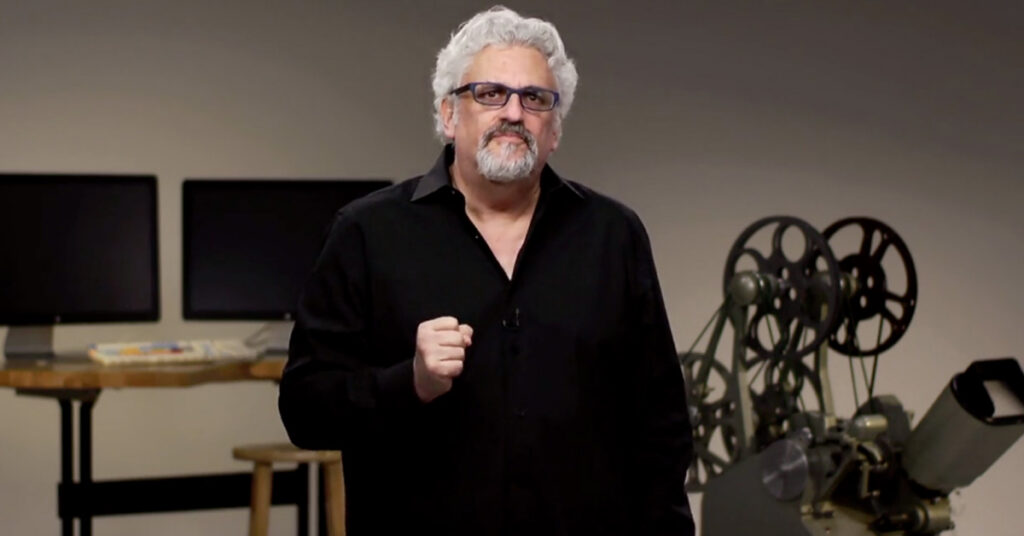
Zack Arnold: I have Mr. Jesse Averna on the other end of my Zoom call. I am so super excited to have you here for people that may or may not know I’ve been trying to get you on my podcast before. I had a podcast every six months, it’s on my to do list. Let’s reach out to Jesse and see if he’s available to do a podcast. And there’s, there’s always at least four or five different reasons that we’re not able to make it work. We have finally been able to make it work. So, Jesse, it is a pleasure to finally have you here.
Jesse Averna: Thanks, man, happy to be here.
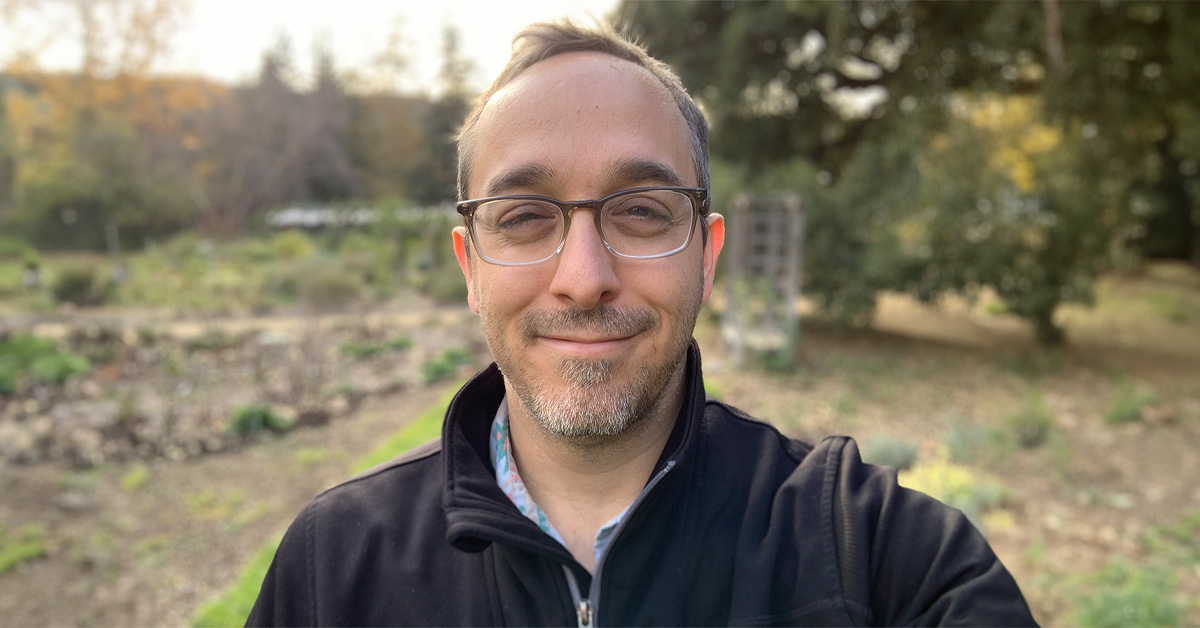
Zack Arnold: So you, sir, you are a member of the American cinema editors. You are a five time Emmy award winning editor. You’ve done features, you’ve done live action, you’ve done animation. You are the creator of the post chat community on Twitter and Facebook. You teach NLEs like there’s so many things going on in your life. How in the world do you even have time to be on a zoom call with me today?
Jesse Averna: Well, it’s, it’s a the Friday before a holiday weekend during a pandemic. So it’s it’s perfect timing.
Zack Arnold: Oh, pandemic. It’s funny. You should mention that I’ve heard something about that. We may or may not bring that up in our conversation today.
Jesse Averna: Nice
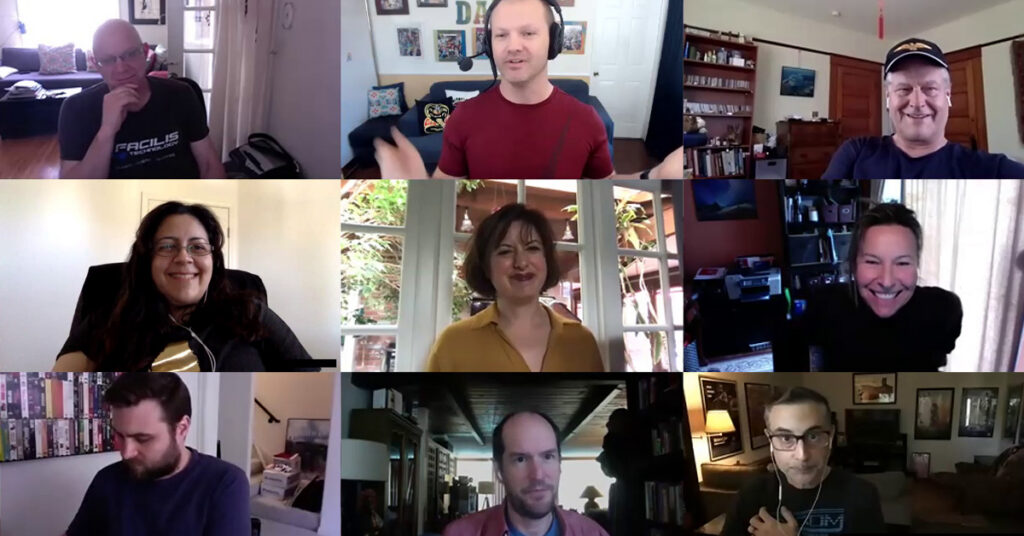
Zack Arnold: if you don’t already know, not only am I here with Jesse Averna, editor extraordinaire, I am also here with my optimizer coaching and mentorship community. So everybody wave, say hi from all of your little zoom squares. So it’s kind of like the Hollywood Squares, but on steroids, because there’s a lot more than nine of them. And I may may call out my squares in my room here at some point to ask some questions and to just chit chat about everything that’s going on in the world,
Jesse Averna: I have questions for you too.
Zack Arnold: Oh, do you have questions for me? Well, then we’re gonna have to schedule another show, because I don’t answer questions, that’s definitely not my thing.
Jesse Averna: No,
Zack Arnold: no, definitely not. So there’s a couple of reasons that I had you come on the show with me today, you and I could talk about 150 different subjects, and I’m pretty sure that offline, whether it’s via social media, email or various lunches we’ve done and talked about all of those subjects,
Jesse Averna: Right? Right?
Zack Arnold: There’s two things specifically that I want to talk about today that I think are going to be very, very helpful to people that are listening, the first of which is just brainstorming and talking about this idea of whether or not animation is essentially going to become the future of entertainment and specifically post production, at least in the near future, because it’s really the one machine that, for the most part, can still work relatively seamlessly. It’s bumpy, but at least you can create your own footage. People that are in live action clearly can’t do that. But then the other thing we’re going to talk about, and we’re going to go back and forth between these simultaneously, is you and I are going to debunk the myth that nice guys always finish last, because I feel like you’ve done okay with your career so far, still a lot of things you want to accomplish, but given where you are so far, you’ve done okay, and I can confidently say you are by far the nicest human being in this industry. And you you project that out into the world every single day, and anybody else is on the community call that knows Jesse, either via social media, Facebook or otherwise, raise your hand if you agree with me, nicest human being in this entire industry. It’s not just me. So where I want to start with you. For those that may not be as aware as others about what it is that you do and how you got where you are, we’re just going to start with the basics. Tell me a little bit more about what you do and how you got where you are. What’s your origin story.
Jesse Averna: I’m an editor currently in feature animation origin story. I’m one of those kids. I’m an 80s kid. I think we actually graduated the same year. Zack,
Zack Arnold: What year
Jesse Averna: 98 I can’t
Zack Arnold: believe you just said that publicly. Yes, we graduated the same year. And thank you for pointing that out. I appreciate that.
Jesse Averna: So, yeah, I was, I mean, I always loved shooting different short videos of my friends on the weekend that that was the fun thing that we did, and then I would take it back and edit it on my own every weekend. So editing had been a part of my ability to story tell or to create or to do artistry since as far back as, you know, middle school and then professionally, I kept getting different editing jobs, not necessarily what I wanted to do, but like wedding videography and then doing videos for churches and you name it, kind of going through the ringer of anything. Thing that would hire me doing post production. And I kept during that time, I kept dropping out of school because I was getting full time work. So I kept ping ponging between trying to finish my degree and moving from job to job. And then finally, my wife and I moved to New York City. I landed my first job in the industry, which I found on Craigslist, and it was a PA job for a documentary on the who so it’s logging footage and file maker Pro and starting to learn what avid was. It was my first experience ever touching avid before that, everything I did was premiere and then eventually Final Cut, but, but, yeah, it started there, and then really the connections I made from that job made me ping pong from job to job to job. Relationships I made with different producers and and other pas I worked with. It kind of just became this network, this spider web of connections where we all wanted to help each other and support each other. Not just that job, but each job introduced more friendships and more network, more opportunities. I followed that trail down to where I am now.
Zack Arnold: There’s a big gap in between. There we have. We have a little more than I might want to talk about before we get to end we’re here now. So I was a PA, went on Craigslist, did some pa stuff, met some people, and I’m here now have a little bit more I want to talk about in there. There’s a certain show by a certain name that people may or may not recognize, where you found a lot of fame and won a lot of awards. So talk to me a little bit about that period. And after you got done with that period, What in God’s name made you think, I don’t want to do that anymore. I want to come to LA so let’s talk about that period of your life a little bit.
Jesse Averna: I had worked for a Disney I think it was called Disney preschool at this at the time, a show called Johnny and the sprites, which was an amazing puppet in person show, and the puppeteers who were part of that show, and a lot of the behind the scenes crew also worked on Sesame Street. And so I worked on Johnny and the sprites, and then I moved away from that and worked in documentary for a little while, even news for a little while. And then got my feet wet in feature assistant editing. Got into the Union, and then I got a call from some of those connections I made on Johnny and the sprites to have a chance with Sesame Street. And I was on Sesame Street for a little over five years, which was amazing, dream job, just unbelievable. After that, we had an opportunity to move from New York City to LA to jump into animation, which is something else that I’ve always had a passion for with Disney. And yeah, and then I took it
Zack Arnold: So let’s talk about that moment, because I’m a little a little bit more interested in diving into that a little bit deeper.
Jesse Averna: Yeah.
Zack Arnold: Yeah, you were not just working at Sesame Street. You were dominating Sesame Street, winning multiple awards, like anybody that knew, anybody in the post production world, as soon as you say Sesame Street, you just say Jesse Arnold, like the two things were synonymous. I didn’t even know who you were for years, personally, yeah, but I just knew, Oh yeah, Jesse. He’s the guy that’s just killing it over at Sesame Street.
Jesse Averna: I definitely didn’t do it alone.
Zack Arnold: Oh yeah, I don’t
Jesse Averna: A mentor. John Tierney. He passed away a couple years ago, but he was a very special relationship, very like a professional, but very fatherly, like I learned so much from that man, and a lot of what I was able to do was because I had someone that trusted me like him. I owe a lot to that guy. Yeah,
Zack Arnold: Well then that’s something we’re going to talk more about, is the idea of mentorship and networking and being nice to people. We’re definitely, definitely going to talk a lot more about that. What I’m curious about is, did you know that animation was the place you wanted to be very, very young, or was it a matter of, I just want to work on these certain types of projects, and then the animation idea came along, you have an opportunity. And you thought, huh, that sounds interesting. So where were you with that decision?
Jesse Averna: It wasn’t necessarily the medium of animation that I’d always been drawn to. I’ve always loved animation, and definitely had a pull towards it, but it wasn’t that one burning I need to do that kind of career decision. It was more there’s certain places and companies and projects that I’ve always respected and loved and cared about and felt like they were part of the legacy of entertainment, of films, and it was something that I wanted to be a part of. Because of that.
Zack Arnold: Are there specific legacies that perhaps I don’t know, the the Disney Corporation may or may not own, that may or may not be a part of your virtual background right now? Yeah, you’ve always thought I want to do, I would love to be a part of.
Jesse Averna: Yes, 100% so. Star Wars.
Zack Arnold: Oh, so that’s what it is. I thought I recognized those. I knew
Jesse Averna: Anything Lord of the Rings too. Those two would get me. I keep hearing rumors of Sandman happening, properties that shaped me and shaped my love for creatures and practical effects and emotional storytelling, but done in a fanciful way. So I think that’s part of not to interrupt you, but go ahead and part of the neat opportunity. I think that’s actually happening with animation right now. The people who make animation obviously take it super personal and serious and care about it to the nth degree, the same way people who make television do, but there was a period of time where television was considered not as valuable or not as important or not as whatever, as feature films. And then finally, I feel like audiences turned a corner and started to see, oh, okay, wait a minute, there’s we should take this medium more serious with things like the sopranos and and I think animation is one of those. There’s some incredible, unbelievable storytelling happening that can only be told via the medium of animation. People can still be prone to, well, cartoons for kids or that doesn’t I know I’m not going to like it, just on the fact that it’s not real people, they’re animated. I feel like this moment in time with the pandemic might open that opportunity for people to give it more of a chance and to take down that barrier. I mean, sci fi was the same way thinking that sci fi could never emotionally connect with you. And then we had, you know, Battlestar Galactica. I don’t know it’s exciting.
Zack Arnold: That’s what I would call the perfect segue, because this is, this is really what we’re here to talk about today. We’ve brought your journey to the point where you worked in New York. You were on Sesame Street for five years. You would wake up in the morning, somebody would hand you another Emmy Award. And then you decided, I have an opportunity to move out to Los Angeles and work for Disney animation, which is amazing, knowing that Disney and working on an animated film is not like the end all be all, but it’s part of creating this larger, fantastical world that can tell amazing stories that only, either animation or heavy visual effects can do with something like Lord of the Rings, Star Wars, etc, etc.
Jesse Averna: Yeah, yeah.
Zack Arnold: So what is it that you were doing at Disney specifically? And the reason that I want to talk about this is so people better understand the process. Because there are a lot of people, first of all, just the general public has no idea how animation is actually put together, but I find most people that are even in the industry in live action, don’t really understand it. And I’ve been getting a lot of questions, of people saying, well, if animation is really where things are going. What skills do I even need to learn? Like, what do you do in animation, and if I wanted to get there, how do I prioritize those skills? So talk to me specifically about what you did on a day to day basis at Disney.
Jesse Averna: Well, I was at Disney Television Animation and then a Disney Feature Animation, and those processes are a little bit different, because one utilizes a house off site for the actual animation that happens, and the other one does it in house, which is Disney Animation. Everything is done there. But really the truth is, editorially, between live action and animation, it’s all storytelling. Are we servicing the story? Are we helping to tell this joke the proper way? Are we delaying a reveal or, you know, the all those methods that we as the editors get to do, essentially being that first audience, viewing footage or viewing ideas and responding to it emotionally, and then trying to encapsulate that as the scene moves on. But for animation, I’ve heard someone explain it. I think there’s actually a good video online. With live action, you shoot and then you edit. But with animation, you edit and you edit and you edit, and then you finally shoot. So the way that animation editing works is that the first iterations of a scene, and then, you know, larger act, and then finally, the film are all done in boards, so drawings that are not frame for frame, but, you know, more sporadic in order to convey the action and the emotion and the blocking, still a lot of work that goes into them. From the story artist the story. Once we have those boards, we’ll record dialog or scratch dialog and add sound effects, and we’ll put that scene up on its feet in boards and see if it’s working, and then tear it apart. Build it up again. Tear it apart, build it up again until we’re telling that moment. And then eventually that scene in that act the best way possible. And then finally, when a scene graduates out of boards, it either moves into, if it’s 2d animation, it will move on to get animated, or in 3d animation, or move on to something. Uh. That’s a more crude uh animation, like a pre vis or layout, where then they figure out blocking, where should the cameras be? What does the actual 3d space look like? How do characters actually move? Because in boards, you can jump positioning with characters, but now in they actually have to walk to a certain point. Those kind of continuity things. And then finally, when scene graduates out of layout or previous, then it’ll move into animation, the actual process of animating.
Zack Arnold: So I think one of the most interesting things that people realize about the animation process when they understand how it works from a post production perspective. And like you alluded to already, it’s not even really post production, your pre production, production and post production all rolled up in one big, giant ball, and you’re kind of managing all of them, yes, but I think as an editor, for somebody that’s worked in live action my entire career, we always say that we do the best with the footage that we are given. So I don’t have complete and total freedom. As an editor, I can improve and enhance, and I can restructure, and I can do composite visual effects and replace somebody’s eyes or mouth or head or whatever it is, but there’s only so much that I can do as an editor in animation. Talk about the level of freedom that you have with both story animation characters, like the whole thing
Jesse Averna: That was something, honestly, that was a hard transition for me, was realizing that we could do anything I really enjoy in live action, the constraints of trying to make the very best out of what you have. Salvaging is the wrong word. But you know, taking all of the magic and the gold from every little piece that you have to form something new and different or unexpected and with animation, yeah, it’s it’s more gratifying, I should say, because you’re helping to craft not only the scene, but also the performance of the characters. Obviously, the the actors and the talent who are recording, the board, artists, the directors, producers, they’re all shaping that as well. But an editor, you’re figuring out the timing of literally every moment, how a joke will land, how someone will will turn and react, or so on. So really, an animation editor, all the way through the pipeline, is the right hand to different departments. We’re the right hand to the story artists, the board artists who are working, which are absolute magicians, because the they’re having to not only draw so much work and be willing to throw it out and draw it again and over and over, but they they’re drawing, they’re figuring out staging. They’re figuring out, you know, the world around them, what props are there sometimes, as well as the characters and how to emote and to best tell that story. So we’re I really feel a responsibility to them, to support them with sound effects and with my timing and with my critical ability to step back and say, it feels like this should come before that. Or what if we step back here, or here’s another option, and we thought of this, and then that kind of mentality goes all the way through to the end, like I’m my goal is to same thing with live action, but to facilitate the best story possible, and not my story, but what the director has envisioned and what the writer has envisioned. And I take a lot of joy in throwing out the bad ideas, you know, building what was intended, but then also, like, but what if we and then shaping other ideas that might then create yet another, third idea that improves on anything that we had thought of? So it really is this cooking. It’s like, I like what I like the stew you guys have. But what if we added a little bit of you know this and that, it’s super gratifying. It’s it’s wonderfully rewarding,
Zack Arnold: Which to me, sounds like a combination of both everything that you can do in post, but you can also do in a writer’s room.
Jesse Averna: Yes
Zack Arnold: If you have a writer’s room and a bunch of people throwing ideas against the wall to see what sticks and what doesn’t right, sounds like you have a lot more opportunity to do that in animation than you would in live action, because once it’s shot, you can’t say, oh, what if this character says something different? Okay, well, it’s gonna have to be on the back of their head. I don’t want that, right, right? You don’t have to worry about that.
Jesse Averna: No, that’s exactly right. We can. We can help craft jokes and then retell a different joke if it didn’t land or, yeah, shake change one word from them, yeah. We get to affect all of that. And really, I mean, I’m talking about my personal experience. I don’t know if all productions work this way, but, um, but yeah, the editor is there for all of it and helping to shape and craft with them.
Zack Arnold: Man, sounds like a lot of work. Sounds like this. Probably takes a while. Talk to talk to me a little bit more about how long you really have to be on a project in animation, because this is the biggest aha moment that a lot of live action people don’t really understand.
Jesse Averna: I mean, I’ve the typical number I’ve heard is anywhere from three to five years for a feature and for television, obviously it’s a more accelerated schedule, because you’re you’re pumping out. Lot more content as you’re as you’re moving, but it’s still, it’s a it’s a long time. It’s longer than any live action experience, experience I’ve had being on a show for three months, four months. This is for for TV. You’re there for at least a year, and then feature considerably longer
Zack Arnold: Given present circumstances. I would imagine anybody that’s listening or watching right now is thinking, I would kill to have that kind of job security. And I can’t imagine a downside, but maybe it’s not all upside. So talk to me about both the upsides and the downsides of animation, just from a lifestyle and a job perspective, for how long they actually last?
Jesse Averna: Well, the upside, like you said, yeah, there’s job security. I feel like you really get to live with those characters. You’re saturated in it. You understand the story and the goal of the story more than you ever possibly could. And it becomes super personal. I think one of the town sides, and this is true for all editing, is you really have to learn the ability to care incredibly deeply about the work you’re doing, the scene you’re doing, the moment you’re doing. Care about it more than anything, because it’s your responsibility to care at least as much as everyone else is caring. To take that torch, okay? The director cares about this, the writer cares about this. I need to care as deeply as I can to make this work, and then the other side of that coin be willing to completely just eviscerate it and throw it out without any ego attached, knowing that that’s just process. It’s not nothing personal. It’s not just your work that’s being shaped and molded. It’s everyone’s and it’s for the greater good of making the story better. But it does take a little bit of practice, at least, for me to be able to give it my all and then to completely let go of it and say, Yeah, let’s make it better. You’re totally right. We tried that idea. It didn’t work. Does that help answer?
Zack Arnold: No, that absolutely helps answer it. So it sounds like not only do you have the opportunity, to be an avid make cuts, move things around, like you would as a live action editor, you also have the opportunity to feel like you’re in the writers room, but it also sounds like you get to be, in a way, like a de facto director.
Jesse Averna: I would say more that I feel responsibility toward the director. So I mean, there’s with any editing, there’s directorial choices that you’re making, like, should I be close for this? You know, feeling with your gut like this is something personal. She’s saying, I really feel like we should be tight. Or now they’re mentioning, whenever something in the environment, we should go wide, those kind of decisions. But I think Director hat wise, really, it’s always in service of the director. It’s it’s trying to know them and understand them and their sensibilities and the way that they enjoy jokes. Some people like things pace slowly. Some people like them faster because of the storyteller that they are. And really kind of owning that and putting that hat on to to be a surrogate of them, to best tell that story, but then also, yeah, including your own storytelling abilities and taste on top of that, live action or animation, I’ve always approached things that way and that it of, here’s what you here’s what you did, here’s what what you had planned for, and this is the best I could possibly do with it. And then, in addition to that, I have a couple options. I want to show you that just some ideas I was thinking, but always respecting their opinion and their idea. First and foremost, not injecting myself in a way that says, like I saw what you were doing, but I didn’t, I didn’t try it, because I think this is better, like, that’s I never crossed that line, because that’s not my job,
Zack Arnold: Sure, and that that part I definitely understand. I can’t even imagine a world where you have ever been disrespectful to anybody ever. But the reason I say that as a director is that if I’m watching footage, live action, and I look at a scene and I’m like, why didn’t they just get me the two shot? You can step in and just order a two shot.
Jesse Averna: Yup.
Zack Arnold: You know what, I don’t think this scene is working. Can you guys just give me a mock up of this? Just give me this one shot. Or maybe I need a close up of this character, and I don’t have it yet. So you’re not making the final determination, but you do kind of get to step in the de facto director’s chair to make decisions other live action editors never get to make,
Jesse Averna: Right? That’s fair, I think so. And also having the conversation with the different teams too, even things that environment, like, you know, we’re having a hard time getting them from here to there. What if the door was just closer? You can do that. Yeah. And really, the magic of that is that every decision isn’t haphazard, which, of course, it’s not in live action either, but literally, everything is servicing story. What’s the best way to tell this? From props to environment to lighting, it’s all with that singular focus. And again, I know live action is the same way, but you’re right. As the editor, you get to not just notice. How to shape what you have to fit that, but also thinking about other things that you can then affect. Like is this, is that table over there distracting? Or you can make those calls
Zack Arnold: Right? So to me, it seems like the difference between, oh, God, I wish I had that, versus, hey, can you guys make one of these for me so I can take a look and see if this works right for me all day long. I wish I had this. Oh, I wish they had gotten that. Well, I’m going to do the best with what I’m given, right? And you have the opportunity to build something and again, not make the choices ultimately, yeah, but at least present options that I could never present using live action.
Jesse Averna: And I do have to say, the counter to that is I’ve had some really good growing moments storytelling wise, to get pushback on those moments of why decisions were made. No, no. We really need whatever. We need that thing there because, et cetera, et cetera, et cetera. So just the care and the thought and the detail that went into those decisions, and not being privy to that being removed, and then learning about why they made those decisions, it’s almost like a master class of mise en scene,
Zack Arnold: Going back to this idea of caring and how long it takes to put something like this together, knowing that it’s years. Even in TV, it’s a minimum of a year. It features three, four, even five years. Right from a job perspective, the security sounds fantastic,
Jesse Averna: Yeah.
Zack Arnold: But from a creative perspective, you’re four and a half years into a film, how do you make any objective decisions whatsoever, like you’re hearing these voices in your head all day, every day for I’m guessing, for four years you heard I’m gonna wreck it, right? So how four years in or can you still make these objective decisions I get I lose my objectivity in like six weeks. I can’t imagine doing something that long and still feeling like I can make objective, creative decisions.
Jesse Averna: I think definitely fresh eyes is important. And the teams that I’ve worked with, they are proactive to get those, you know, either people inside the studio or whatever solutions they find. But the ways to have someone who hasn’t been saturated, to give an opinion. And then this is true with live action too. There is a magic that happens when you finally step out of the nitty gritty of moments and scenes and step back to watching the entirety, seeing the flow and the pacing. And then I think that helps with objectivity too, like my character at the beginning of this movie versus the end of this movie, is this tracking? Is this working? Is this making sense? But yeah, I think it’s a constant headspace of stepping back and trying to look objectively as if, okay. Now, does this? Does this make sense? If I had never seen this before, constantly asking that question,
Zack Arnold: Got it okay? So what I want to do now is, I want to dive a little bit deeper into the specifics, into the weeds. I want to talk about the skills. The reason being that, number one, I have three people on this coaching program alone, all of whom are on this call are actively pursuing the world of animation. But another question that I’ve gotten repeatedly is, again, like we alluded to at the beginning of this call, where is the industry going, and if it’s going towards animation? And I’m a live action person, and I’m waiting for cameras to roll either until there’s a vaccine, or until Monday, according to the governor, or until August, according to the mayor. Like, the crazy thing about all these calls is I do them live on Friday, I release them as a podcast the following Friday, and they’re already obsolete. Everything I’ve said is wrong in seven days. So everything you and I talk about is going to be proven wrong. And I know they are, because people reach out and tell me how wrong I am, either Well, you said this or that, and you said there wouldn’t be cameras until a vaccine, and 25 comments about why that’s not true. It’s like, Guys, this is such a rapidly moving target, I’m just doing my best here,
Jesse Averna: Right?
Zack Arnold: So I don’t want to talk about where we think it’s going specifically yet from a political perspective. I just want to better understand if I make the decision that I want to move towards animation, what are the things I don’t know, I don’t know.
Jesse Averna: Do you mean hard skills or soft skills?
Zack Arnold: I think it’s going to be a combination of both. But let’s start with the really basic hard skills, like, what are some of the things you realize, oh, my God, I I have to know the basics of Maya or this or that. Like, if I’m coming from live action and I live in Avid or Premier, are there things that I just wouldn’t know that I have to start working on?
Jesse Averna: I think the first surprise will be footage, the fact that footage is a series of stills, of boards, and that the first part of it is getting that footage on its feet, so pacing out boards to to dialog, or sometimes, if we don’t have dialog yet, pacing them out and adding sound effects, creating some kind of time for these boards to become shots. It still always goes back to the language of live action, of how framing should be, how long we should be on something animation still very much lives in the medium that we’re in. So I guess, yeah, that was the first surprise for me. Is not just pulling up your dailies and looking at everything you have watching. It, finding what you like, tagging it, and then start placing it on a timeline. Cut that together. Instead, you’re shaping it from scratch. You’re looking at a series of pictures that some artist has painstakingly done under the direction of the writer and the director, and they’ve iterated several times before you’ve gotten it, and then you figure out, okay, now timing wise, how will this be a shot? How will this be a moment? How will this be a scene from scratch and so choosing the performance, the words that they say to maybe half of this sentence, another half of that one, or just taking the T from that word and putting it on that word and shaping exactly what said to the timing of when and how that said, and then sometimes even choosing switching shots to choose when and where that camera should be, all just in boards.
Zack Arnold: So from a just the hardest of the hard skills perspective, everything you’re talking about is more the creative process storytelling. Yeah, do you still pretty much live in Avid or did you have to learn new tools?
Jesse Averna: I’m 90% avid. I do some After Effects. I love, absolutely love After Effects. Always have I have sesame to thank for that, because I spent a lot of my time in After Effects there as well. But again, it’s all servicing stories. So if a moment could be helped or better told because of motion, then I’ll graduate something into After Effects to help show that. But, but yeah, it’s mainly you’re living in Avid or Premier in order to tell that story. Yeah.
Zack Arnold: Okay, so then it wasn’t like you had to take months and months of training in Maya to do your own basic threed mock ups, and
Jesse Averna: No
Zack Arnold: It’s mostly reaching out to teams that are already supporting that you providing the direction or the basic ideas or collaborating with others, but you’re still living and breathing mostly in AVID using the same tools that I as a live action editor.
Jesse Averna: Yes, yeah. So, and the truth is, it’s because those people, again, in my personal experience, but they specialize in that. So for me to even dip my toe into faking that I could somehow do a better job than them or a clearer job, would be just incredibly naive. So what, what they’re leaning on me on, is specifically, yeah, the editing portion of it. So I know it’s that I don’t need an understanding of how they get to where they are, but more the creative side is the way we’re executing the best way possible
Zack Arnold: Got it. Because one of the questions that I’ve gotten recently and also in the past, is, is it easy to make the transition from live action to animation? And if I were looking at it from my own perspective, it sounds like technically, I could sit in your chair this afternoon, and I have enough technical skills to be able to do it, but I would probably be overwhelmed by how different the storytelling processes and the workflow is, but I have the technical skills to just go do it today.
Jesse Averna: Yes, yeah, I agree. Got it. I think, honestly, that’s true across the board. I think that there’s a misnomer. I see job postings for a comedy editor or a promo editor, and I understand we want people who specialize and understand those crafts and understand how to tell a longer narrative documentary. Those are all incredibly valuable, because those are creative muscles that you’re building in order to tell that type of medium, whether it’s a trailer, etc, etc. But in terms of the hard skill the Could you sit at their computer and put something together. We’re all editors. We’re all trying to figure out when and where we should be, and is it making the best impact, the clearest, funnest, whatever, funniest way?
Zack Arnold: Yeah, I agree with that wholeheartedly. Unfortunately, I left my pigeonholing soapbox in the other room, and I don’t have time to go grab it right now, because I could stand on this one for an hour. And there are people that have listened to me stand on the pigeon holding soapbox, and I’m not going to do that for now, but I do at least appreciate the fact that you’re alluding to just because you worked in live action doesn’t mean you can’t do animation,
Jesse Averna: Right? And vice versa,
Zack Arnold: yeah? And vice versa, absolutely. So for anybody that’s thinking, well, I could never do animation, or, more importantly, nobody would ever hire me because I haven’t done it. What I’m trying to dissect are the abilities that you have if you don’t have the experience. We talk about this on our calls all the time. Are people looking for ability experience or both? And if you don’t have the experience, then the story you have to tell to a prospective employer is, I have the abilities that you’re looking for, even if I don’t have the experience, and there’s a lot of translatable abilities,
Jesse Averna: Yes, and I think in general, not to keep zooming back out, but in general, when you’re trying to get a job, it’s a trust. It’s a question of trust, like, can we you as an editor, are not just a button pusher. You’re not just facilitating something. You’re not just putting whatever a puzzle together. You are one of the creative voices. And so can we leave you in a room and trust you to be able to do that without there being issues or delay or whatever else? So that’s really what I think they’re asking. And tech skills. Are an easy thing to poke at. You know what? I mean? It’s a first. It’s like a first defensive level of, can we trust you?
Zack Arnold: And I think that the other thing to go into, and again, gonna do my best to not grab the soap box, but I can. I can already feel one hand on it. I’m like, I gotta stop. But the one other thing I want to say about this, and then I want to loop back to another part of the conversation I want to finish. But when it comes to pigeon holing, I think it’s so important for people to understand once again, they have to highlight their abilities, but they also have to step into the perspective of the person that would be hiring them.
Jesse Averna: Right
Zack Arnold: That person wants to keep their job too, and they’re afraid to hire somebody that doesn’t have the experience, because if things go wrong, it makes them look bad. So you need to convince them you really have nothing to worry about, because I have all the abilities that I need. Don’t worry about maybe the lack of experience in animation. Specifically, if you can tell the right story to that employer and alleviate their fears of, well, you’re not a round peg that fits in a round hole. Therefore there’s no way you could ever do this. You need to learn how to, how to better tell that story, to give them that trust in that comment. That confidence.
Jesse Averna: I think you could take that mentality and apply it to every professional relationship you have, having an empathetic view of why is someone approaching you the way they are, with the perspective that they are, with the mentalities that they have. It’s, everyone comes from a place, I believe, of wanting what’s best, not just for themselves or for the production, but possibly for you, and maybe not hiring you at that moment might be a good idea. You know what I mean. It’s, it’s a hard pill to swallow, but I really do think that if the more you can put your head into someone else’s, like you mentioned, the in a way, the less personal you take decisions as well.
Zack Arnold: Yep, I agree with that wholeheartedly, and again, that we could do an entire two hour discussion about this topic. Yeah, what I would like to go into Next, I want to actually circle backwards, and I want to cover one more thing before we dive deeper into this idea of trust and confidence and how to treat people. But the one other thing that I know comes up a lot, we’ve talked so far about the process of being an editor in live action versus being an editor in animation.
Jesse Averna: Yeah,
Zack Arnold: Talk to me a little bit about what it looks like to be an assistant in live action that moves to being an assistant in animation, because that’s a very common question. If I can’t find any assistant work, well, animation still hiring, but do I have any of the skills at all? So talk to me about that translation just a little bit.
Jesse Averna: I think I always go towards soft skills again, but I think it’s you’re wearing the same hat in the sense that man, the assistant is one of the toughest roles, I think, in editorial, because they are the selfless giver of that room where they’re helping to set up their editor and helping to set up their production and keep things moving and keep it tidy, and caring about the things that no one else will notice. But if they didn’t, the thing would probably crumble and fall apart. And so between live action and animation, it’s in that respect, it’s the same job in terms of animation specifically, yeah, you’re, you’re getting boards, you’re getting records, you’re helping facilitate records. You’re, you’re owning everything that sets up your editor with the best footing to then be able to do their job quickly and efficiently with any inside knowledge that they’ve gained that the editor might not be privy to or the editor might be too busy for. But something else that’s nice about animation editing, at least in my experience, is that there is more opportunity for that assistant or that associate to cut, to help put that scene on its feet and lay sound effects, do more of that creative type work, to help get it in a place where then the editor or the Associate Editor, whoever could step back and watch it play without Having to do the nitty gritty of timing every board, so that the assistant can get that opportunity where they take what’s given to them and make it the best that they can for then the editor to see it and be able to think more globally about the scene and not those minutia moments.
Zack Arnold: So in the world of live action. That’s true as well, but there’s a very distinct caveat to that, that’s if the editor is willing to provide the opportunity and provide the mentorship. What I’m curious about is an animation with the sheer volume of material like I can only imagine, you have 1000s of Jpegs or tiffs or whatever they are, but 1000s of folders of images sound effects, you’re building things from scratch, right? Having your assistant editor facilitating the creative process and absolute necessity and they all do it, or is it still kind of up to the editor and whether or not they want to open that door.
Jesse Averna: I mean, I can’t speak for everyone.
Zack Arnold: I know your answer. I already know what you’re doing. I’m sure you’re giving them all the opportunities in the world of being an amazing. Mentor, I’m just curious if that’s still just you, or if it really isn’t a choice because of the volume of work and the schedules.
Jesse Averna: I mean, I think for anyone it’s always a choice until the schedule demands otherwise. So yeah, it depends on personalities, this and that, but a production can get to a point where we need all hands on deck, like we, we, we need, we need to start pumping this out. We need to start making this so here comes some opportunities for you, because we’re in a crunch. Yeah, my personal take is, I’ve always treated my assistants as it sounds stupid to say, but as equals with me, where you’re an editor as well, you’re just facilitating this production differently than I am. It’s not that I’ve got the magic and you don’t. It’s just that we’re at different points right now, and so giving them that love and respect to say, like, Hey, if you have ideas or frustrations or confusions or anything. Please let me know like i You’re hoping to tell the story as much as me. You’re part of the team. You’re part of what is making this film better, and if you’re in this circle, it’s because I trust you and value your voice, not just because you can organize things or whatever else, because of who you are as a person. And there is no expert storyteller. Obviously, some people are better at it, but man, that is the one thing that every story just takes being cracked, and the more input you can get, the better, you know. And some of the best ideas can come from anywhere. And so I just hate the mentality of treating anyone as lesser or less able just because of a title. Does that make sense? And obviously, we
Zack Arnold: Definitely make sense. That’s why you’re here today. Please go on
Jesse Averna: Well I mean, we all need to facilitate, obviously, for the job that we were hired towards, and that’s your first and foremost responsibility. This machine is running because of that thing you’re doing and because of the thing I’m doing. So let’s own those. And then on top of that, how can we be better? How can we make this better? How can we work better? How can we whatever? How can we organize better? How can we treat this department better? How can we tell this story better, etc, etc. It should only be plussing from there, but yeah, fool and wholeheartedly owning the job that you were meant to do, because we this, this machine will not keep moving unless you do it and feel proud of that. You know it’s not. You’re not just some replaceable person. You’re someone who’s in the inner sanctuary of the edit room, and you’re special for being here. And the editor and the second assistant, or the whoever the Post Coordinator is eternally grateful that someone like you is able to do that job. So never see it as like I only get to do whatever, whatever your job is you’re doing that one thing that other people aren’t, and that I don’t know, there’s so much gratitude that comes with that. I think I’m spiraling.
Zack Arnold: No you’re doing the opposite of spiraling, my friend. You’re pontificating and you’re sharing your brilliance. So that there’s a few things on there that I want to double and triple down. First of all, you’re going to get 150 resumes of all the assistant editors, they’re like, Wait, an editor wants to me to be a team member and be an equal collaborator. How does that work? I’m an extension of my computer right now. I organize data and I do visual effects lists, and who’s this guy?
Speaker 1: I’ve always I’ve said too, and I rub people the wrong way, but I feel like the Assistant Editor should be called the technical editor, where then the lead editor gets to be more the creative editor. But those are two sides of the same brain, and if, if one side is not working, the other side is not working, and they are just, just as equally as important in order to tell that story. And if you have an unhealthy department, you’re going to end up having more unhealthy decisions creatively. I really believe that,
Zack Arnold: Yeah, I will build my teams exactly the same way. I love the idea that you say we work together and we collaborate. It’s all about the best idea in the room. To me, that’s a really important factor for the people that I will work with. When I was young, just pay me and let me put something on a resume. Don’t care, but I learned very quickly, the quality of the people and the quality of the collaborative experience are worth way more than the money. So for me, I don’t look at a script or look at the people that worked on something and say, I got to work on this. I say, this looks interesting. Let me meet the people and talk to them first and understand their process. And for me, the number one thing on the list. The number one criteria is, if we don’t all collectively agree that the best idea in the room wins, I’m out. I will not work for you. Yeah. So if like, and that was the first conversation I had with the guys on Cobra Kai. I said, I want to know what your process is, and I want to know if the janitor walks down the hall and my doors open and like, Hey guys, you’d be better with a close up. Don’t listen to him. He’s the janitor. I don’t want to work with you. But if you’re the showrunner, creator of the show, making millions of dollars, and you’re like, damn, the janitor is right, that is better fix it. That’s who I want to work with. I want to work with guys that believe the best idea is the one is the one in the room. Doesn’t matter who it comes from. Yeah, one thing that I want to add to this that I think is really important for people to hear and understand that are perhaps in the editor position, working with assistants if they want to get more out of their assistant. I actually go even a layer deeper. I love this idea that you say we work together and we’re equals, and I’m not above or below based on title, the way that I actually put it, and I truly believe it, it’s not just me talking. I say that I work for you. The only way that this gets out of our little island here and gets out to the rest of the world is if I do my work on time, I get it to you in an organized fashion, and we’re able to deliver it. Otherwise, if we can’t deliver it together as a team, then what’s the point of what we’re doing? So I work for you. You tell me what you need to make your life easier. And I do that the same way with how I manage my team doing this. I mean, I’ve got Debbie on the call right now, and she can attest to this. If I go back to the group. Debbie Germano, did I not just say to you, I think two days ago, when it comes to this specific conversation about XYZ, you’re my boss. I work for you. You tell me what you need so we can make this happen. Right? So maybe the larger vision in the direction first comes from me, and I say, here’s the strategy, but in order to execute it, I need you to be my boss and hold me accountable. And as soon as you give somebody some modicum of control and they don’t feel like they’re just being told what they do, their performance skyrockets.
Jesse Averna: The only I love that, and the only thing I’d add to that is I think the same has to be true with comfort. So the idea of being able to make a mistake, or to be able to be tired or to and I’m not talking about like being sloppy, but I’ve always had the attitude that if a mistake happens and it’s in the room, it doesn’t leave our department, then the mistake never happened, you know? I mean, like we’ll let’s all trust each other and care about each other enough to allow people to do dumb things or to make a mistake or to whatever. Yeah. So I think, yeah, having that room of trust and also feeling safe. I guess that that it’s not every job you’re doing at that moment will determine whether or not I trust you or whether or not you’re still owning your position. I just, you know, letting people be people, but at least owning up to those mistakes, being being honest about them and fixing them before it leaves us, because if we can do that, there’s not a problem.
Zack Arnold: Yeah, I like, I really like this idea of if we make a mistake internally, it never happened and nobody knows about it. My perspective on mistakes is, I understand how vital it is for people to feel a sense of comfort and not always be freaked out about, oh my god, if I do this output wrong, or I forget to put this on the slate, or whatever, like, they’re gonna be so mad at me. That’s gonna make you worse at your job, not better.
Jesse Averna: Oh yeah. Well, I am prey to that too. Like, I’m, I’m constantly like, and I’ve, I’m slowly growing out of it, but still, I’m like, did I, you know, I’ll lay in bed thinking about, did I make sure to whatever, you know, worrying about something tiny, about my edit, that that’s going to go out or and, yeah, that kind of dread or anxiety can just really zap your creative energy and also makes you less bold later.
Zack Arnold: And the the ability to take creative chances is absolutely paramount to being not only good but great at what you do, and that’s ultimately what people hire you for, but they can’t expect the boldness and the creativity without being willing to have bad ideas in addition to good ones, and that applies to being an assistant. So I will always say, I never want you to be afraid of making a mistake or asking a stupid question. Just know that if you make a mistake, that’s fine. That’s a learning process, but we have to take the time to learn why that mistake happened, so it doesn’t happen again.
Jesse Averna: And beyond,
Zack Arnold: Always a big and be very honest about it. Yes,
Jesse Averna: And same with the editor, like being being honest and open to their team, not just, you know, shrugging it off, but But owning it if you did something wrong, or you were whatever you were tired and short with someone, or whatever it is, you know, like own it care and love about your team enough to to be good enough to do that.
Zack Arnold: All right, so now I’ve got a question that goes really to the heart of where we started. This idea of me saying, not even really jokingly, you’re the nicest guy in this industry? I am hard pressed to pick anybody that’s probably nicer, and I know that it’s going to be a paradox. You’re not going to be able to answer this question because you’re too nice and you’re too humble. So I’m going to phrase this question in such a way that you can’t get out of it.
Jesse Averna: Okay,
Zack Arnold: If I were to ask some of your closest friends and colleagues in the industry that have seen you make. You arise from where you started to what you’re doing now, and will continue to rise. And I can’t even imagine the stuff you’ll accomplish in the next 10 years. What would they tell me about you that has been the key difference in the way that you manage people, you manage relationships, and the way that you put yourself out into the world. What would they tell me because you can’t get out of this by being Mr. Humble.
Jesse Averna: I will say that one of the something that I take the most personally is that almost all of my jobs that have been really crucial to me, that have made change my life, have even when I’ve left them asked me back, either to support in some way or questions or to help, but that that relationship is still there, and that we still care about each other, so that that has always spoke a lot to me on not just how I left that opportunity, but on, hopefully the way that I treated that opportunity while I was there. I know that’s in some ways dodging.
Zack Arnold: Well, I knew you would dodge, so I knew that this is going to be an impossible question to get an answer to. Now I’m going to ask the opposite.
Jesse Averna: Well, here’s here’s one way I’ll answer that.
Zack Arnold: Sure, yes,
Jesse Averna: I’ve been extremely fortunate, and I’ve had the opportunity as I’ve had because Right place, right time, knowing the right people, and I point that out just because I want those people to know that are working editing material that they don’t like or that they don’t care about or wasn’t what they plan to do, it isn’t because I’m necessarily a better editor than you. There’s there’s there’s putting yourself in the right opportunities around the right people, in the right locations, and the right willingness to do, you know what it takes to get into those jobs that you really want. But I in no way believe that I have some magic ability that that kid who’s editing weddings that doesn’t want to be editing weddings, doesn’t Yeah, that’s it.
Zack Arnold: And I think, I think that’s a really good way to put it, is it’s so easy. When you’re looking at people from below, they’re up above you, they must have some amazing magical skills, or some powers I’m not aware of, and I need to get those powers. And then once you get up to a certain level, you’re like, you’re all like me, wait what? You’re all insecure, and you all think you’re imposters, and you all think you’re going to get discovered as frauds, like none of that ever changes. And you realize, oh, they just took different paths. They made different choices. And I think the what I’m so glad you didn’t say was the L word. Maybe you’ve already listened to my show, and you know how dangerous that can be, but you didn’t say, I’ve been so lucky. Because if you had said you were lucky, I would have pummeled you, my friend. You said, I am so fortunate. Huge difference between the two. And you also didn’t say, I just had all of these opportunities that happened in the right place at the right time. You said, I put myself in the right place at the right time.
Jesse Averna: Yeah.
Zack Arnold: So that is so key for people to understand you have control over that. You don’t have control over the timeline or when the opportunity strikes, but you have control over putting yourself in that position,
Jesse Averna: Right? Yes, I agree with that wholeheartedly. And it takes sacrifice, you know, being being willing to sometimes choosing something you really want to do, versus security or being responsible and continuing to do what you need to do for your family, but then also working on something on the side in order to start chipping away at what you really want to do, and, you know, all of the emotional and mental and physical juggling in order to make that happen.
Zack Arnold: So let me ask you this question now. It’s going to be the exact polar opposite. We’ve talked about this idea of putting yourself in the right place at the right time, building this network, developing these soft skills for comfort, for trust. We’ve talked some about the hard skills. Now I want to talk about how other people do it. Why do you think the assumption is that in order for me to get ahead in Hollywood, I need to step on people in order to climb the ladder. Why do you think that is such a prevailing notion that the only way for me to get to the top is to burn everybody along the way, and nice guys finish last.
Jesse Averna: I think that that perception is from people who aren’t in the business. I think when you start to be a part of the business, you realize, like you said, that we’re all we’re all just people, and we all have insecurities, and we all have abilities and lack of abilities, but we’re all working out those same muscles of how to be the best at our job that we can and my experience has been that people hire who they want to work with, not just who’s the best. If someone’s the best and they’re hard to work with, they’re probably going to choose the second best people we live and breathe and eat with, the people we work with, sometimes more than our own families and. So it really, from the top down is, are these people that I trust, that I want to be around, that I could joke with, that I could learn from, that I could grow with. And I think those soft, you know, none of those say is the best, is the fastest, whatever, in terms of skills. But are they the type of person that I think I could be around during this process, and that the film could be or the TV show could be better because of their input. Maybe they’re not the fastest cutter. Maybe they’re not, you know, on and on, but do they own that? Are they a good person? Essentially,
Zack Arnold: That’s hard to put on a resume, though, I would much rather just spend all of my time developing my After Effects skills and getting better at avid and saying I can do script sync and x and y and z, because that’s all for people to do. That’s what that and it’s all important. Yeah, that’s that’s the only component that people focus on, because it’s less scary. It’s just work, but it’s not scary. But once you have to actually talk about human relationships, especially considering that all the people, not all, but most of the people, that gravitate to our ends of the industry, we gravitate to the small, dark rooms in solitary confinement for a reason, because we we prefer it because we’re introverts. Yeah, right. So it’s harder to talk about comfort and trust and building relationships when you’re you’re an introvert at heart, I would assume that you’re probably no different,
Jesse Averna: Right? 100% Yeah, right. I’m very, very introverted, yeah.
Zack Arnold: Yet, you can go to a networking event and you can have wonderful, in depth, warm conversations with people, but it’s not like you’re going around and handing out your business card and your Mr. Sleazy businessman. That’s how people think they need to get ahead, right? And that’s not the way that it works.
Jesse Averna: Well, I think there’s two sides to that, too, that every time I go to a social event, even if it’s just friends or people I work with, it’s an effort. It’s something I have to talk myself into to finally go and do it. And then when I do, I’m fine, but I’ll probably be I’ll probably duck out early just because of that, that feeling, it is, it’s, it’s a muscle that I’m continually, I keep mentioning muscles, but I do, I really feel like, if these are all skills and abilities that you’re constantly growing and taking care of and maintaining, and they can fatigue, but yeah, and then I think that there is something to desperation. I think when someone can come off as really needing something. It can be a little harder for people to engage them, because then there’s more of a responsibility of like taking caring of them or owning them instead of bringing them in. Does that make sense?
Zack Arnold: Oh, absolutely. I talk about this idea of asking for something versus providing value all the time. I talked about this for three hours yesterday, just doing a call with the editors guild of 100 people, saying the exact same thing. You have to reframe your mindset that it’s not about what can I get from this person, it’s what opportunity do I have to give to this person?
Jesse Averna: Yes,
Zack Arnold: It completely changes your conversation in a networking perspective. It makes it that much easier. But I do have to say, You’ve made me and so many people, so much better that you have to psych yourself up to go out in public to events. I’m so the same way, like I’ve got an abacus and a ti 85 calculating all the reasons I shouldn’t be doing it. Oh, fine, I’ll go, Okay, fine. Like, it’s not easy. There’s nothing effortless about it.
Jesse Averna: The good news about that is that’s how everybody else feels. There’s like maybe five people who don’t, but you’re in a room in this industry, especially in our little neck of the woods, everyone feels that way, everybody and so, yeah, just know that you’re not alone. There’s not something weird about you. It’s not a disability, it’s just hard and it takes work. Yeah,
Zack Arnold: Takes work and it takes skill, right? It’s a skill that you’re not born with, so something that you have to learn and develop, but you’re not born like you said, with a disability, unable to network. You just don’t do it often enough, and maybe you don’t know the skills or the strategies.
Jesse Averna: I think one of my mindsets too, with networking in general, and this is true with jobs. Is instead of trying to make connections, I think you hit on this, instead of trying to find ways to make yourself better, what can I get out of this having a leech approach of what can I get from being here? Instead go with the opposite mentality of like, what friends can I make? What connections can I make? What? How can I help support someone else? And that, for me alone, selfishly, takes some of that uncomfortable feeling away. Instead of that pressure of trying to what I don’t know, what, try to find a job at a networking event, it’s not going to happen. Instead go trying to, you know, actually connect with another human being who happens to be in the type of job that you want?
Zack Arnold: Yep, I completely agree. That’s that’s obviously my approach as well. And I don’t want people to think I’m going to go to the networking event and I’m going to come away bearing fruit. No, you go to the networking event and you plant the seed, that’s it. You got to wait for the seed to germinate and grow. And I think that. The whole approach, if I were to distill it down to one sentence, and I’m paraphrasing from a quote that’s the email signature of a friend of mines, but it just really sums up everything that I talk about, which is that the best way to make yourself better is to focus on making other people better first.
Jesse Averna: That’s nice,
Zack Arnold: if you can just put all of your energy into making other people better. Rising Tide is going to lift all the bolts real fast, right, right? So the faster you can make other people better, the faster they’re going to help make you better as well.
Jesse Averna: Yeah, I just, I just think that the attitude of you are better, or that you’re doing them some service, that they’re coming to you and you’re giving them, you know, something really gross about that too, that I don’t like. Again, we’re people, and we’re at different points and where we are with where we want to be, but you matter, and you’re important, and people care about you, and your future is just as important as mine, and you’re you’re just as valuable as I am. And just because I’ve maybe figured something out that you haven’t, or that person has, and I haven’t. None of that determines who we are as an individual or as a person. So if anyone has that approach of, like, looking down in terms of, you know, feeding the peasants, then I’m just not interested. Yeah,
Zack Arnold: And hopefully you and I today together, we can start an uprising people helping each other and being nice so we can all get where we want, as opposed to stepping on each other to get where we want, which at least celebrated be the holiday mentality, right? Exactly. So anybody that needs to hear that they matter and they have a place in this world and they’re valued, just go to Jesse’s Facebook page and read the last 25 entries. You’re going to get a whole lot of doses of that medicine, my friend. I appreciate you for all of that. What I would like to do now is I want to turn it over to questions. So if you have specific questions for Jesse, go ahead and start sending them, and there’s a little bit of a delay. So one of the really specific questions, we don’t have to go too deep into it, but going back to kind of the politics of right now, have there been any major disruptions, like with with anything live action basically just gone, just completely destroyed. There’s almost no live action work. But other than some of the like, Oh darn it, I got to work from home right now, is animation pretty much running the way that it was before.
Jesse Averna: I mean, again, I can only speak to my specific situation, but yeah, I think it’s interesting that it felt like we couldn’t do these jobs from home, that that’s ridiculous, that can never work to now that we have to, oh yeah, it’s suddenly incredibly possible. So yeah, I think there’s more hoops to jump through. There’s more opportunities for technical issues. Because you’re, you’re dealing with more tech but, no, I mean, we’re I’m working. I’m able to do it, yeah,
Zack Arnold: So I have at least three people in my community right now that I am expecting questions from very shortly. And you all know who you are, because you have Jesse Averna on the call with you, so you already know who you are. I’m going to give you guys maybe another minute or two. I’ll kill some time, but I’m expecting some questions from you guys, while we’re waiting for, hopefully questions from the three people that already know that I’m pointing them out, and I don’t even need to use names. Have you heard anything specifically as it regards, in regards to animation and the timing of what’s going on with live action. I’m sure you’ve seen all of the conflicting posts about the governor says that, you know, we’re going to start shooting as soon as Monday, and then people say we’re going to be shooting in September, and then, like, I do a podcast a week ago, there’s not going to be cameras rolling till there’s a vaccine, right? So what? What kind of like, what’s scuttlebutt? For lack of a better word, do you hear in the animation world? Are you just kind of insular where you’re like, Yeah, whatever. We’re just going to keep doing our thing.
Jesse Averna: It’s a little of both. I think, I think, as you know, anytime you’re on a production that’s, you’re you’re kind of in that bubble of only knowing what the production is doing and then hearing things I try to stay up on, on the news, which I love to share on post chat, as you know, but yeah, I think it’s the word everyone keeps using. It’s unprecedented, so we just don’t know. I hate that people aren’t able to work and can’t afford their lives or can’t afford the rent, or can’t afford their medicine or whatever the situation is. But I also hate that the other option is to possibly put lives at risk. So I don’t, I don’t know. I don’t know what the right answer is, or if there’s a good answer. And I feel like we’re, I’m very proud to live in California, because I feel like we’re, we have leadership who is really trying to balance that, of trying to get people working again, but also caring and saying you need to wear a mask, like, even if you’re healthy, care about other people, you need a mask on, because we there’s things we just don’t know.
Zack Arnold: So if I’m somebody, and I’m looking at a couple of the questions that are coming in now, and I’m going to, I’ll good, get to these directly, but I think one thing that would be a. Follow up to this, let’s say that I were talking to you right at the moment where you were at Sesame Street and you were considering going to animation. Maybe you didn’t have any opportunities yet, but you saw everything that was going on in the world. So let’s say that eight weeks ago is when you were right at the cusp.
Jesse Averna: Yeah
Zack Arnold: Do you think for somebody else that is in live action. This is a good opportunity for them to say, I’m going to make the leap to animation. There was never a better time, even, because I was going to do it anyway, versus well, I need to find work right now, so I might as well go work in animation. How would you how would you approach this?
Jesse Averna: Well, I mean, both of those answers are true, right? I think that there’s sometimes you have to go where the work is, and maybe you’ll be pleasantly surprised with how rewarding and wonderful animation can be. So if that’s your motivation, you need a paycheck. I don’t fault you for that. And for people who have been wanting to do it, if those are the jobs you’re seeing come up, yeah, you should, without a doubt, take them, or at least try to start like we’re talking about, build some of those skills and some of those things that make you the kind of person that they could trust to be able to take on an animation job. And I do think one of the tricky things for people is jumping like that. This is true across the board. You might need to take a step down or do something else that’s uncomfortable in order to get there, but if it’s something you really have your heart set out for, think if you can, if you can afford it, think of the long game. You know, I always say it’s better to be climbing up. It’s better to be at the bottom of a ladder you want to climb than be halfway up the ladder you don’t want to climb, so sometimes that’s a hard pill to swallow, but you know, you’re making cartoons. Maybe it’s worth it. Yeah,
Zack Arnold: I’ve now literally made a living talking people off of the proverbial ledge that are at the top of the rung of the ladder, and they’re looking down and saying, I desperately want to jump, but it’s really high. Yeah, and I might hurt myself, and I’m getting paid way too much money to be in the top rung, but I’ve never wanted to be on a ladder less in my life. So I hear this all the time, but I agree I would much rather be climbing the right ladder and be a few rungs lower than be at the top of the wrong one, which is a decision that I saw coming very early in my career, and I jumped from a six figure salary to making like, 600 bucks a week flat, because I wanted to be on the right ladder, not the wrong one. So I know that fear very well.
Jesse Averna: Yeah. And you have to the counter side of that is, be responsible to the people that you need to be responsible for to like, don’t, don’t, don’t. Make that decision lightly, if people need you even financially, like, take care of your stuff first and figure out a way to do that.
Zack Arnold: I agree with that wholeheartedly. That’s something that I tell multiple people, where they say, Yeah, but I’m just doing it for the paycheck. And I say, there’s no shame in that if you need to do for the paycheck, and that is legitimately your reason. Some people it’s an excuse. Oh, it’s just for the paycheck. Well, is it really for the paycheck? Let’s, let’s break down your financial needs, what that’s paying and they find out, Oh, maybe that was just an excuse, but for other people, it’s very much not an excuse, and they need to eliminate the shame and forgive themselves for doing work because they need the money. There’s nothing wrong with that at all. But like you said, you have to set yourself up to eventually be able to escape that endless cycle, otherwise, you just get stuck in it forever and it never, ever ends,
Jesse Averna: Right, right, right.
Zack Arnold: So we’ve got a couple more specific questions here. One of them says, if someone is thinking of adding animation to their skills along with being an editor, is there a certain path that they would take? Is there anything different about this path specifically that we should be aware of.
Jesse Averna: I don’t think so. I mean, I think even the the titles of the positions are the same between live action and animation. I think obviously TV, there’s usually more work than feature. Same thing with live action. You know, it’s finding those, those entry points. But no, I don’t. I think it’s the same game. It’s just a different medium, essentially.
Zack Arnold: So if I wanted to start from the bottom rung, and I wanted to break in on the ground floor, what does that look like, specifically in the animated world?
Jesse Averna: It could be a post PA, it could be a second assistant editor, maybe an internship, if you still have that ability, it could be maybe, yeah, just trying to network and meet people or get an interview or a tour, or some way to poke your head in, or maybe you find an opportunity of a friend that is trying to do animation, and they’ll give you the opportunity to cut that. I mean, I think any of those, anything that helps fill that bucket. I guess the way I think about it is that you’re not you’re not too good for any of those jobs. If those help you open that door, you’re not too good for it. If you want to be in that door.
Zack Arnold: I love it. We could put that on a bumper sticker. You’re never could. You’re never too good for any job.
Jesse Averna: Yeah,
Zack Arnold: Right. You absorb that no matter what level you’re at, that’s going to move you ahead a lot quicker.
Jesse Averna: Yes, yeah.
Zack Arnold: So another question that I have, and this is from somebody in my group, what I would like to know in I think she already knows that I’m talking to her, Would you prefer that I ask, or since you’re on the call, would you like to ask and have this conversation? Give me a thumbs up if you want to do it. I won’t. I will not feature you unless you give me a thumbs up. But you already know who you are, because you’re laughing. Thumbs up. Are you good for me to bring you out? All right, so we are now joined by Deb Cohen,
Jesse Averna: Yay.
Zack Arnold: Deb, you’ve got Jesse Averna on the line. You guys already know each other, and you have a really, really good question. I know you spent like, 20 minutes like, I don’t know, I’m drawing a blank. I don’t know what to ask. You have a really good question, and I want you to ask him the question.
Deb Cohen: What’s ironic is that my sugars are also a little weird right now Jesse, so it’s just very funny to me. When we met, my sugars crashed when I saw her. Very funny. Anyway, I was asking, like, you know, so first of all, we’re all stuck, but, like, even in this pandemic, but also out of it, like, how to know about putting yourself in the right place at the right time? Or, like, what kinds of things to look for? Because it’s hard to know. You know what I mean. Like, I can be walking through it every day, and you might not see something that you should be looking for, that could be that kind of thing. It’s like, what’s weird because me, especially, like, you know, I’m working on Lucifer right now. That’s a completely different place working on Lucifer. What kinds of things like because of that mindset, in that bubble that you’re in, you may not see, know what I mean?
Jesse Averna: Yeah, you’re asking, how do you put yourself in a position to best notice opportunities
Deb Cohen: Yeah, or like, What kind Yes? And also, like, what kinds of things to look for? I guess.
Zack Arnold: The other thing I want to add to this, not to interrupt, but I am going to interrupt. This is something you mentioned in your question that you wrote to me is you said, I want to be helpful to people, and I want to put myself out there, but I don’t know how to be helpful to people. And you’re talking to the you’re talking to the industry expert at this. So does that help clarify the question? Jesse, or not?
Jesse Averna: Well, I think, I think it’s a it’s a very valid question. The reason I’m struggling is because it’s such a personal thing. I think the best thing that I would recommend is what you’re doing right now is being on social networks. Is taking avenues least effort, of least resistance as well. You know, becoming friends with people who are in types of positions you hope to move into online, either on Twitter or on Facebook or what you’re doing here, but letting people know you as the wonderful person that you are, and not just who you are on a resume. You’re someone I’ve I’ve recommended jobs to. We’ve talked about this, but um, and that’s because of getting to know you, and that was because you were proactive in doing that. So I don’t, I don’t think you’re doing anything wrong. I just think it’s a continued effort with that. And I know that’s frustrating, because it’s like, Well, how long do I have to wait? And what about this? And I’m sure they’re hiring their friends. Why would they hire me level? So I get that, but I think it’s, I think it’s honestly doing what you’re doing, being plugged in in the community, being active and being someone that people can look to, not just for those professional skills, but also, you know, someone that they enjoy. That makes sense?
Deb Cohen: Yeah, it totally does. I just, I guess also, like, I don’t feel very helpful, even though, like, I try to be so it was one of these things, of like, I like being helpful. I like actually being able to not be in my own head and do what I can for anybody else. Like doing that.
Jesse Averna: Well. So do you mean I was, I was commenting on the opportunity bit of it, but in terms of helping people, I think that you, at least, for me, you’re incredibly positive, and you’re always sharing positive things online, and you’re going out of your way to check in on people and to care about people and to try to brighten people’s stream online. And I think a lot of ways, that’s the most you can do. And there’s certain people in your life who can only be loved the way that you can love them without sounding cheesy, but I think owning that and like letting those people know that they’re valued and that you care about them, even if you feel like it’s not always reciprocated, because people are dealing with this in their own ways. They’re having their own battles. They’re having their own insecurities and their own frustrations and but being the person on the side of instead of feeling like, How come no one ever reaches out to me and worries about me being on the other side of that and saying, You know what, I don’t care. I’m going to constantly. To be someone that lets them know that they’re valuable to me and that I care about them, and I think that that not only helps them, but it helps you too, does and helps you feel connected. And so all that to say, I think you are helping them, and I think having that impulse to want to help already points that to the fact that you are a helper.
Zack Arnold: So now I’m going to ask a question of Jesse on your behalf, Deb, because I’ve I know you well, and I know your goals and your aspirations, and I’m certainly not going to share anything too private, but I would assume you’re okay with sharing the fact that it would be pretty cool if you worked in animation, like you love the genre, and you love fantasy and you love the feel good. I mean, you’re wearing the shirt, so I didn’t think you were trying to hide it. No, the question that I would want to ask on your behalf is, as somebody that has plenty of ability, that is has a resume of experience at a very high level in television, specifically, but may not have the when we talked about ability versus experience. If you were to hand your resume to somebody in animation, they’d say, Oh, you’re you’re a scripted TV editor. Well, we do animation, right? So what’s the one step that Deb can take Jesse if she wants to make this transition to being an assistant in animation instead of live action TV?
Jesse Averna: That is a good question. I think one of the things you can do is meeting and becoming friends with recruiters and building the relationship with those gatekeepers for them to know you and to know that about you, that, hey, look, I know what my resume says, but this is what I’m passionate about, and I feel like that these skills translate. So even though that seems obvious to you, sometimes it might take just saying that to someone for them to be like, oh, yeah, of course, yeah, yeah, you know. I mean, they don’t, they don’t come to that conclusion. But I think, yeah, it’s finding those opportunities online when they come up, but then also building relationships with people who their job is to find and recruit talent and that. And again, that might be, it might be stepping down in order to do that, but, but I wholeheartedly believe that you, yeah, you have the skills and the ability to do it. It’s just finding the right timing, and also the person to say that to see that as well, and my guess is that’ll probably be television because of more opportunities. And there’s a lot of houses, especially in LA. I mean, you have so many things, bento box and Cartoon Network and Nickelodeon and Disney Television Animation and DreamWorks just on and on. So the work’s there. It’s just right, right timing, making those right relationships and not giving up.
Zack Arnold: So now I have a question.
Jesse Averna: Yeah,
Zack Arnold: I didn’t even know that there were recruiters. If somebody said to me, if I want to break in as an assistant editor in live action, I would never give the advice to get to know recruiters, because that doesn’t even exist. Talk to me a little bit more about that. That’s new to me.
Jesse Averna: Oh, go to LinkedIn and search for the different companies that you’re interested in and look up recruiter, and they exist. Yeah. And then I think it’s a really tough position for those people, because it takes some of that ownership of saying that this person is the type person that we think could fit in our culture, but then also, you know, bringing it to that team. So I think it’s a tough job, but I think animation is lucky to have that. I actually didn’t know that TV didn’t have that just because my path, I’d never I haven’t done like, Hey, look at my resume, it’s always been like I said, this person knew that person, and that person trusted me, so they passed me. I haven’t really found jobs that way.
Zack Arnold: So a follow up to that that I just got is somebody wondering, does that just mean it’s the same thing as connecting with a company’s HR department? And my guess is it’s not. I’m guessing a recruiter is a third party company that’s contracted by the studios? Yes,
Jesse Averna: I don’t know. I don’t know, but I, but my experience with the few that I’ve done, they’re people who are a part of that studio. It’s a position, it’s not a third party. But again, I can’t speak to all of it.
Zack Arnold: So then, did you get your job? First from Sesame Street to Disney, and now from Disney to Will you posted about this, right? So, yeah, so you move from Disney to DreamWorks. Did both of those happen through recruiters, or did those happen because of your relationships?
Jesse Averna: Relationships.
Zack Arnold: It’s not, it’s not mandatory. It’s not like you have to go through a gatekeeper. It’s just there for the people that haven’t built the relationship.
Jesse Averna: Exactly, yeah, exactly
Zack Arnold: Got it. So if I’m if I’m going back to Deb, I’m going to keep picking on Deb. If I’m going back to Deb, and I want to make this transition, if I had to choose between getting to know recruiters or getting to know this other person in this one position at Disney, at Nickelodeon, at DreamWorks, wherever, would you say, focus on the recruiter or focus directly on the editor or the other assistant. Or the post producer, like, Who is the person that if I’m going to pick one, I need to put all my attention towards?
Jesse Averna: I honestly don’t know. I mean, I think they’re all important because, I mean, as you know, editors hire other editors, and assistants get hired because another editor recommended them. And so editors, I think are some of the most gracious people in terms of that, in order, in terms of helping good people continue to get good jobs. But, but then, yeah, since there is another avenue and possibility, why not meet them and talk to them?
Zack Arnold: So obviously, I don’t want you to pick just one person. Deb, I’m just trying to get an idea of how to prioritize. The simple answer is, all of them,
Jesse Averna: Yeah,
Zack Arnold: Because you got all the time in the world, right? But I get what I was trying to understand, because I don’t even know the answer to this, is, is it worthwhile to focus on people that aren’t recruiters? And it sounds like it’s no different than focusing on the people you would in live action. Oh, yeah, where, if you build the right relationship, you’re going to get in the door regardless?
Jesse Averna: Right? Right?
Zack Arnold: Got it? Okay. So that makes sense. So I have one more follow up question that’s very specific, and I knew, I knew eventually he was going to come out of the woodwork and ask this question. So talking about this idea of recruiters, who hires, who builds teams, the question actually, you know what this is from Maxton. Maxton, do you want to ask this question yourself? Yes, all right, so Maxton, introduce yourself very briefly, what it is you do, and then ask Jesse your question.
Maxton Waller: Hey Jesse, thanks for the talk. It’s really awesome. I’m a composer. I’ve worked in animation for most of my projects. But what I’m wondering is, about for recruiters, do they use recruiters to hire audio, post music as well.
Jesse Averna: I honestly don’t know. I wish I could. My impulse, same thing with Deb’s question is I want to just give you an answer, and I feel like I’m being a little disingenuous by doing that, because I don’t, I don’t know. Again, I think that choose all paths, I mean, but all the people who could help make those decisions in terms of hiring, but I would be, I’d be lying to you if I told you any answer there.
Maxton Waller: Thank you.
Jesse Averna: Sorry.
Maxton Waller: No worries. Thank you.
Zack Arnold: My answer probably would have been relatively similar where I would say, I don’t know, but it never hurts to just try everybody
Jesse Averna: Exactly
Zack Arnold: Right. What I know for a fact is, and I talked about this extensively in the workshop that I did for the editors guild yesterday, one person had specifically said, Do you think it’s just it’s better for me to wait for the opportunity, or should I just really reach out to the person and I’m like, Do you really not already know the answer to this? Like, it’s got to be rhetorical, right? The one thing I can guarantee is that sitting around and waiting is going to yield you zero results. Maybe something will come along eventually, but you have to put yourself out there period. So my assumption would be, I’ve never worked in animation. I did cut one animatic when I was an assistant editor when I was 22 years old. So I can speak as an expert, but having never been an enemy, yeah, exactly 2002 so having never worked in animation, my guess is it’s probably the same as just about anything else where, if you’re a director and you have a really good relationship with a composer, and you love that composer, you’re going to bring him in the room and say, I’d love for him to do the music for my movie, and that composer is going to have a team and going to have assistance. And I’m guessing it’s probably not terribly different in animation. I don’t know if you want to disagree with that or not.
Jesse Averna: I’m gonna say something to cheesy again, because I’m I’m just love throwing cheese all over all this. But I think if, if there’s people who have jobs that are in companies or mediums that you’re interested in, they’re probably people that you want to know like they could be good, they could be friends. They could be someone interesting to you because you share that same pool and that same draw to that same thing. Does that make sense? So I think maybe try and network, not just to get jobs, to get work, but to meet someone, or to develop a relationship, or a mentorship, or something other than just a specific opportunity for yourself, like you mentioned before, Zack planting seeds, and sometimes those friendships that you have, someone that you’ve been friends with, whatever for years, will come around and they say, I have this pilot I can’t cut or I can’t do music for. And I thought of you would you, you know, those things come back around but, but I would just encourage you to get to know people and pursue people, not just again because of the opportunity for yourself, but to make a relationship, to make a connection, and then if the byproduct of that is an opportunity for you, then all the better. I we’re saying the same thing, but just a mind shift a bit, because these are all people you’re going to hopefully work with one day and or people that will hopefully support you and help you one day. I don’t know, see, see it as that, as what, as a friend of a friendship that could blossom from that
Maxton Waller: Very cool. Thank you.
Jesse Averna: Cheesy.
Zack Arnold: I brought. You on for the cheese. I didn’t bring you on to reduce the amount of cheese. I brought you to exacerbate it, because that’s that’s your thing. That’s what you’re all about. And I of course, say that in the best possible way, that’s
Jesse Averna: Zack. You’re a perfect example if, like, I only decided to have a friendship with you because I thought you could get me a job or better, my I don’t know it just I would have missed an opportunity to meet an amazing person, and how stupid a life decision would that have been.
Zack Arnold: I couldn’t say it better myself. I mean, there’s no way that I can top that. So that’s I appreciate you saying that about me personally, but saying everything else about relationship building and just this, this whole process and demystifying this myth that I kind of have to be an ass to get ahead, and I need to step on people, because it’s Hollywood, and that’s the way that it is, like you’re the perfect example. You can be the nicest person in the world and still make it to the top. And instead of pulling people down, you can lift people up and grab them and bring them with you,
Jesse Averna: And that’ll never hurt you.
Zack Arnold: Never
Jesse Averna: Helping people and helping and raising them up doesn’t put you at some risk or make your job vulnerable. I just want to throw that out there. You don’t you don’t have to hold on. This is mine, and if that’ll somehow make you safer, no way like we should be cheering for each other and celebrating each other and happy for each other and helping each other and hope, and ultimately, that only helps you, not just career wise, but as your own mental health.
Zack Arnold: I would have said that on March 12, and now two months later, given everything that’s going on, we just need to multiply that by about 100 given the circumstances that we are all in, so that, having been said, you and I are both editors for a living, and our timing sucks because we’ve gone over time. We need to edit ourselves where we’re both very
Jesse Averna: Two minutes out of this.
Zack Arnold: We got to take two minutes out. We got to find it somewhere. Don’t worry, my podcast editor will fix that for us and add his little audio filters and do his magic. He’s the magician. I don’t know how he does what he does, but it has been such a pleasure. It’s been so worth the wait, because when I say that, we’ve literally been trying to make this happen for happen for years, yeah, I’m not being facetious. We’ve been trying to make this happen for years, and it only took a global pandemic to make it happen. So and
Jesse Averna: I will, I will be vulnerable and say that one of the reasons it hasn’t is because of what I talked about before, is social anxiety around it, like saying something that will, I don’t know, just, you know, that little voice in your head of like, oh, do I really want to do that and open myself up to whatever it is? So, just so you know, you’re not the only one. If you deal with that, dealing with that, like it’s, it’s, again, a muscle always being worked out. So, Zack, thank you for having me do this.
Zack Arnold: You’re more than welcome. I know that I promised you one point that I would push you outside your comfort zone just enough to get you here. Little did you know it would be during a pandemic, and Facebook live right
Jesse Averna: Home with my troopers. So, yeah, exactly.
Zack Arnold: You’ve got, you’ve got protection, so you’re good,
Jesse Averna: Right?
Zack Arnold: So that, having been said, I just want to say thank you to everybody that’s out there on Facebook right now that’s been sharing your insights, it’s been sending your questions. Really, really appreciate that. I want to let everybody out there know that, as Jesse says, You guys matter. There’s a reason that we’re all here and we can all help each other get where we want to get, even during a global pandemic. So that, having been said, I want to thank everybody. I hope you have a wonderful Memorial Day weekend, and I bid everybody at Facebook Live at do so have a good one.
Jesse Averna: Bye. Thank you guys. See you on post chat.
Transcribed by https://otter.ai