


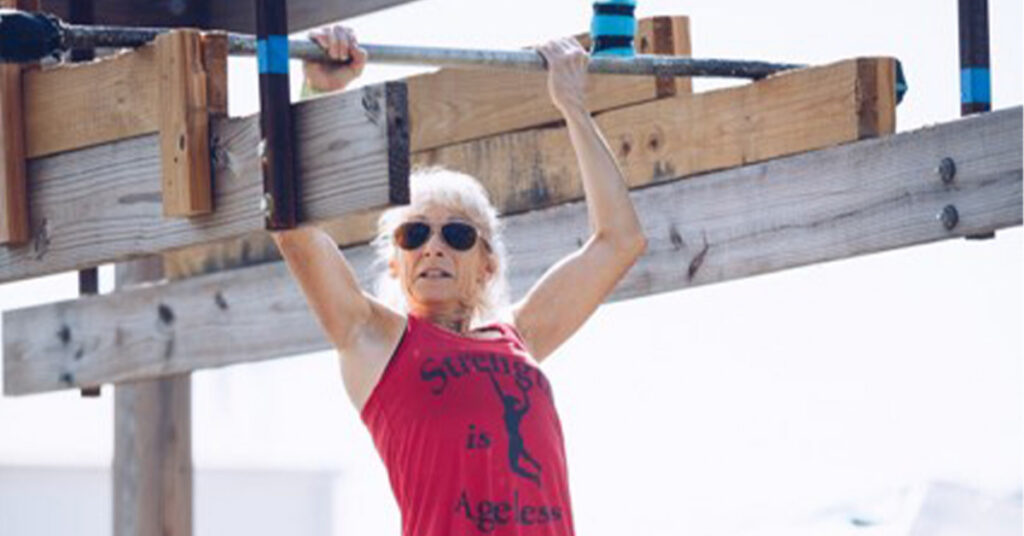
It’s Never Too Late to Get Stronger (and Become a Ninja) | with Ginny MacColl, ANW
Have you ever wanted to pursue a passion your whole life that’s well outside your comfort zone…but felt like you missed your opportunity and now you’re “too old?”
Let's create things that matter. Together.
Did you miss Part 1? Click here for my episode with Jessie Graff’s mom Ginny MacColl
If you’ve been listening to this show for any amount of time, you know that I love breaking seemingly impossible goals down to small, manageable steps. I’m all about creating tiny habits and incrementally building upon them to progress gradually – hence playing chess with your life instead of checkers. This is one of the key elements in my coaching and mentorship program and it’s also the foundation that today’s guest has used to build herself up to one of the top competitors in American Ninja Warrior (which is frankly being modest – she’s a LEGEND).
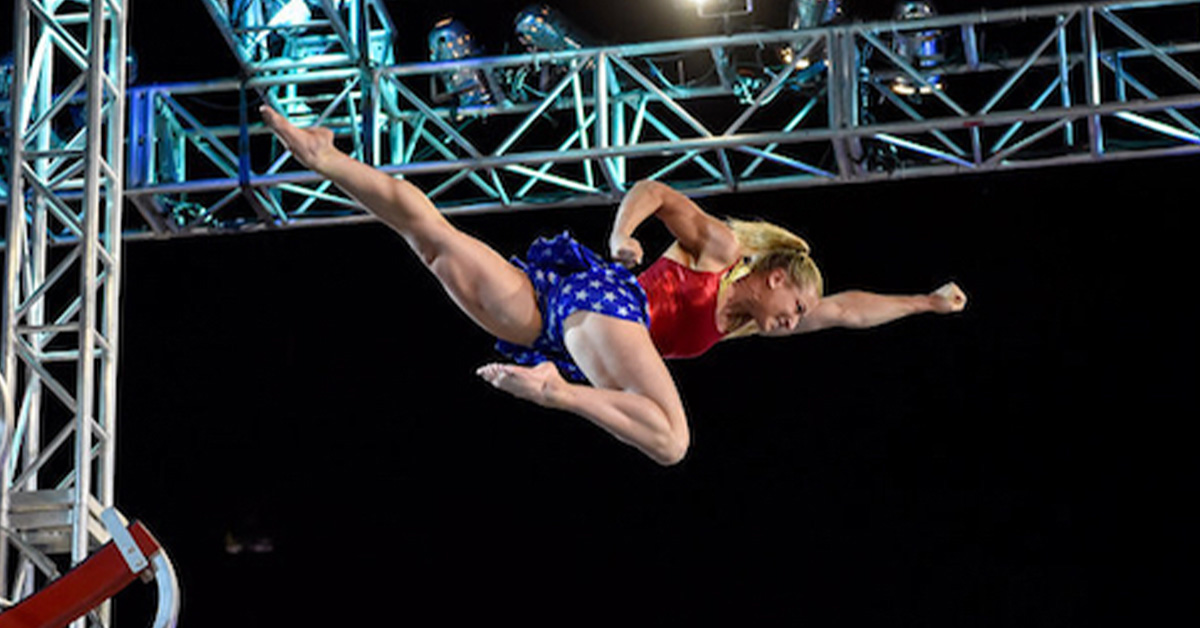
Jessie Graff, also known as the modern-day Wonder Woman, is the first woman to finish stages 1 & 2 in the Las Vegas finals of American Ninja Warrior, she is an accomplished stunt woman in Hollywood working on such films as G.I. Joe, Transformers, Wonder Woman, and Alita: Battle Angel (to name a few), and she is also the daughter of fellow American Ninja Warrior and recent podcast guest Ginny MacColl.
In today’s conversation, Jessie and I go deeeeeeeeeep into the inner psychology that drives her to compete and perform with such consistency and at such a high level. We talk about the practices and habits that have led to her success as well as the struggles, injuries, and the challenges she has overcome both as a child and an adult. And most importantly we discuss how she developed the mental toughness and fortitude that has led to her becoming the badass she is today (spoiler alert: Her mom had a lot to do with it).
But don’t let all of that scare you away…Jessie is also one of the nicest, sweetest, and down-to-earth “celebrities” I’ve had the pleasure of interviewing.
One of the top competitors on NBC’s “American Ninja Warrior,” Jessie Graff is quickly becoming known as a modern-day Wonder Woman, breaking stereotypes as she continues to break records. Graff was a national sensation and breaking news phenomenon in 2016, when she became the first woman to complete stage 1 in the “American Ninja Warrior” Las Vegas national finals. She’s the first woman to clear Stage 2 in both American Ninja Warrior and Sasuke (the original Japanese Ninja Warrior). Known for her superhero outfits and continued history of record breaking, she has ranked among the top 6 overall competitors in all of the past 5 regional competitions, making her the only woman to qualify among the men for national finals 5 years in a row.
Graff attributes much of her success on the seemingly impossible obstacles of American Ninja Warrior to her decade long career in stunts. Awarded the Action Icon Award for “Stuntwoman of the Year,” her credits include: Wonder Woman, Bright, G.I. Joe, Transformers, Die Hard, The Dark Knight as well as being a recurring double on Supergirl, Futureman, Agents of S.H.I.E.L.D, Leverage, and many more. Graff has a black belt in Tae Kwon Do and Kung Fu, with extensive training in countless other styles of martial arts, high falls, wipeouts, sky diving, motorcycles, stunt driving, fire, wirework and, flying trapeze. Graff also broke the pole-vault record at Georgia Tech (where she majored in Aerospace Engineering) and the University of Nebraska (where she earned her degree in Theatre) and was 1.5 inches away from qualifying for the 2004 Olympic trials in the sport.
The journey for Graff was ignited at the age of 3, when she attended the Big Apple Circus and begged the ringmaster to let her try the flying trapeze. Although her attempt to join the circus was unsuccessful that day, the experience immediately sparked a passion to fly and push herself beyond what others said was possible. Her parents enrolled her in circus gymnastics classes, which began her training and led her to other specialties in various acrobatic and fitness disciplines, helping her develop her range of strength, agility, and adaptability. Jessie currently lives in Los Angeles. She hopes that she can be a positive influence and show people all over the world that strong is beautiful.
[0:00] Zack Arnold: My name is Zack Arnold. I'm a Hollywood film and television editor, a documentary director, father of two, an American Ninja Warrior in training and the creator of optimize yourself. For over 10 years now I have obsessively searched for every possible way to optimize my own creative and athletic performance. And now I'm here to shorten your learning curve. Whether you're a creative professional who edits, writes or directs, you're an entrepreneur, or even if you're a weekend warrior, I strongly believe you can be successful without sacrificing your health or your sanity in the process. You ready? Let's design the optimized version of you. Hello, and welcome to the optimize yourself podcast. If you're a brand new optimizer, I welcome you and I sincerely hope that you enjoy today's conversation. If you were inspired to take action after listening today, why not tell a friend about the show and help Spread the Love. And if you're a longtime listener and optimizer O.G., welcome back. Whether you're brand new or you're seasoned vet, if you have just 10 seconds today, it would mean the world to me if you click the subscribe button in your podcast app of choice, because the more people that subscribe, the more that iTunes and the other platforms can recognize this show, and thus, the more people that you and I can inspire, to step outside their comfort zones to reach their greatest potential. If you've been listening to this show for any amount of time, you know that I love breaking seemingly impossible goals down to small manageable steps. I am all about creating tiny habits and incrementally building upon them to progress gradually, hence playing chess with your life instead of playing checkers. This is one of the key elements in my coaching and mentorship program. And it's also the foundation that today's guest has used to build herself up to one of the top competitors in American Ninja Warrior. And you know what, let's be frank. That's being modest is a legend Jessie Graff, also known as the modern day Wonder Woman is the first woman to finish both stages one and two in the Las Vegas finals of American Ninja Warrior. She is an accomplished stunt woman in Hollywood that has worked on such films as GI Joe, transformers, Wonder Woman, and Alita: Battle Angel just to name a few. She's also the daughter of fellow American Ninja Warrior and recent podcast guests, Ginny MacCall. In today's conversation, Jessie and I go deep, deep into the inner psychology that drives her to compete and perform with such consistency. And it's such a high level, we talk about the practices and habits that have led to her success, as well as the struggles, the injuries and the challenges that she has overcome, both as a child and as an adult. And most importantly, we discussed how she developed the mental toughness and fortitude that has led to her frankly becoming the badass that she is today. And spoiler alert, I'm Jenny. Yeah, she had a lot to do with it. But I don't want all of this to scare you away. Because on the other hand, Jessie is also one of the nicest, the sweetest, and the most down to earth, quote unquote celebrities I've ever had the pleasure of meeting and interviewing. If today's interview inspires you to get up and start moving again. But you have spent so many years stuck in your desk chair and you are so out of shape that you're not even sure where to start. Well, then you're in luck, because I have over 50 pages of tips, tricks, strategies, and my favorite tools to share with you and my ultimate guide to building a more active workstation. This Ultimate Guide is a collection of over a decade of my own research and experimentation that summarizes how I stay active, focused and energetic all day long, Despite living in front of a computer for the past 20 years. This includes my favorite recommendations for standing desks, ergonomic desk, chairs and mice, tools and equipment that I keep within arm's reach all day long. alleviates and eliminates wrist forearm shoulder neck and lower back pains. Seriously, this is a manifesto on how to not let your desk chair slowly kill you. To download your free Ultimate Guide visit optimize yourself.me slash workstation Ultimate Guide. Alright, without further ado, my conversation with American Ninja Warrior legend Jessie Graff made possible today by our amazing sponsors ever cast and airgo driven who are going to be featured a little bit later in today's interview to access the show notes for this in all previous episodes, as well as to subscribe so you don't miss the next inspirational interview. Please visit optimize yourself.me slash podcast.
I'm here today with Jessie Graff, who is a stunt woman with such film and television credits as Wonder Woman, Alita: Battle Ange,l Birdbox, Bright, Agents of SHIELD, X Men First Class, The Dark Knight, Transformers, Supergirl. And by the way, this is one that you probably don't talk about all the time but restaurant patron on Hell's Kitchen. That's a big one. You are also an American Ninja Warrior, a modern day Wonder Woman, and you are going to be featured on Season Two of NBC, the Titan Games, hosted by The Rock, I got to work on my cardio. I am exhausted just reading about everything that you've accomplished. And you haven't even started talking it. I'm so happy to have you on the show. I really, really appreciate you taking the time to be here with my audience today.
[5:26] Jessie Graff: Thank you so much for having me. That was such a fun introduction. And oh my gosh, Hell's Kitchen was actually I had such a scary moment on that, because I'm pretty strict on my rule about I only have dessert, if I'm really craving it. Like I try not to have dessert at all. But the only time I make an exception is when I really want it. They ignored me for most of the show until they serve dessert. And then suddenly I was surrounded by cameras and they're like, how's the dessert? Like, I can't, I can't do it. I'm sorry. I can't.
[5:57] Zack Arnold: I love it. I was just making a little offhand joke and all of a sudden, we've already dug into the number one challenge you've ever faced in your professional career, the desert on Hell's Kitchen. I love it. That's right. Can
[6:06] Unknown Speaker: you just bring me back some broccoli, and I'll give you Oh my god,
[6:10] Zack Arnold: it's amazing. I love it. That's fantastic. We have a lot of stuff that we're going to talk about today, we're going to go off a little bit off the beaten path of just talking about Ninja Warrior. I want to dive into a lot of stuff about mindset and behavior and failure versus success and confidence. And there's a whole bunch of stuff. When it comes to Ninja Warrior specifically, though, that's where I want to start to say that you and I have a lot in common with Ninja Warrior would be a little bit hard to state that because you are literally one of the people on the poster for American Ninja Warrior. And I'm a 40 year old Hollywood film and television editor nerd and dad that's just trying to get rid of the dad bod for as long as I can. But you and I have one very specific thing in common, which is we like to look at something and break it down to its smallest components. So most people say oh cool. There's a rope so I have to swing from this platform to that platform and I know your brain is like, Wait a second, it's at this angle, but it's designed to put me here. So what angle Do I need my body to be there like you and I love to break things down to the smallest tiniest components steps.
[7:11] Jessie Graff: That's the exact same example I use all the time to
[7:13] Zack Arnold: Yes. And I love doing that. I love to point out what I think is a seemingly impossible goal. And say, yeah, this looks crazy now, but what do I have to do next? Right. So like for me, when I I've been watching Ninja Warrior for several years, you were one of the people that inspired me to really get into it. And I'm sitting on the couch watching it with my kids bowl of popcorn on my fat stomach chasing it with Oreos, thinking, well, that looks like it would be fun. But then there was a switch that said, You know what? I think I could do this. I can't do it today. I probably can't do in a year. But there's part of me that thinks that I can do this. And I love to think Alright, well if it's about hitting the buzzer on worthwhile and qualifying or whatever it might be what's the first step and I broke it all the way down to I run Spartan races have been for about 10 years. Yours. And after having dealt with an injury, I went to go do the rings. And I didn't have enough strength in my hand to do one ring swing to the next one. I'm like, right. That's where my journey starts, I need to do one ring swing. So that's an example of how you and I think love to break something down into the smallest pieces. And the thing that I want to do today is break down you to the smallest pieces. I want to really dig in. And where I actually want to start is not with you as the Wonder Woman star of American Ninja Warrior, but I want you to tell me about this girl that just wandered up to the starting line in 2013. Dressed like Big Bird.
[8:37] Jessie Graff: Well, first of all, that was a chicken dress. It was a chicken dress. And you gotta check it out for Big Bird. Yeah, that's true. It did look very big bird like, but I was dying to do more fight scenes. I've been doing stunts for six years and was working a ton. But my main training I was spending almost all day every day learning martial arts and I wasn't getting hired to do fights. A lot of that is just because I was established as a gymnast, and people didn't know my fight skills yet. And so I wanted to shoot a fight scene that I could put out and show people and be like, see, this is, this is what I can do. But everyone sends around demo reels, and a lot of people get pretty bored watching them. So I wanted to make something fun and entertaining. So we did a live reenactment, not reenactment it, it went off on its own creative turns, but it was the family guys epic chicken fight. And so we shot our own version. It's about four minutes long. And when I got the call for Ninja Warrior, I almost said no, it was I was completely out of shape. It was seven weeks after my my ankle surgery. And that year, I had had actually three ankle surgeries and one shoulder surgery. And I had no idea it was going to be so soon. So when they called and said, hey, you're going to be on in two weeks. I just I was like, I don't. This I want to perform when I'm healthy when I'm strong. But you never know when these opportunities are going to come around and hey, This will be a great chance to advertise your chicken foot. And so I wear my chicken dress on the show. They can, you know, at least even if I fall on the first obstacle, at least, maybe someone will be like, Why is she dressed as a chicken and look it up and then it totally worked. Like the video went kind of viral and got spread around. And I do fight scenes for film and TV all the time now, and it's one of my favorite things. But it also introduced me to Ninja Warrior.
[10:25] Zack Arnold: Well, and I think that for a little bit of context for people that are listening that might not understand the history of Ninja Warrior thinking, why would you take the call like season five people are like, American Ninja. What is that that Wipeout show? I think I've heard of it. Like the season five. It wasn't what it is today. It was a very, very different show.
[10:41] Jessie Graff: Right? But even today, I'd say if if you get the call to compete, and you know that you can be strong enough to do really, really well. If you go compete when you're not at peak, that might be your only shot. But if you're able to come and compete when you've trained and you're ready, you can make a big splash and have a huge impression. And that's what I wanted. I didn't want to, I mean, that's pretty bad for your stunt career to show up, and and be like, Oh, I can't do anything. So I was really nervous about that. I knew I really wanted to do it. But I wanted to do it when I was healthy and strong.
[11:17] Zack Arnold: So now I want to back up way, way back from even that moment, we're obviously going to come more to the present later. But my audience at this point has already heard from one of the most, if not the most influential person that got you where you are now, which is your mom. And I obviously was introduced to you first then your mom came on to the American Ninja Warrior scene a little bit later and started to make a little bit more sense while you were the the person that you have become. And then I met her spent an entire day with her while we watched the the Ninja Warrior course get doused with rain as we just sat and looked at all the toys we couldn't play on. Got to know or even better. And I said wow, this is a really interesting background and I could really understand where a lot of these mindsets came. So I want you to go back to, I would say maybe you know, 910 years old, all of a sudden you're living in the Poconos. There's no everywhere. And one of the favorite things your mama told me, it's this idea that well, we just need to plan for what happens if a bear shows up in the house. Let's come up with a plan. What if we need to get medicine like So talk to me about some of those more formative years, and were just this this Die Hard work ethic and this need to approach impossible challenges really comes from
[12:29] Jessie Graff: one of the things I think is the way my mom turned every hardship into an adventure. Like we felt so cool and heroic when we knew that like we were collecting firewood all summer like spring, summer fall, we're just like building this wall of firewood on the screened in porch because we know that we're going to have to take care of ourselves all winter, and we're going to need that firewood to keep the house warm and not freeze to death. And just like I don't know, it was so much fun the time that like have time. Phone pole fell over. And there were like electrical wires blocking the path. And so if we wanted to get home at 10 o'clock at night, we had to hike through the woods with flashlights to get back to the house. And, of course, we have flashlights in the car because you never know when you're going to get stranded in the woods. But yeah, there were bears around. And my mom told me later, like how scared she was. But at the time, we were just like marching through the woods singing lions and tigers and bears. Oh, my and it was so much fun and such an adventure. So I don't know. It's It's like an attitude switch that she taught me so early of like, when you're faced with a big challenge. It's like, ooh, here's an opportunity to be a hero. How can you conquer this in the most exciting way?
[13:41] Zack Arnold: Yeah. And that's something that I've been talking about. Probably every single episode that I've had since the the outbreak hit us is everyone is so focused on. Let's look at all the crazy things happening in the world. They're out of control. And I just say let's bring it back to center and let's focus on where the opportunity is in this situation. What are the things that we can control. And now I want to fast forward pretty much back to I would say, I think that day was either March 11 or March 12. You were going to compete in LA this year. Correct? Mm hmm. So how difficult was it for you to know that you were less than 24 hours away from the redemption of what had happened on season 11. And then all of a sudden, it's like, sorry, guys, we're not shooting the show anymore like that. That's a hard thing to be able to swallow for anyone. For me. It's just a guy that wanted a test. That was devastating, but for you to spend an entire year getting ready to redeem yourself after what we'll talk about had happened at the end of season 11. Like, what where's the opportunity in that situation?
[14:40] Jessie Graff: Oh, my goodness. There's so much in this year has been such a whirlwind. Part of me feels like we need to go back to like season six and seven which is why when I really started Ninja Warrior, should I do that now or Louis?
[14:52] Zack Arnold: Let's do it. You're taking the range. You're you're in the drivers. Okay,
[14:55] Jessie Graff: great. So season five I competed kind of on When like I wanted to do it, it looked fun, but I hadn't trained I wasn't ready. Season Six, I thought about it. It was like this would be really fun. Maybe I should train for this. But I was busy doing stunts all year, I didn't have time to train, I wasn't really ready. And I blew out my knee the day before submissions were due. And that's when I kind of reorganized all of my training because I was like, Okay, well, why did this happen? What did I do wrong? All of my training revolves around high impact lower body park or free running Taekwondo, all kinds of martial arts jumping, flipping, and I wasn't doing any strength training to support that kind of impact. And so when I blew out my knee, I became determined to rebuild and create an armor of muscles around all of my joints so that I would be strong and protected in the future. And there's always a concern as a stunt woman in Hollywood, you know, most of the women that I'm doubling are very thin actresses and they they don't have the kind of muscle I typically do even when I'm not training for Ninja Warrior, I'm kind of a naturally muscular build. So I've been criticized a lot for being too muscular. But here I am in the situation where I know I'm not going to be working for at least eight to 10 months minimum. So why not try to get as strong as I possibly can protect my body and see what happens. Maybe I won't turn into a giant bodybuilder that can't double actress's anymore. And so I just I started a strength training program and started doing pull ups and it was super boring. I was determined I wanted to get stronger really badly. But it's also pretty tedious trying to just maintain the routine of lifting. And so I needed something that would be really fun and exciting that I knew I was training for not just stunts, which I wouldn't be able to play with for a long time, but something that was more tangible that I could get inspired by. And I thought back to ninja warrior and I was like, you know, the main thing that I was missing on that show was pull ups and grip strength that could keep me really inspired. When it comes to my strength training right now, I can't do legs, I can do like very basic physical therapy stuff. So I got way more excited about my pull ups and I started, I was able to increase my pull ups by one to two reps every week. It was so empowering to feel so much stronger and have so much improvement and to feel so capable because you know, I couldn't walk. But now I could Monkey Bar around and climb and swing and started training with other ninjas, and playing on obstacles. And, of course, I'm very good at falling and not landing on an injured leg so I could really do big obstacles and then fall on my back if there weren't enough pads. And so through this whole year of training and getting strong, the real intent was just to keep me off my legs so I wouldn't reinjure myself and get back to stunts. But I fell in love with the sport. So by the time I competed a year later in season seven, I was completely in love with it and immersed in this community and and from Then on it became a very central point of my life. And one of my proudest things about competing on ninja warriors that every year since then, at City finals I've placed within the top six men.
[18:12] Zack Arnold: And that's one of the things that I love about the Ninja Warrior sports specifically, that drew me to it both first as a just a spectator. And then as somebody that decided I'm going to give this thing a shot is that it's open to anybody. Literally anybody if I said 40 years old with two kids, you know what? I missed out? I think I'm going to try the NBA. literally impossible. It's never going to happen, right? It's that way with so many other sports. But with ninja I feel like it's the one sport that's all inclusive to pretty much everybody. And you could say, well, what about guys with one leg? Yep, yep, check that off. There's guys with one leg like that. Pretty much if you have the will to do it. And you can put yourself in the position to fail over and over and over and over and over to slowly get better. Like this is the sport for you. Definitely. Right and I know that for you. One of the interesting things about your trajectory. And I know that this is a big thing for you personally and mentally, is it's not so much about I'm either going to be the most successful Ninja Warrior person ever and hit all the buzzers or I'm a failure. It's Wait a second last time I got to the, you know, 37% into this one obstacle, what if I can get to 41% through the same obstacle the next time, it's all about these increments and these personal victories. So talk to me a little bit more about your progression. Because season five, like you said, it was a whim It was fun. And then all of a sudden, you come out season seven, and the next three years. You're just like hello world. Here I am. So talk to me a little bit more about like your Ninja Warrior coming out party and what that looked like,
[19:37] Jessie Graff: well, like you said about the progressions. I saw some of the guys doing the cliffhanger in season five, and was like, Well, I would have thought that was impossible, but these guys are clearly doing it. So surely I can do it. And I got on a cliffhanger and I was able to hang for about one and a half seconds before my fingers just peeled off. And it was amazing because it just gave me this new reference point of like They are so much stronger than me. How did they do that? We have the same bones, we have the same skeletal structure and muscles, why can they do that? And I can't. And so each time the goal was just to beat myself. So first time, I could only hang for one and a half seconds. So I would do a bunch of sets of that. Give my muscles two days to recover while working other muscle groups, come back to it and get three seconds. That's a huge improvement. And so I kept working on it. Over the course of a couple months, I think I forget, it was a long time ago, but I got up to, I think a minute and 18 seconds, and then moved on to different games and drills. And I do the same thing on like a cliffhanger ledge which is a three centimeter ledge that you put your fingertips on, you have to climb across and swing and leap from one to another. So I do that on like the ledge on a bar that spins on balls on nunchucks on thicker nunchucks and just testing my grip for how long can I hang and then that started getting too long. I'd be getting two minutes on Everything. So then it became how many pull ups Can I do on each one? So now I can get, I think my best is 17 pull ups on the three centimeter ledge. But now I have to start doing dynamic ones because because you just have to up the level. Once you get past that point where you're like, Well, this was clearly impossible. And I've doubled that. So what's the next thing and you just keep increasing the challenge? And as long as there's a challenge to work for I'm inspired.
[21:25] Zack Arnold: Well, one of the things you bring up that this interesting that I talked about some with your mom and I've talked about on other podcasts that has been the the number one revelation that I've had through all this is I spent my entire life listening to this stupid voice that kept saying you can't. And then all of a sudden as I started to do these things that I said I couldn't do, I can't even imagine. Let's say I started this journey when I was 38. So if I were 35 or 36 years old, saying you're gonna show up at Tony Horton's house creator p90x on Sunday afternoon, and you're going to spend four hours doing a push pull workout going up. Now pegboards and ropes and beams and all this other stuff, I would have said, I can't do that. Are you crazy? And then I showed up and guess what, I couldn't do it. But all of a sudden, I started to be able to do it. And then the voice in my head became us. Oh, what else? Have you been telling yourself? You can't do Really? Like, do you realize how much of life you might have missed out on because you keep saying I can't. And I feel like that's a voice that you just don't have. You say, No, I can't yet but that's fine. I'm gonna figure out how to do it by breaking it into the smallest pieces.
[22:31] Jessie Graff: I definitely have that voice. But I've taken all the power away from it by proving it wrong so many times. Like there's so many times even now that I go into a ninja gym and someone will do something and I go, I definitely can't do that. Let's try. And then I prove myself wrong on the first time. So can't just doesn't mean anything to me anymore. Fail doesn't mean much it It means like, Oh, I tripped. Let's go again. So, in a way, you know a lot of people say Oh, don't use that word. It's a bad word. I I guess I still use it. But it's such an absurd word because it's been proven wrong so many times I think I just really enjoyed the process of proving it wrong. I think I'm kind of inspired by someone saying you can't. And so I let that voice exist in my head, and then I show it who's boss.
[23:17] Zack Arnold: Yeah, I would say that the the same thing has happened to me too, when what your mom had said, was, well, you just add a word to the sentence. I can't yet, right. It's that simple. And I like you. You're like, I can't let's try it. Right? So just the entire world as a playground, but you're able to acknowledge here's something I can't do now. But it's not a an absolute. It's not there's no way I could ever do this. But I'm going to announce a reality. I can't do that at this moment. Let's figure out how to do it.
[23:43] Jessie Graff: Right. And I think the more powerful the can't is, the more certain I am that I can't do it, the more exciting the victory will be and therefore more the more exciting the processes and the more inspired I am to push towards it.
[23:58] Zack Arnold: So speaking of that, talk to Now about the American Ninja Warrior contestant that couldn't get up the wall, the in Vegas finals, stage one, and then oh seven, seven, and everybody's saying a woman can't finish stage one. Oh, I was talking.
[24:17] Jessie Graff: I was so confused. When they asked me that actually season five. They were like, do you think a woman could finish this course? And I was just like, What are you talking about? How is that even a question. Of course, a woman can finish this course. Stage one especially is just so volatile. A lot of it is like playing the odds, you can step one inch in the wrong direction, and everything's over so suddenly, and there just aren't that many women competing there because it takes so much strength to qualify for stage one. And there's so many men who compete on stage one, who are more than capable of doing it, but fall. It's just you know, so many people trip. And that's why I had to be so incredibly calculated and measure every single distance and be prepared for every scenario but I'm season seven. Well, that's an embarrassing story.
[25:09] Zack Arnold: You're gonna make a daddy
[25:13] Jessie Graff: Oh, it's embarrassing how hard like because my my goal has always been like be the hardest worker push the hardest. leave no stone unturned. You're the most intense and that has driven me to so many injuries and season seven was probably the last major one. I had just come back from that knee surgery in my right knee and had been a couple months and I was so determined to rebuild that strength and to make sure that even if the right leg wasn't 100% strong, the left one was strong enough to make up for it and I was doing tons of sprints and stairs and drilling the Warped Wall over and over a Jumping Spider especially because that one I'm not sure if any other women have made it through the Jumping Spider yet. Maybe Megan had I forget I
[25:58] Zack Arnold: think I think Megan was the first if I Remember,
[26:01] Jessie Graff: that's probably true. I'm just drilling them over and over and I started getting this little tweak in my hip. I think it was in my hip flexor and then, and then it was also in my groin, and then my glute, and then every single muscle attached to my hip started locking up. And I was like, I don't know what's wrong with it. I'm foam rolling. Turned out, I had a stress fracture in the neck of my femur. And this was like, maybe a month and a half to two months before Vegas. And so the doctor was like, if you can rest it for a month, it will heal and you can rebuild. So I tried to rest it but not completely, it never healed. So I lost all the muscles in my legs, but also didn't heal. So the first time attempting a Warped Wall was on stage one, I didn't have any explosive strength and re injured it so I was like limping for the rest of the week. So that was awkward. And so the thing that made such a big difference for season eight is that I committed to everything I felt a tweak like I had felt in my hip that year. I was going to stop, go home foam roll and do whatever recovery stuff was necessary. Say, okay, like, I know that you are the hardest worker, that's fine. But if you're as disciplined if you want this as badly as you say you do, you have to be disciplined enough to rest, when that's the thing that's going to make you a better athlete, even if everything in you says otherwise. So I would leave the track in tears feeling like I turned lazy, and who am I anymore, and foam roll and because of that, I made it through that year, healthily, and was still able to build up just more slowly. So I was still I ended up doing all the same things. I did tons of push sled which is a very high power, but very low impact. And so I was so much stronger. So the Warped Wall, worked much better in season eight and I was able to hit the buzzer and be the first woman to finish stage one.
[27:54] Zack Arnold: And what does that mean to you knowing that by by a season eight people obviously knew who you were already Lot of people were watching the show and you were becoming a role model. And I know that's something you take very seriously, you also have a lot of fun with it. But you, you're there a lot of people in a similar position in either other sports or in the other world you're in, which is the Hollywood entertainment industry, that don't really understand the power of being in that position. And you use that superpower beautifully. So talk to me a little bit. We're veering off the beaten path a little bit, but I think it's a good time to talk about just how you use this power as a role model for good.
[28:28] Jessie Graff: Gosh, I mean, it's like every time you have the choice to do something good or to do something lazy. Sometimes it feels like it doesn't make that big of a difference. But when you imagine that there are 1000 little girls looking at you copying your behavior, it's so and it becomes like, Oh my gosh, I can make a huge difference just by like washing and recycling this item that I could throw away. Like if I show the little girls, this is what I'm doing like that can start to make a real difference. But it's always been really important to me to behave in a manner that If the world was watching, I could be proud of it. And so now that more people are watching it, I'm really grateful that I built that habit. But also it makes me think twice about things like riding my bike without a helmet, or darting in front of traffic. So it's good for me and my personal development to to know that people are watching and that it's important for me to take the best action. Like I feel like I just outed myself and I want to say
[29:32] Zack Arnold: well, you're human By the way, I did want to give give you the specific newsflash that you are still human. So
[29:37] Jessie Graff: yes, I'm, I think I'm really grateful that I've been working in that direction for so long that like, my vices are so minimal at this point. Like this year, I've finally taken some of the final steps to be a really healthy eater. I was I was overeating on dried mango and chocolate chips. And I quit the dried mango. And now I've like eased off For the chocolate chips to just like super dark chocolate, and it's it's so exciting to like look in the cabinet and be like, ooh, I get a treat. It's like those, those salty, dried green beans from the grocery store. And I'm so excited about it. And to be able to get that much joy from something that is relatively healthy is such an exciting step that like, took all these little baby steps over a long period of time.
[30:25] Zack Arnold: You have no idea how much better it makes me feel personally to know that you are just now figuring out the diet apart. Because this that's by far my number one challenge going and doing the workouts I'm similar to you where the intensity level is fairly easy to summon. But the recovery level the resting like I'm all young energy, right? The Yin energy hold. That's a tough one, like tell me to just do yoga for an hour. That's hard, not physically, like I can do yoga. I did it for years. I even enjoy it. It's mentally getting me to do something at that speed as opposed to let's do 54 bucks. Pull Ups now go like, Okay, no problem. So it's, I can very much understand that but just knowing that you would maybe not so much anymore, but just that there's any struggle at all with diet. Oh,
[31:10] Jessie Graff: yeah, yeah, that was such a long prog process because I actually decided to start eating perfectly healthy, probably my freshman or sophomore year of college, and it just, you know, trying to flip a switch and go from eating candy for every meal to eating like tons of protein and vegetables and low carb and, and no dessert was, it was just like, I could ride this high of being like I'm eating perfectly for a little period of time and then it would flip another switch and go back and forth. And it's just over time. So many years actually, it's just worked so much better for me to take one little change and make that change and get used to it and make that be a comfortable thing and be like You know what, I feel like dried mangoes are interfering with my ability to enjoy All of my other meals, like I don't want to have a real meal because I would rather have like eight servings of dried mango and that's interfering with my ability to be healthy. So let's see if you can have single sized servings of mango. Nope, not satisfying. Okay, well, well, maybe it's time to lose the dried mango. And that's been the thing that has worked best for me. And it makes it much easier to eat other things in moderation and, and to enjoy the healthier things. So it's just baby steps all the way.
[32:29] Zack Arnold: Well speaking of things that are getting in the way of your larger goals. Now I wonder we've kind of done this chronological progression we're going to get back to the the end of season 11. Don't worry, we will get there. I know you're not afraid. But talking about things getting in the way I would imagine that it was a tremendously difficult decision to have to choose between what I would presume are your two biggest professional loves being a stunt person being a ninja knowing you came off the highest of the highs. And by the way, here's your dream project on a silver platter. You can't compete on Ninja Warrior. So talk to me about that.
[33:03] Jessie Graff: Wow. Yeah, that was huge. And it, it wasn't so much a choice. It was an interesting period of my life where there were starting to be so many live events and Ninja opportunities that I had always been afraid of accepting speaking engagements more than a week in advance and so I wasn't able to get big speaking arrangements because they like to plan ahead. And I finally was at this point where I was like, you know what the opportunities from Ninja Warrior are worth missing out on the possibility of a big son job what what stunt job could be big enough that it would be worth missing out on you know, this 1010 event tour of ninja motivational speaking and competitions and events. What job could be worth missing that? I think I know. And suddenly enter Wonder Woman 1984 I was like, well, that's the one that's that's the one where missing it for. And so those events ended up being canceled. So I, luckily I was able to go do Wonder Woman. And I think that I had been under the impression all along that like, there was a chance that like schedules would line up and it would be on a weekend and but I knew when I accepted Wonder Woman that there was a chance I was going to miss Ninja Warrior. I was so lucky that I was able to go to qualifying and regionals because we started rehearsing in March. And so I'd been there for probably a month, I think, when when I got permission to fly back from London, just for like three days to compete in Miami for ninja warrior and qualified for nationals and went back and that wasn't going to be until June and that happened to be, I think, our second week of shooting when we had some of my biggest stunts and there was just No way to make it possible and I was so lucky that they actually were willing to let me record a message to Ninja Warrior that they aired on the show saying like, I love you guys I miss you. I'm sorry I can't be there. But I'm doing my dream job I'm on Wonder Woman 1984 and you know, I've gotten to compete on Ninja Warrior so many times I'm so lucky in that area and missing it for something like that is like what better way to miss it.
[35:26] Zack Arnold: So one thing that I'm curious about and you can correct me if I'm wrong if I are the information doesn't line up or I'm reading it to improperly but when I was digging through your IMDb profile, this isn't the first Wonder Woman credit that you have is that correct? That is correct. Yeah. Talk to me about the difference between being on Wonder Woman years ago. Mm hmm. And were you ever thinking that time Oh, I'm gonna be doing this again but on a whole different level.
[35:49] Jessie Graff: Well, Wonder Woman was actually the, the the Kickstarter to getting me into stents in the first place. When I was in college. I saw a promo that said They were talking about making a wonder woman movie. I think it was 2005 maybe. And that I didn't know at the time. But that happened to be Patty Jenkins in discussions about a different wonder woman movie that didn't end up happening. But they had said something like, oh, there's they're looking to cast someone unknown. And I was like, Okay, I'm a theater major, I know, there is zero chance that I'm going to get chosen for this. But if I put everything I have into this into getting an agent and doing all my headshots, and resumes and putting stuff together, like, only good things can come with that. And so I went to see this agent, and accidentally gave her the resume I'd made for the circus, in high school, not knowing it and she looked at it and she was like, What is this? Why are you even here? Do you do you even act? You should be a stunt woman call this guy and she shooed me out of the office and I called the guy. It was in Maryland. His name's Johnny Becker and he He's a stunt guy. And he kind of explained the whole industry to me and how it worked. And I was like, oh, man, stunt people get to do all the most fun things. Maybe I should look into this and just studied my butt off because I'm a nerd and made a binder of all of my research about stunts, took field trips out to LA while I was finishing my senior year of college. And, you know, the whole intention was like, I don't know, maybe, you know, I'm going to try with everything I have to become wonderwoman maybe I'll end up being a stunt double, maybe I'll be an Amazon who knows something good is going to happen at the very least I'm going to learn a lot and improve and and that brought me to stents and years later, they had an audition for Wonder Woman TV show with Adrian colicky was the Wonder Woman. Shawna duggins, doubled her and I doubled Elizabeth Hurley as the bad guy. So I got lassoed by Wonder Woman and yanked off my feet into the tile floor. I shoulder didn't like that very much, but otherwise it was it was a really fun job.
[38:00] Zack Arnold: Well, I don't I don't think there's any coincidence whatsoever that looking at where you are now that people call you the real life Wonder Woman. It's one thing to look at did nothing against a gal Of course, because she was the the star of the film or
[38:14] Jessie Graff: let her she is wonderful.
[38:15] Zack Arnold: Yes. Nothing against her whatsoever. But you are the real life Wonder Woman at this point. And I love it all started with Oh, there's an audition for this one thing. How cool Will this be then you ended up being in the pilot that never ended up getting picked up to series. And now the dream job that takes you away from the show that got you the dream job keeps you like it's there's just so many different. It's amazing how all of this came together. But again, it's all coming down to this mindset of this is something that I want. You even said it yourself two minutes ago. Well, there's no way this could ever happen. Yeah, but let me figure out how it could happen. And look at where you've ended up now like to me that's amazing.
[38:55] Jessie Graff: That's the thing because I've always loved setting borderline impossible goals. But I wouldn't be crushed if they didn't come true. And the thing I've learned over the years is learning to appreciate how much I grow in the process of pursuing those goals. And so that if I don't hit the buzzer on stage four of Ninja Warrior, which, at this point seems pretty clearly impossible. Look how much stronger I've gotten in the process. And I know you were going to get to this later missing the grab on the double Dipper, but like, you know, that can feel devastating because I wanted to hit a buzzer and go to stage two, and there's so much that could have happened. But, you know, you can't look at that and be like, oh, I've wasted this whole year of my life because I fell. How much stronger did I get this year? How much more coordinated and healthy and what impact Have I been able to have on all these little girls all over the world and what things have I gotten better at because I was pursuing this goal. I don't lose any of those things because I tried to grab a bar and missed and now I've gained a new inspiration to get good at catching Double win.
[40:01] Zack Arnold: So what I find so interesting, this actually really surprises me that you said this. I think that's a pretty impossible goal at this point. That doesn't sound like Jessie Graff, I would think that if there ever was going to be a woman that said, stage four is attainable, it would be you. So why say that you don't think you can make that happen? My sincerest apologies for the interruption in the middle of this interview. But if you are a content creator, or you work in the entertainment industry, not only is the following promo not an interruption, but listening has the potential to change your life, because collaborated with ever cast is that powerful. Here's a brief excerpt from a recent interview that I did with ever cast co founders, Brad Thomas and award winning editor Roger Barton, living this
[40:41] Roger: lifestyle of a feature film editor has really had an impact on me. So I was really looking for something to push back against all of these lifestyle infringement that are imposed on us both by schedules and expectations. When you guys demoed whatever cast for me that first time my jaw hit the floor. I'm like, Go My god, this is what I've been waiting for. for a decade. I also
[41:04] Zack Arnold: had the same reaction when I first saw ever cast two words came to mind game changer. Our goal honestly, is
[41:10] Roger: to become the zoom for creatives, whatever it is, you're streaming, whether it's editorial, visual effects, Pro Tools for music composition, LIVE SHOT cameras, it's consistent audio and video, lip sync, always stays in sync, whether you're in a live session where you're getting that feedback immediately, or you can't get it immediately. So you record the session and you can share those clips with people on the production team where there's no room for any confusion. It's like this is exactly what the director wants. This is exactly what the producer wants. What matters most to me is it makes the entire process more efficient, which then translates to us as creatives who spend way too much time in front of computers. We get to shut it down, and we get to go spend time with our friends and family. The biggest complaint
[41:50] Zack Arnold: and I'm sure you guys have heard this many many times. This looks amazing. I just can't afford
[41:54] Roger: it. Tesla had to release the Model S before they released the model three. So by the end of the year. We are going to be releasing a sub $200 version a month of efficacy for the freelancer in indie creatives. Anyone who is a professional video creator outside of Hollywood, I think what we've learned over the last few months is that this technology can translate to better lives for all of us that give us more flexibility and control while still maintaining the creativity, the creative momentum and the quality of work.
[42:25] Zack Arnold: I cannot stress this enough ever cast is changing the way that we collaborate. If you value your craft your well being and spending quality time with the ones you love, ever cast now makes it possible for you and me to listen to the full interview and learn about the amazing potential that ever cast has to change the way that you work and live. Visit optimize yourself.me slash ever cast. Now back to today's interview.
[42:50] Jessie Graff: I think based on numerical data, I'm very aware of where my strength level is and how Pull Ups I can do and how long my dead hang is. and comparing those numbers to the numbers of the guys who have pumped out strength wise on those obstacles. Gosh, I'm trying to remember how long Jamie's dead hang is it's at least three times as long as mine I can hang for about five minutes he can hang for over 16
[43:19] Zack Arnold: which is insane for anybody that's tried to dead hang, by the way, three minutes. That's hard. 15 minutes like that seems inhuman.
[43:26] Jessie Graff: Correct. That's, that's my feeling on it. So looking at how long it's taken me to get to five minutes how many injuries I've gotten along the way. Sort of like if I am able to train at my maximum rate for I don't know, another three years. How much can I increase my strength? It's hard to say and there's there's so much more scientific research I want to do to see if I can optimize my strength training and maximize my strength. Because I'm really inspired by that goal. Stage Three is the problem for me. I think if I work on rope climbing technique, I'm pretty sure that I can get fast enough to get up the rope in 30 seconds or whatever the time limit is, I am very confident in my rope climbing skills, but I haven't worked on my speed that much because it is still such a big jump from where I am strength wise now to what I would need to finish stage three. So right now that's that's the focus. How do I increase my grip strength? How do I catch up to the strength of an elite male rock climber who's been training grip strength for 20 years? Can I do that as a 36 year old woman who started training grip five years ago, and has had several like hand and shoulder and elbow injuries along the way. I don't know. But I'm going to find out how and the fact that it feels impossible to me is not going to hold me back in any way. It makes it more exciting to me. I think if it were something where everyone was like, yeah, woman can probably do that. It just hasn't happened yet. I wouldn't be as excited by it. The fact that other people are might think it's impossible and the fact that it feels impossible to me is just like, ooh, prove it wrong. What's it gonna take to prove it wrong? And I don't know.
[45:10] Zack Arnold: I knew there was a reason I gravitated to you specifically because I've exactly the same way. When somebody says, I don't think that can be done. Really? Okay, I'm gonna have to, I'm gonna have to get back to you on that one. Because the all the things that I've been working on for years in my industry, trying to bring health and like work life balance into Hollywood, like the words work life balance, none of those belong in the Hollywood equation. You know what that looks like? You You live and work in this industry. And I'm thinking No, I think that it's a possibility. I don't think it's completely impossible. I think that it's incredibly difficult. But when everybody said Kant's, I'm like, No, I'm gonna see if I can find a way if at least to lessen the blow a little bit. I want to bring that voice into this industry, which is the whole reason that you and I are talking here today. The thing that I wanted to talk about now we and you would already alluded to it as this idea of first woman to finish stage one first woman to then finish stage two which technically was not during the regular competition but it was during USA versus the world. It's probably one of my top three favorite rounds is your USA versus the world stage meeting I don't remember the name of it but the one that has the little ball thing the wedge Yes, like that just seems speaking of the word impossible, like the best ninja males were just getting annihilated on that thing and rip rip rip EULA, share right through a BAM like it's such a cool experience.
[46:28] Jessie Graff: That's another one that was one of the most satisfying ones to me, because from the moment I saw that I was like, well, crap, I can't do that. It was just like adding up all the high impact upper body obstacles and the fact that that one looked very high impact. After four other high impact upper body grip things like every time you jump and land on the Salmon Ladder, it just sends a shock through your hands that zaps your biceps and your grip strength faster than hanging and swinging. And so it just was like I don't know. Why you guys think this is possible? This is way harder than everyone's imagining, and one after another, they all fell. And so when I got there, and made it through and landed, I was so shocked and excited. And I was like, anything's possible. I did it.
[47:17] Zack Arnold: I love that. So now what I would like to do, I want to dig a little bit deeper into the the engineering brain of yours. One thing we that I didn't know about you that your mom had mentioned is that at one point, you were thinking of being both an engineer and an astronaut, which, by the way makes complete sense for you like total, I can see that fitting perfectly. But when you look at any challenge, it doesn't matter if it's a physical Ninja Warrior obstacle, it's I'm going to be Wonder Woman, whatever it might be. What are the questions you're asking in your head? What are you actually thinking where you're going to approach something? People are either saying it's impossible can't be done or it just looks incredibly difficult. I believe that the quality of your life is dictated by the quality of the questions that you ask yourself. What questions do you ask yourself
[48:00] Jessie Graff: Well, when you're facing an impossible challenge for me, I usually go with, well, hypothetically, if it were possible, what would you do first, but just breaking it all down into baby steps, and then even smaller baby steps. And once you have your plan, then knowing, okay, well, what are all the things that could go wrong? And what actions do I need to take to prevent each of those things from happening, and then you look at the whole thing as a whole and try to find any other problems because on Ninja Warrior, you only get to try at once. And so just having the most detailed plan, and with contingencies for everything that could go wrong, and then drilling them in my head, like once I have my plan for stage one. I know that it all has to be fast because you don't have rest time on stage one. And so I almost programmed all my mental cues for what I'm going to do physically, almost into the rhythm of a song that I think I'm going to do it so as soon as I land from snake run, I'm thinking about Finding the plus sign on the trampoline for the jumping, whether it's the propeller, whatever we had this last year. And I know that it's like look at that until your feet are two inches away from it and spot. The next thing you're going for height on this one, you're going for distance on the Jumping Spider. So it's like every detail in order program, so it's automatic. And so I link those things like you know how, when you're going out the door, I have a thing where it's like touch the doorknob keys, door knob keys, make sure that like anytime you touch a doorknob, you're thinking about keys so you don't leave the house without your keys. So for me, it's the same thing of like I imagine what it's going to be like to land off of the giant wheel. And so I program in my body and my mind when I hit the ground. That landing equals spot the trampoline for the Jumping Spider. And I know that I'm going to start with my left foot with a baby half step because there's only enough space for two and a baby half step steps for the trampoline and so each of those details is programmed in so specific Quickly that I don't have to think, while I'm trying to go fast. And that was going to be my next question. This is something that I talked about with Kevin bolt. And we talked about the mindset and the focus that's required to just run through a course. Because when he runs a course, he just looks like a machine. He's just like, you can just see it in his eyes. Like he has laser beams coming out of his eyeballs. And he's like, you just you, you put yourself in a position where you just don't think there is no time to think. And you're just reacting. So I'm curious, do you get into that headspace to where it's complete? and total flow? Or is there still a matter of there's a thought process you are conscious of either the audience or the lights? Or is it just right hand on this thing, left hand on this my right hip flexor fires now, like what's going through your mind? I definitely do best when I continue thinking about it. I spend hours back and forth calculating and I've had so many people be like, Oh, you're gonna do great. Don't overthink it. And I'm like, you can't. Like I cannot overthink it. There's always more to learn and plan for and to have your backup plans and when I'm in the moment, I'm falling The plan and when something goes wrong, my instincts react and take over. And Kevin's faster than I am in general. So he's I think he's used to going through courses fast. Whereas I, I tend to calculate the whole time. Yeah, for me it goes best when I'm when I'm following the plan.
[51:19] Zack Arnold: So there's a T shirt. That's one of my favorite t shirts that a friend of mine has it says, hold on a second, while I overthink this. It sounds like I need to, I might need to send you one of those. Because I'm certainly I'm certainly in that category.
[51:30] Jessie Graff: I think I'm also comfortable with the scenario that like, especially at work instances, there's never enough time, like, I'm never gonna be able to calculate to the full extent that I want to. And so I'm comfortable with being interrupted anywhere in that process and being like, okay, you're going now? Well, I'm doing the best I can with what I have. And my instincts are pretty good, especially for the physical adaptations of going through whatever's there. And especially with Ninja Warrior like Yeah, where you're not allowed to touch the obstacle beforehand. Whatever you plan, it's going to feel different. And you're going to have to adapt to that. And that is one of my biggest specialties from the experience I have in stunts, where it's just like, everything's weird. You're not swinging on a regulation gymnastics bar, you're swinging on a tree branch, and they sprayed it down, because it looks better when it's wet. Like, you're just used to having to adapt around things. So you plan absolutely as much as you can to get the best result as quickly as possible when cameras are rolling. But you understand that you're not going to have as much time as you want, and you're going to do the best as you can. In the moment.
[52:38] Zack Arnold: The assumption would be that if you're going to spend all this time either thinking, overthinking planning to the nth degree, my elbow needs to be a 37.5 degrees while my right hand is crimping this and my thumb is crimped over the forefinger like that's the level of detail that I know you think that's should bring about a huge level of confidence and I know this is a really interesting word for you have a saying that I want to break down That his confidence is the number one ninja killer. And here's my thought on this. And I know that I've heard you talk about this before. I think to a certain level, confidence is a good thing. And maybe if we're talking about ninjas at your level, it's different for somebody like me if I walk up to the starting line, and when that moment comes, I hope I have some level of confidence because otherwise I'm going to get destroyed. I think that overconfidence not just in the ninja world, but in just the regular world. overconfidence is the ninja killer. So let's break down the saying that you have and I really want to understand where this comes from from inside your brain.
[53:35] Jessie Graff: Okay. Well, I think you're correct. And that is a more accurate way of saying it
[53:39] Zack Arnold: just doesn't sound as good. Your sound better?
[53:42] Jessie Graff: No, I don't know. I'm not sure it could go either way. I think it's hugely important to have confidence in yourself and who you are and your ability to work through things and achieve things. But I think on the obstacle course, it depends on how you look at things like it If not believing you're capable of doing it is going to hold you back from giving your full effort or to keep you from trying or to scare you in some way that makes you less able to function, then confidence is going to be a more important piece for you that you need to make sure you have plenty of it. For me, I, I get lazy, if I, if I know I can get through something I'm not going to think it through as carefully and if I approach a course going, Okay, you are not strong enough to get through this. How can you do it more efficiently to save every ounce of strength and to plan every piece so that you can get as far as possible and Okay, maybe you are going to fall before you get to that ninth obstacle. But if you make it there and you have no strength left, how are you going to skip rungs? Or how are you going to get through it faster so you can save every bit of grip strength for the elevator, climb at the end. And thinking about it in that way, forces me to be smarter and to take the best route and I always go Go back to season nine on the flying squirrel, which is like, I'd already done it twice. In season eight, I'd finished stage one doing the flying squirrel. It's the last obstacle. I done it in the All Stars competition. I knew I could do it. I knew especially the swing to the cargo net was Piece of cake. I was ahead of time I had I was on pace to, to have one of the top times on stage one. And I should have I had that momentary thought of like, you should take one more swing. No, I'll be fine. Because I'm good at swinging. I've done this twice before. This was not hard last time. I'm sure it's the same. It was also the only obstacle that I hadn't measured obsessively, because I was like, oh, I've done that before. I was so confident about that obstacle that I didn't take it seriously. I didn't give it that extra swing. I aimed to get like super high on the cargo net, which is like if you imagine you're jumping and you're going for distance, you want to go at a 45 degree angle. So that you will get the maximum distance Well, I thought I was close enough that I could aim for a higher angle and land higher on the cargo net. Well, I went up and I hit my peak about four feet before the cargo net. So by the time I got there, I was dropping, and there was so much downward force that my hands peeled off of it. And I failed on the last move of the last obstacle. And, and, for me, like most of the mistakes I've made on Ninja Warrior can be attributed to being overconfident. And I mean, it's not like I was like, Oh, this is going to be easy. It was more like, I should be fine on that one. Let's focus on the others. And that's why especially since then, it's always been. If you think it's easy, you're missing something. Think Carter.
[56:44] Zack Arnold: I love it. And that's a great way to approach anything. And I think also, we're going to look at the spectrum of lack of confidence being I don't even think I'm capable of this. Obviously, we want to build confidence and we can apply this to any impossible or difficult challenges somebody wants to go after.
[57:00] Jessie Graff: Yeah, but that is about understanding your own psychology and what what phrasing is going to inspire you the most and push you the most to do your best?
[57:08] Zack Arnold: Well, and I know that for me, the biggest lesson that I learned in doing my first round of testing was that I just wasn't ready to be committed to something at that scale, because you watch it on TV, and you see people like you do it and drew and all these other athletes and even some of the quote unquote, normal people to do it. And you're like, Wow, that looks hard. But that looks like it's so much fun. And then you get in front of one of them. And you're like, Oh, my God, this is huge, huge. This is so much bigger than it looks on TV. And it was just like a giant, like Gulp moment where I'm like, Whoa, this is not even remotely what I've trained for, didn't expect this. And when I walked away from it, having gotten wet, more than once doing the testing. First of all, it was like one of the funnest experience of my life to fail. That's spectacular. Yes. But I came away from it. I said, The really cool thing was I realized, I can't actually do this, like this isn't out of the realm of possibility. Like physically, I felt like I'm on strong enough to do some of the basic ones. What I realized it wasn't about, I didn't spend enough time on grip strength or on this route, the other all of which could get a lot better. I hadn't worked on my level of commitment. When you're swinging from one bar to the next, you can't say in the middle of it now, I'll just kind of try, right? Like if you're in martial arts, you can spar, right? You can go 50% speed with your punches with your kicks, or you can go 100%. But there's a there's a spectrum. When you're swinging on something or walking the plank. You can't say in the middle of the pendulum swing, I'm just going to give it a try. But I'm not going to give it my all, splat. Walk your your way. Right. And that was something that I had learned that I hadn't developed yet, that I need to be able to get in front of something and say no matter what I have to be committed to it, as opposed to man, I'm just going to give this a try and see what happens. That was something I hadn't mentally experienced before.
[58:49] Jessie Graff: Well, I think there's a big difference between that's an important mentality to have when you are competing on the main course. But in training, I think there are 100 intermediate steps of feeling it out that are hugely important. Like when my mom first started trying to chaise you know if she was going for a five foot leg Shay, and she committed 100%. And she was maybe just barely close enough to reach out with her arms and grab it arms fully extended, she's going to get this huge yank on her shoulders, and that's terrible for your joints. And she's almost 69 like, I don't want her to have that I want her to do a practice swing, tap the bar. I want her to keep swinging and tapping the bar and doing it halfway until she's tapping the bar with it at her face level her arms at 90 degrees and I want to know that she's done enough essential pull ups that she has the strength to cushion and absorb that same thing with the Warped Wall when I first started trying to work while all the guys were like, okay, you have to give it 100% percent sprint with everything you have. And I'm like, okay, have you practiced how to fall? If it goes wrong? Like what if you give it 100% and fall Do you know how to follow safely, well, I recommend jogging at the wall quarter speed, and practicing a fall and then going like, one third speed and then half speed and feel it out and get used to how to fall safely and go a little bit harder and build that confidence. And once you, it's not just confidence, it's not talking yourself into believing in yourself. It's building the experience to where you can say, I'm confident that I can fall safely, because I've done it every little step of the way up. And then you build speed. And finally you catch it. And that's the way I approach all obstacles in training. But I also know how to flip that switch where I one of the great examples I was given is if you're doing a stunt jumping from one building to another building, and there's a 12 foot gap in between, you're not going to do that one halfway. It's you're going to do it or you're not going to do it and if you make up your mind to do it, and you sprint at it and change your mind halfway your diet So it's no, when the cameras are rolling, and this is your moment, do you know that you're giving it 100% because that's your only chance.
[1:01:09] Zack Arnold: And the lesson that I learned was I didn't know about that switch. Because my approach was the same way I drove the I found a few different ninja guys at various gyms, and just kind of, you know, sidled my weapon like, Hey, guys, what are you doing? Can I train with you? And now some of them are, you know, my best friends and my training buddies on a weekly basis. But I remember one of them was, they were going off the worst wall and just run it up it over and over and over and over. And I said, Wait, hold on a second. Just show me where you're putting your first step. I just want it. Is it the right foot? Or is it the left foot? Where is it? How far up is it? And that's what I would do. I'd run up, put my first foot on, and I would come back down, and then one foot and then come back down. Like do just run up and like, just be patient with me. Now show me where your second foot goes. Because I when I had first tried it myself, I was like a foot away. I mean, it was embarrassing. But then as soon as I figured out what each individual foot did, and I wouldn't let myself do the third step. Until I was really good at hitting the mark on the second step. And then the fourth step, all of a sudden, I think it was like a week later, right up. I think it's that much stronger. I didn't get that much more explosive,
[1:02:10] Jessie Graff: your technique got better
[1:02:11] Zack Arnold: because my technique got better. And I understood the mechanics of both the human body and the obstacle. And it was driving my ninja friends crazy because they just want to run around like squirrels. Right? I'm not sure I'm sure you can you can attest accurate. Yeah, I mean, I would say I don't know that maybe from a scientific level, but I would guess that what do you think 85 90% of the the ninja community is probably got some form of add. I mean, everybody just loves bouncing around and swinging on stuff. And I myself have been diagnosed with adult onset add so I can, I can understand it. But I also have that crazy level of hyper focus to say, I'm going to go to Tempest and I'm going to spend an hour I'm getting the first two steps right on the Warped Wall. That's it. Like I and that's fun to me breaking it down. But when you're training with other people, it drives them crazy and I'm sure that you've gone through that As well,
[1:03:00] Unknown Speaker: uh, yeah, I guess so.
[1:03:04] Jessie Graff: Yeah. But then on top of that, you have to take into account that every Warped Wall has a slightly different curvature. And so you have to know Okay, well, like at apex, I know exactly where I put my feet. Because I've practiced on that wall a lot. I know it Tempus, where do I put my feet? But if you face a new ball, can you look at the curvature and translate that into where do your steps go now? And then calculate that enough on the side to get it on the first try
[1:03:33] Zack Arnold: totally changing the subject for a second. Are you familiar with the author Gretchen Rubin? Yeah. Are you familiar with the concept of the four tendencies? Yeah, this is something that I have a feeling you might be interested in. I could be wrong. But this is something that I talk about in my program a lot. And the four tendencies is this framework based around how people meet expectations and how they set accountability for themselves. I am not a fan of personality tests and you fit in this bucket Then all these types of people go here, here here. I believe there's a large spectrum of the way that people are wired. But what I love about the four tendencies is it talks about how people either meet internal or external expectations. There's four types of tendencies. There's an upholder, that can very easily meet both an inner expectation and an outer expectation. There's a questioner that can easily meet an outer or inner expectation, if the justification makes sense. They're obligers that meet everybody else's external expectations have a very difficult time taking care of themselves, in meeting their own inner expectations. And then there are rebels that can't meet other people's expectations, and they also can't meet their own. I've had the suspicion for a long time about where I think you might belong. And the reason that I'm asking is to better understand how you stick with what you do so consistently, because consistency is the magic. It's all about just showing up and doing over and over and over. And how people stay accountable to it is very different based on their tendency. So it sounds to me that you're the kind of person that says I'm working out at 1230. Therefore, I need to work out at 1230. I can't eat mango, because mango is not good for my training, therefore, I must eat broccoli. So of those four just off the top of your head without diving too deep into them, is there any one of them that resonates?
[1:05:22] Jessie Graff: No, they all sounded confusing.
[1:05:25] Zack Arnold: They all sounded confusing, interesting.
[1:05:28] Jessie Graff: I found that I just tried to understand what makes me excited. And what makes me feel rebellious and use that to steer myself in the most positive directions. I guess for Yeah, I don't know if I if I understand it in the context of this question. Really?
[1:05:47] Zack Arnold: That's fine. I can rephrase the question then. Okay, what is it that's going through your mind knowing that all these workouts are going to be hard, who doesn't want to have cheesecake or have dried mango over broccoli? But you say no, I just I know that this is going to be better for me. So I'm going to make this choice for most people that is really, really difficult without some form of external accountability. So do you feel like you've built an external accountability system? Or are you just the type of person that says, nope, this is what I'm going to do, therefore, I'm going to do it.
[1:06:17] Jessie Graff: Um, I've learned to be really honest and realistic about the rules of nature and the consequences of my actions. So and then to keep that in perspective. So it's not just a choice of, do I want to do my squats right now, or do I not want to do my squats right now? Like, I tried for a long time to say, I love squats. I love squats. I really hate squats. Like, I can't lie to myself about that. Every single squat I do. I'm like, well, maybe five is enough. And the answer is no. You said you were going to do eight. So what's going to keep me accountable to that? And the answer is the fact that in my experience, if I don't do squats and build my legs, Strength, I'm going to do high impact stuff that I love and break my legs. And I love not breaking my legs. That is 100% true. I love not breaking my legs so much that I will do all the squats in the world. And I have a poster that I made right in front of my squat rack so that every time I'm on number three, and I'm like three feels like enough, I see a bright colored sign that says, I love not breaking my legs. Like That is so true. I wanted. I'm going to do five more squats right now because I'm going to not break my legs. And so understanding what motivates you and keeping that in the foreground of every exercise. Like every time I do shoulder raises with dumbbells and like, yeah, they're super boring, but I'm thinking about flying through the air and catching on the Flying Squirrel and having the shoulder support to not rip my shoulders out of the sockets. And that's inspiring to me So, so not just thinking about how it feels in the moment, but connecting The feeling of those muscles burning in this range of motion with what you're going to be able to do and how you're going to feel. And having that so tightly linked, makes every move of the the more boring discipline part. feel more exciting
[1:08:16] Zack Arnold: God. Okay, so that's what I was going for what was truly motivating you to get over that hump of Yeah, I don't really want to do this and it actually makes me feel good to know there are things that you don't want to do. That means that you are in fact, human. That's very exciting. Because for me, that's what I deal with all the time. Just don't feel like getting on the rowing machine today. Or, oh, man, I got a drive for an hour to go to this workout or I'm tired or whatever it is. And I find that if you don't have a connection to your deeper why and your deeper motivation, the little stuff you just get lost in and it's so easy to say no, I'm going to skip it today. You skip it once, which means you skip it again, which means now you're on this downward trend. And I'm just always fascinated by what keeps people accountable and consistent. And I mean that that's like an amazing poster. I never would have guessed.
[1:09:01] Jessie Graff: It has a couple of things it says I love flipping Hi. I love when warped walls feel easy and I love not breaking my legs.
[1:09:09] Zack Arnold: That's fantastic. That should be another one yes shirts By the way, I would buy that.
[1:09:13] Unknown Speaker: I should make that. I I'm gonna do that I'm gonna re redraw that. I was gonna
[1:09:20] Zack Arnold: say I would totally buy that because you want to talk about a conversation starter? Yeah. What a great conversation starter. Yes. Yeah. What one more quick follow up question for you. And I've always wondered this since the very beginning of you really breaking out in season seven, becoming the the huge face of American Ninja Warrior being a stun person. Do you have any interest in no longer being a sun person and being the main person?
[1:09:46] Jessie Graff: Definitely are. So yes, I would love that. I think that'd be so much fun.
[1:09:51] Zack Arnold: But then you couldn't do the stunts anymore.
[1:09:53] Unknown Speaker: So Oh, yeah.
[1:09:56] Hmm.
[1:09:57] Zack Arnold: Unless you're Tom Cruise Of course. Then you know
[1:09:59] Jessie Graff: what? Just if I had more money than I could produce it myself and then do both, but um, no, I mean, I want to do both so badly. And I would never say that I want to move away from sons to do that. I just want to add that into my life.
[1:10:14] Zack Arnold: So as somebody that loves taking on impossible challenges, and I think this is far from impossible, how do we make that happen for you? How do we get you to be the star in front of the camera that isn't the stunt person? Ooh, what is the first step? I don't know. It's all he said. It's all about breaking it down. Yeah. How do we make that happen for you?
[1:10:32] Jessie Graff: Well, here's a fun thing. Um,
one of my roommates wrote in outline for a sequel to The Princess Bride.
[1:10:41] Zack Arnold: Oh, that sounds like fun,
[1:10:43] Jessie Graff: because there was actually a book written by the original author that was meant to be the sequel, about Wesley and Buttercup have a baby named Waverly. And so this is up after that first chapter and goes on to where that story might have gone. And so in our story, Waverly grows up to take on the mantle of the Dread Pirate Roberts. So I would be playing their daughter marauding the sea. And it's, it's super fun and exciting. And it's so true to the feeling of the original. But we don't have a script, we just have like an outline with character. write ups for each person. So if anyone wants to collaborate with us on writing that, that would be super, a great step. But I mean, I do have a theater background and my roommate has his master's degree in theater. So he works with me on my acting skills a lot. I try. I tried to be prepared with the skill set, but I have not done the work in terms of like, I don't have a theatrical agent right now. And I haven't been doing the networking or the auditioning that I feel someone who's really pursuing acting should do. And that's why I don't talk a lot about wanting to do that because I have such a connection to like, if you want it, you take the steps and you Do it because I'm not taking all those steps I'm like, but do you really want it? And the answer is yes. But I I'm more obsessed with doing the training to develop the skills than I am with putting my skills out there. So that's something I need to work on. But you're right, I should break down my my steps and start working on it seed plant planted.
[1:12:24] Zack Arnold: I love it. Well, my My specialty is doing a little inception, planting seeds in people's minds, getting them to ask questions that they don't usually ask and I do anything that I can to help them go down the path to achieve whatever that impossible goal might be. So if there ever comes a time when there's any way whatsoever that I can help you make that happen, obviously I will put that out there. But at the end of the day, I got to say I can't thank you enough for this. This is well worth the wait. I knew as soon as I saw you on the show years ago, I'm like Sunday. We're going to get her on the podcast up Jessie graph on my podcast. That's impossible. All right, so then what's step one? Right That's exactly how I thought about it an hour here and now it's in the can and I can't thank you. This has been so inspiring for me it's been great to be able to dig into your brain a little bit get to know you better how you're wired. And I know that this will inspire a lot of people to hopefully take that very first step as well. So I think that most people would already know how to find you and learn more about you but if they don't, and they're either hearing about you first or they want to dig deeper where the best places to follow you see what you're up to training movies, Ninja Warrior, and otherwise,
[1:13:34] Jessie Graff: I'm probably Facebook and Instagram and they're both Jessie Graff power at je ss IEGFPWR that's, that's where to find me.
[1:13:46] Zack Arnold: So do you have any final words of advice or thoughts either for the, you know, the the young woman that's just breaking into the industry, whether it's stunts or editing or writing or anything else or anyone, just any any piece of advice To get them started to actually take action on their first step towards the impossible.
[1:14:04] Jessie Graff: Hmm, actually, I recently found a web that I designed of like, here's the goal, action star, what are all the components and it breaks off into webs. And each one of like, all the styles of martial arts and falls and flipping skills that I need to work is broken down into, like, where I'm going to train and who I'm going to train with and what drills and it just goes out in every direction. I don't know, I think you have to figure out what the steps are first. And if you don't know the steps, then you have to ask lots of questions. And don't be afraid to ask, but Google at first. Do some basic research to figure out what the steps might be. And if they're confusing or complicated, then do some research on who to ask and ask. But one of the big things Oh, this was a good one. If you figure out who to ask, and you get advice from them, follow up on it. And then Make sure you do it. Because if someone asks me for advice, and I give them advice, and then they come back to me for more advice later, and they haven't carried out what I gave them first, I'm not inclined to give them more advice. But if someone asks me how to get good at ninja and I say do pull ups, and they come back, and they're like, I did my first pull up, and now I can do 15. I'm like, sweet, here's what you do next. And I'm excited to teach you. But if you're not going to follow the advice, then like, you're not very fun to teach. And I don't believe that you're motivated.
[1:15:32] Zack Arnold: I love it that if there is was ever million dollar advice, I would say that is it right there. Number one, somebody says, Well, I don't know how to do something great. Google it, figure it out, find the steps figure out the first one. But I think this one that's so overlooked, it is so important, is when you reach out to people to pick their brain seek their advice, and I'm sure you get those questions on social media all the time. You got to follow through, you actually have to take the advice put in the work, but what people don't realize is that one of the The best ways to provide value to a mentor is simply to show that their advice made a difference in a positive impact in their lives. Like you said, you want to help people, as long as they're listening and they're taking action. That's such an important piece of overlooked advice that nobody talks about. Thank you. You're more than welcome. So this has been an absolute pleasure. I cannot thank you enough for taking the time out of your day to just chat with me and learn more about life and psychology and people and impossible challenges and everything else. This has been absolutely fantastic. Thank you so much. Thank
[1:16:29] Jessie Graff: you. I can't wait to listen to all your other podcasts.
[1:16:32] Zack Arnold: I appreciate that. I would love to love to hear what you think.
[1:16:34] Jessie Graff: Okay, sounds good.
[1:16:39] Zack Arnold: Thank you for listening to this episode of The optimize yourself podcast to access the show notes for this and all previous episodes, as well as to subscribe so you don't miss future interviews just like this one. Please visit optimize yourself.me slash podcast. As a reminder, this was just the second of a two part episode. If you haven't already. I highly recommend the go backwards to the previous episode and listen to part one, which was my full interview with Jessie's mom Ginny MacCall. And a special thanks to our sponsors ever cast and arrow driven for making today's interview possible to learn more about how to collaborate remotely without missing a frame, and to get your real time demo of ever cast in action, visit optimizer shaft.me slash ever cast. And to learn more about airgo driven and my favorite product for standing workstations, that Topol mat, stick around, they're coming up next, if today's interview inspires you to get up and start moving again, but you have spent so many years stuck in your desk chair and you are so out of shape that you're not even sure where to start. Well, then you're in luck, because I have over 50 pages of tips, tricks, strategies, and my favorite tools to share with you and my ultimate guide to building a more active workstation. This Ultimate Guide is a collection of over a decade of my own research and experimentation that summarizes how I stay active focus and energetic all day long Despite living in front of a computer for the past 20 years. This includes my favorite recommendations for standing desks, ergonomic desk chairs and mice, tools and equipment that I keep within arm's reach all day long to alleviate and eliminate wrist, forearm, shoulder neck and lower back pains. Seriously, this is a manifesto on how to not let your desk chair slowly kill you to download your free Ultimate Guide, visit optimize yourself.me slash workstation Ultimate Guide. Thank you for listening, stay safe, healthy, insane, and be well. This episode was made possible for you by you guessed it airgo driven the creators of the Toko mat, my number one recommended product if you're interested in moving more and not having sore feet, your height adjustable or standing workstation. Almost every new person that I meet in this industry starts our conversation with Hey, I got a topo map because of you It's changed my life. Thank you. Listen, standing desks are only great if you're actually standing well, otherwise you're just fighting fatigue and chronic pain. Not like any other anti fatigue mat. The toboe is scientifically proven to help you move more throughout your day, which helps reduce discomfort and also increases your focus and your productivity. I'm literally standing on one as I read this, and I don't go to a single job without it. And if you're smaller and concerned, the total map might be too big, or you simply don't have the floorspace. Well, there's a tobacco mini for that. To learn more visit, optimize yourself.me slash toboe. That's t o p o
This episode was edited by Curtis Fritsch, and the show notes were prepared by Debby Germino and published by Glen McNiel.
The original music in the opening and closing of the show is courtesy of Joe Trapanese (who is quite possibly one of the most talented composers on the face of the planet).
Have you ever wanted to pursue a passion your whole life that’s well outside your comfort zone…but felt like you missed your opportunity and now you’re “too old?”