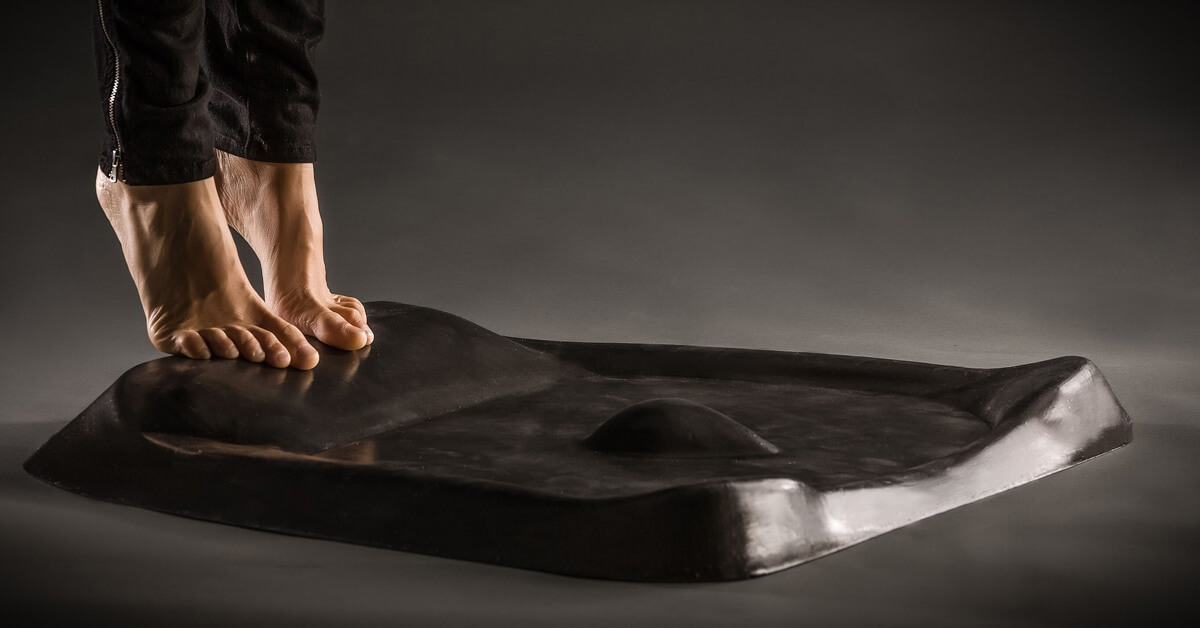
Take Your Standing Desk to the Next Level with the Topo Mat – REVIEW


About Episode
If you’re looking for an in-depth review of the Topo Mat, this is not a point-by-point breakdown of how this product works and is built. Instead I want to tell you the story behind how it was invested and how it can help you as a creative professional to become more active, energetic, and focused if you spend long hours at a standing desk.
The standing desk revolution is upon us, but the number one complaint I hear from those who convert is that the transition is painful, and standing for long periods of time can get uncomfortable very quickly. After years of searching for a solution for myself, I have finally solved these problems thanks to the Topo Mat. This is the best anti-fatigue mat I’ve ever used. It’s literally like a playground for your feet!
In this bonus podcast episode I have re-released my in-depth conversation with Kit Perkins and Ryan Feeley, the designers of the Topo mat and the CEO and CTO, respectively, of ErgoDriven. We talk about the inspiration for creating the Topo mat, why it isn’t just another anti-fatigue mat, and how it promotes more activity throughout the day (and alleviates the pains associated with chronic standing).
Note: This interview was originally recorded right after I first tested my Topo Mat (and you’ll see very quickly that I didn’t even know how to properly pronounce it yet!).
Episode Highlights
- Kit and Ryan’s respective backgrounds as engineers
- Your body as a machine
- On their passion for changing the standing workstation
- Where did Topo originally come from?
- Why a standing workstation should promote movement but usually doesn’t (unless you know how to do it correctly)
- The research phase and how the product was designed
- Standing can cause just as many health problems as sitting
- Movement is essential!
- The prototype phase and how the Topo mat came to be
- Testing Topo on the masses (video: Flat mat vs. Topo)
- How the design of Topo keeps you moving and helps promote good posture
- The issues with standard anti-fatigue mats
- The half-sphere in the middle…what the heck is it and what do you do with it?
- The texture of the mat and what they are improving in the future
- How we started sitting so much and what it is doing to our health
- You need a good sitting to standing transition plan (Here’s a great place to start)
- How do I start using Topo? Stand on it and see what happens next…you’ll be hooked!
Useful Links
- Learn more about the ‘Move Yourself’ program
- Purchase your Topo Mat
- Leave a review of the ‘Optimize Yourself’ podcast to WIN a Topo Mat
- QuittingSitting.com
- Vascular Hemodynamics for Dummies
- The Standing Desk Calculator
- The Topo Blog
- Move Your DNA by Katy Bowman
- How Is Sitting Bad For You?
- building a healthy workstation
About Guest
Kit Perkins | CEO
Kit is a mechanical engineer by degree, and a self-taught entrepreneur, growth hacker, and web developer. With a strong interest in human design and its implications to guide his thirst for knowledge and get-stuff-done mentality, Kit is determined to make the world a healthier, more productive place for everyone.
Ryan Feeley | CTO
Ryan has a PhD in Mechanical Engineering from UC Berkeley. As a brilliant engineer and burgeoning scientist, Ryan leads product development and validation. On the weekends, you can find him sprinting barefoot and shirtless in his local parks, with myriad home-brew sensors quantifying his body.
Transcript
Zack Arnold: So I’m here today with Kit Perkins and Ryan Feely, and these guys are the brain children behind the product that I’m literally standing on right now, which is my brand new anti-fatigue mat called the Topo Mat. So welcome, guys. I’m really really excited to. You on the show.
Ryan Feeley: Thanks, Zack. I am also standing on a topo mat right now, though mine is not quite brand new. A few mechanical testing samples have been removed from various locations, so I’m a little jealous of you right now.
Zack Arnold: Yeah. So mine is literally brand spanking new. I’ve probably had it for no more than two weeks. And for those that don’t know, I will have a picture in the show notes, I have a link to the site in the show notes. I actually have a special link for Fitness and Post users, which is just fitnessandpost.com/topo-t-o-p-o, where you can learn everything about it. But this is kind of like an anti-fatigue mat on steroids. I really want to talk about kind of the genesis of it, where the idea for this came from, because it’s not just another mat. Because a question that I get from people a lot is they say, “Hey, I’ve decided I’m going to take your lead, and I want to stand all day long. What should I stand on? And I’ll first say, “Well, standing all day really isn’t the answer either. And we’ll go into some of that a little bit later. But I say an anti-fatigue mat is kind of an anti-fatigue mat. It’s just something cushy that’s under your feet and it’s flat and it’s easier than standing on concrete or a hard surface. But I’ve never found something that I really liked. And then I found this product and it’s like the skies opened up and the angels started singing. So I’ve been recommending this to anybody that asks. So what I want to start with is just understanding the background that you two have, because I’m really a geek in personal development and learning about how the body works and biomechanics. But I have no formal training, but you guys do. So I want to kind of go back a little bit. Just tell me a little bit about yourselves. What kind of formal background you have in either engineering or biomechanics, and then where the idea for this product came from
Kit Perkins: Yeah. So in terms of formal training, we’re both mechanical engineers by degree. Ryan took that all the way through to a PhD, so he’s got me beat there big time. But yeah, so that’s you know that’s that’s sort of where our system started. You know, viewing the body as a machine more than a lot of other people do. I think first through diet. You know, I sort of fell into the the paleosphere a little bit dragged Ryan along down with me there, and so the combination of those two things, you know, there’s lots of really interesting biomechanics insights you can draw from, you know, the combination of thinking of your body as as a machine or a mechanism, plus you know, sort of viewed through the lens of you know what are we evolved to do? What environments did we evolve in?
Ryan Feeley: Yeah, like Kit said, I did take my studies in mechanical engineering all the way through to the PhD level, and actually specialized in what is known as sort of control and dynamic systems, which sounds somewhat manipulative. And if you’re flying around an Air Force plane or trying to shoot a missile out of the sky, I suppose it is. But what my big takeaway from that was just to look at systems as dynamic, always changing, and really systems. Pay attention to inputs, pay attention to outputs, and then really zero in on what’s going on between those. And I think you know, Kit’s right. Looking at the body as a machine, and especially a machine that we can influence through our decisions, our choices, and our you know inputs through food, exercise, whatnot, really as a sort of reinforce my my view of what we’re doing here.
Zack Arnold: Well, one of the reasons that I wanted to really bring you guys on is that I’m a big believer in smaller companies that are really trying to change the world and make a difference. And if Office Max had suddenly come out with this brand new anti-fatigue mat. Then, like, oh wow, this is working so much better. I wouldn’t have some guy from Office Max on my podcast because they’re just trying to make a buck on a new product. But you guys, one thing that I really gravitated towards is that in the bio of your website, it basically said that you guys will sit around a campfire and geek out on biomechanics for hours, and that’s when I said these are guys that I want to talk to because that’s exactly the way that I am geeking out about all the different things that I talk about on the show and with colleagues. So, just tell me a little bit about where the passion came from and what the instigator was to say we can do this better, and here’s our idea.
Kit Perkins: Yeah. So, in in general, I think the passion came from mostly from that paleo angle. You know, for me, it was just totally eye-opening for the first time to really to start thinking about what am I meant to do instead of you know what is my body meant to do instead of just you know doing what I’ve always done or what I see everyone else doing. So that was a big sort of paradigm shift for me that got me really excited. In terms of the specific idea of topo, both Ryan and I really enjoy cliff jumping. That’s a fun way to use your body to its fullest, I think. And Ryan can tell you a little bit about the trip where he came up with the idea for the first time.
Ryan Feeley: Yeah, so it was actually on a camping trip with a handful of friends over Labor Day weekend two years ago at a place south of San Jose in California called Ario Seco, which basically means dry, which is there. There was water, and as Kit said, we were cliff jumping there. But yeah, it was an interesting weekend. I actually had just left my previous job. Kit and I were both working together, and this was. Last-minute trip, we’d planned it very, very much at the last minute. So they decided to send the guy who just quit his job out on a Wednesday to secure the campsite of one of the two first-come, first-served sites. So I had spent probably 72 hours alone with my pickup truck prior to this inspiration. So it was definitely one of those inspired by nature, and actually had a friend with us who had the the five fingered shoes, and I had just converted to a standing desk. Was just watching him sort of move over the train, climb over the rocks with those you know barefoot shoes, and I really said, you know, the standing desk is fun, but that’s not a that’s not really solving the fundamental issue here, which is getting the environment and getting the human being to align, you know, much better.
Zack Arnold: It’s funny that you bring up the five finger vibrams because guess what I’m wearing standing on my topo mat? I’m wearing five finger vibrams. I mean that that’s what I wear all day every day now because of all the issues I’ve had chronically standing, which gives you just as many issues as you have chronically sitting, and that was one of the the inspirations that I had was trying to find a way to just have more natural movement the way that my body was designed. So that’s a little little tangential, but I wanted to make sure I noted that I’m actually wearing a pair of those right now, and people make fun of me for them all the time. So carry on.
Kit Perkins: Nice. Well, yeah. So I can tell you around our workspace, both Ryan and I are barefoot pretty much 100% of the time. We certainly don’t make fun of each other for it, but we have actually when we were shooting a promo video for Topa, we had some footage of Ryan barefoot. You know, we sent it to a bunch of people to review the footage, give us feedback. You know, before the pre-order campaign, and the overwhelming feedback was that Ryan’s feet were kind of off-putting. So maybe we should have invested in some Vibram five-finger shoes for that video. Yeah,
Ryan Feeley: When we shoot the video for the next product, we can definitely cover up this birthday suit of five toes on my end at least.
Kit Perkins: I don’t want to speak for Ryan too much, but I think the the big insight there is right, especially that immediate juxtaposition of we had been working a lot, had been in the office a ton, and you know sort of the the best most natural thing we were doing was working at standing desks, and then you know just right away out in nature, Ryan sees joints ambulating, full range of motion. You know, applying force in all sorts of different directions, changing with your balance on the fly. You know, jumping rock to rock, and it was just-it’s just such a strong juxtaposition that it’s so obvious to say, “Well, wait a minute, why is everything flat in the office? And so he, you know, came to me with that idea and said, “I feel like a standing desk shouldn’t be flat. I feel like a standing desk should be driving movement, and that’s probably going to result in in you being healthier. So the next step was head to the research, you know, see what the literature says about that. Which, you know, as your intuition would would probably guess the research is you know is is pretty strong that movement is a very good thing absolutely and that you know exploring your ranges of motion is a very good thing and especially getting that calf pump for blood flow at a standing desk is is really really important. It’s also more fun. It’s definitely more fun.
Zack Arnold: Yeah, I can definitely attest to that. Like even now, just as you guys are talking, I’m going back and forth and move my feet around. And the best, most scientific explanation I give people is I say, “Well, I’m more fidgety when I have the mat, which seems odd, but it’s I know that that is your goal. You want me to fidget more and move around more. My journey, and I’ve talked about this on the show before, is that I decided to go to a standing workstation about eight years ago, and I went full on, jumped right into it, and thought, okay, well, I’m standing now, so I’m healthy. I’m not sitting anymore, so all is good. And then all of a sudden, I started having all these new health issues that were just like the the problems were moving; they were migrating. Used to be all lower back and you know tension in the hips, and now it was I was having issues in the shins, issues with my calves, a lot of issues with the arches in my feet. So I started going to podiatrists, trying to figure out what was going on, and I realized that I couldn’t be standing all day the way that I was sitting all day, and that’s when I got a height adjustable workstation and started sitting and standing and moving back and forth. And I’ve since migrated to having a treadmill workstation, but even that is not the answer because it’s still the same repetitive motion, creating the same loads on your body throughout the day, which is one of the really cool things about this topo mat is that you just kind of move around all day long in these different positions, and it is varying terrain, and it’s not like this giant rock or something. It’s still a fairly flat mat, but it has different levels on it. So talk a little bit about the research phase and how you guys actually came to design the product as it is today.
Kit Perkins: Yeah, so that it definitely went. In stages for us. So, as engineers, we’re big on what we call, or what engineers call, first principles. Which early on in that process, you want to define the problem really clearly. So it was really important for us to say, okay, well, so if the default is sitting, what are the problems there? And if the you know sort of first solution that’s exercised is standing. What are the problems there? So starting with sitting, you know, I’m sure you’ve seen all these articles. I’m sure the listeners have seen all these articles about you know sitting is the new smoking, right? Sitting causes contributes to you know sooner like overall mortality, right? Shortens your life essentially. So we you know, we wanted to learn a little bit about why there. We can, I think, probably we should dive into that one separately. But, but we’re, you know, we are able to more or less confirm sitting is a bad thing. You know, you know, sitting all day long not a good idea. And then, so that if the first pass solution is standing, what’s wrong there? Because we had definitely talked to plenty of people who weren’t really happy with that solution, you know, sort of similar stories to yours, and so looking into the research there, we found some health problems actually increased with standing, especially really, really stationary standers like cashiers or car dealers at casinos. You see stuff in the literature about deep vein thrombosis-it’s a common one with blood pooling issues in your calves-and that that blood pooling ended up being a big deal. And actually, it’s part of a series we contributed to on quitting sitting, which we can put links in the show notes. But we have vascular hemodynamics for dummies, and how is sitting bad for you? And that covers some of the some of the new stuff we found in the research phase, and actually a hypothesis of our own, which is that what’s really bad about sitting, you know, what really causes an increase in heart disease risk and cancer risk and obesity and and you know diabetes, all those really serious issues, actually originates from a blood flow issue, and that standing still has the same blood flow issue. So for us, it was really important to say, how do we address that blood flow issue? And the way to address it is movement. And so we we set out to make you move. And actually, early in the process, our first at first we thought we had to move the floor to make you move. So Ryan can tell you about our our first couple prototypes there.
Ryan Feeley: Yeah, so we did. We we moved the floor. I guess that’s the first thing mechanical engineers are going to do when they say the problem is everyone’s standing too still. So yeah, we we made a couple different prototypes. This is definitely two guys in the startup prototype. So we’re talking yeah PVC pipe, plywood motors from from eBay that were you know from the last decade technology or whatever. But we did actually come up with a few different variations on moving the floor. Realized it was very important to actuate the legs independently, and I think that was that was part of the blood flow issue and engaging sort of the calf pump that we sort of just discovered empirically, which was that the independent motion of the limbs is very very important with respect to kind of you know increasing motion in the joints. The prototypes are probably still around on the web if someone looks very very hard, but we’re a little embarrassed about all of them right now.
Kit Perkins: Actually, if you if you want to see them, you can go to topo blog all one word.ergodriven.com That that’s actually they’re kind of fun to look at. That the latest, the last, most recent prototype used a windshield wiper motor to actuate your feet independently.
Zack Arnold: Wow! I want one of those prototypes. That sounds like fun.
Kit Perkins: Yeah, it sounds like fun, but it’s nowhere near as cool as Topo. Just having these features on the ground, the calculated terrain features, engages your brain and actually causes you to move more without even thinking about it, which is awesome because you know when you’re actuating with motors and you need linkages and hinges, the motion is really constrained, right? Because every degree of freedom you add adds a ton more cost to the product, and you know obviously we don’t want to be we we want the solution to be accessible, right? And we want we want this under every desk. And if you’re selling some machinery for $1,000 that’s never going to happen. So what I really like about static solution like Topo is that you can have all this awesome geometry, you know, all these curves and contours that really explore your range of motion, without having to worry about motors that run in each dimension and stuff. And as you can see, I mean, you were attesting to the fact that you fidget like crazy on topo, and that’s right. I mean, you get all the movement that we were originally hoping for, and actually more without having any motors in there. It’s actually a much nicer experience. Yeah,
Ryan Feeley: Yeah, certainly. The body already has all those mechanical degrees of freedom in it. You just have to sort of give give you a place to put your limbs, and it’ll do itself. Right.
Zack Arnold: So then, what was the aha moment where you suddenly realized, well, duh, we just need to do this, that, and the other thing. And how did you get from there to the point that you now have this product that was on Kickstarter and is now available publicly?
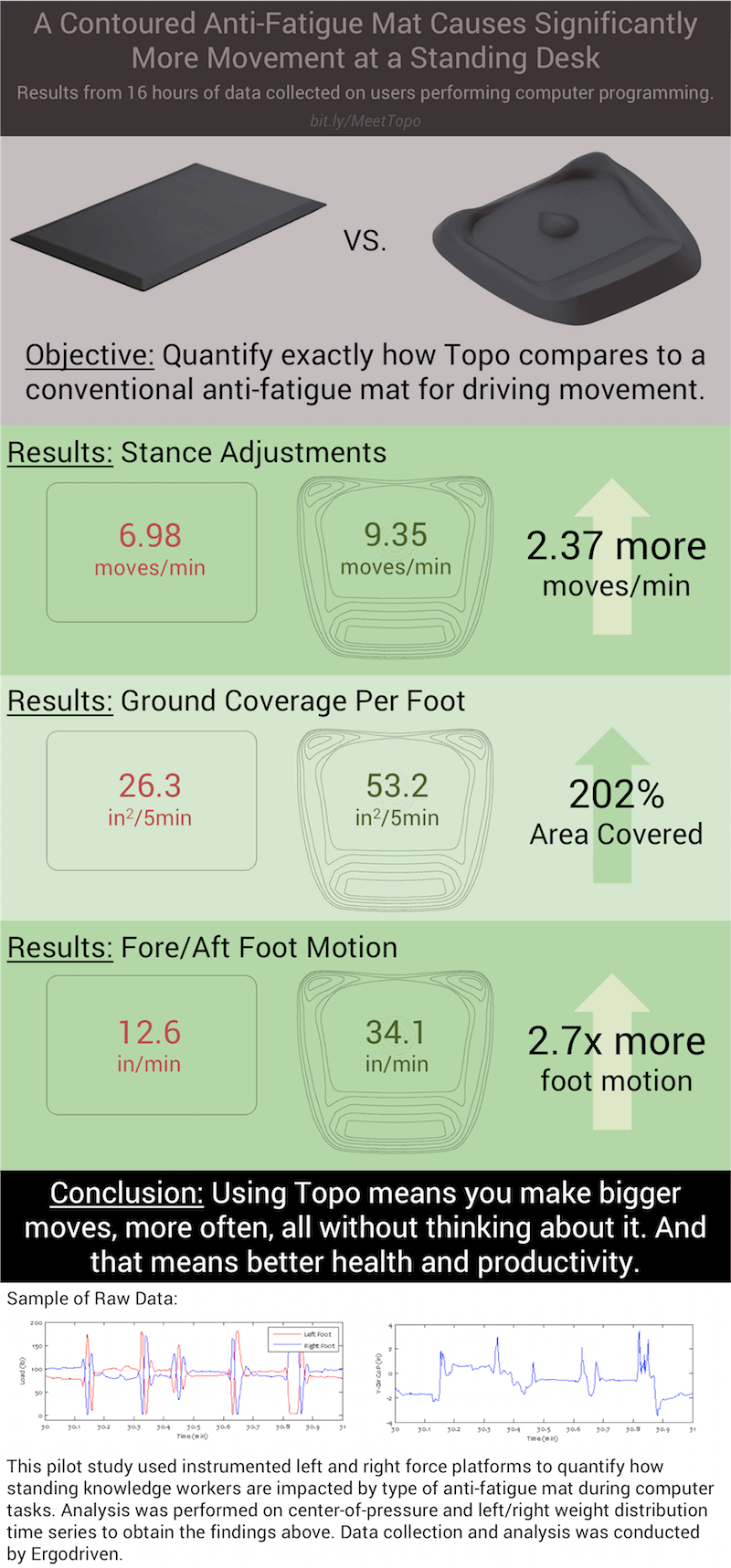
Kit Perkins: Yeah. So, so. We’re having issues with how can we get the cost down so you know this product’s accessible. How can we get more degrees of freedom in there? Everything. Finally, we said, oh, you know what? We don’t even need motors. We’ll just we’ll just put all the features there that we would want you to have, and then we’ll put a little like vibrating motor in there that just vibrates. You know, it’ll sense when you don’t move very much, and if you don’t move for too long, it’ll vibrate and remind you to move. And so we were in the process of building that, and we made these mats that were you know looked similar to Topo, and started testing them without the vibration motor, you know as a first step, and we just moved like crazy on them. And so we said, oh wow, we don’t even need to bother you and distract you with a vibration motor because you’re already jumping all over this thing, and actually you can see as part of our testing there we instrumented the floor under topo and under a flat mat and tracked how much standards moved on topo and on a flat mat, and we actually have a video of that online if you’re interested. It’s bitly b i t.ly/v i s o t o p o vizotopo
Zack Arnold: Awesome I’ll definitely put a link to that in the show notes
Ryan Feeley: Yeah great but yeah as good describe it’s basically just a data visualization exercise where we instrumented the floor underneath the flat mat and with various sensors we could figure out exactly where people were standing what their weight distribution was, how often they moved around, et cetera, et cetera, and we did the same thing for Topo, and the results were really, really compelling. We’d already felt it, but you know, I guess we we wanted to have that empirical validation, and it definitely came through for us.
Zack Arnold: So, what is it then? Because it sounds like you guys certainly know what you’re talking about. You’ve done extensive research and testing, what is it about the mat that makes people move more? Because I know that when I was at a standing workstation, I would just be in the same position for I don’t know how long, maybe 2030, minutes at a time, and you’re just not conscious of it because you’re staring at a screen, you’re expending all of your energy on your creative task, and you’re not thinking about your body, but then all of a sudden I’ll realize I’m standing on one foot, my hip is jutted out to the side, I’m really crooked, like any chiropractor or anybody that you know knows something about posture would literally cringe looking at the way I’m standing, and that’s very very common for people that stand. So what is it specifically about the design of this mat that makes me fidget and makes me not get in these horrible positions.
Ryan Feeley: So I think there are probably two aspects to that. One is just the conventional anti-fatigue mat aspects of Topo already, which is that the the surface is somewhat deformable. It doesn’t have like that sort of self-centering effect that hard ground would would have that just sort of tends to lock you in place. So there’s a little bit of a sort of not really instability, but flexibility in the interface with your feet in the ground on topo, which that already creates that sort of motivation to maybe assume a different posture. But then beyond that, you’ve got that second level effect where your next step is sort of more interesting than the last one because it’s new, it’s a new position. Your joints are in a different place. The blood flow is better, and that process just becomes sort of self-reinforcing. It becomes almost a habit, really, where you have this anti-fatigue mat. It causes you to move a little bit more, but then you have these these features that are available to really you know take that process to the next level. And you know, at a certain point, that just becomes sort of a self-reinforcing behavior. The body craves movement. You give children a playground, and they will play. And you you see the same phenomenon under your feet at the on the topo mat. Yeah,
Zack Arnold: Literally the whole time that we’ve been having this podcast, just I’m rocking back and forth and stretching out my calves, and I’ve I don’t usually do that. It’s not like it’s a habit that I’ve always had. I actually am not. I don’t like recording podcasts from, I guess, a health perspective because it’s one of the few times where I’m standing, but I feel like I’m in a fixed position because I can’t move up and down. A lot of times I’ll do stretching or whatnot, but when I’m recording a podcast, I’m kind of stuck there in front of the mic. But now that I have this mat, I’m just moving around a whole lot more, which is giving me more of that circulation, and I just don’t feel stuck. So I can attest to everything you’re saying. I just have no idea why, but I’m really glad that I’m now understanding why. Because the more people ask me about it, I can now give them more informed answers. So it makes a lot of sense now that you explain it to me.
Kit Perkins: Nice, yeah, and actually, you know, I can speak to Ryan’s sort of habit discussion there too, because I I’ve been using you know variations of Topo for quite a while now, and that habit has definitely like I can’t stand still anywhere anymore when I’m not even you know not Topo. I’ll be at a party with friends or something and find myself you know, my feet exploring weird stuff around the corners of the room and everything lunges randomly, stuff like that. It definitely does get sort of, you know, rewires your brain a little bit back to a much more natural state. I think
Zack Arnold: Right, and that’s kind of where I wanted to go to next a little bit. One thing I wanted to hit first, because I really want to go a little bit deeper into this. Of paleo movement because anytime somebody hears paleo, they think, “Oh, well, you’re eating sticks of butter and steak for breakfast every morning, and there’s so much more to it than that. So I wanted to go into that, but the the last thing I wanted to hit was going back to some of the testing that you had done on traditional mats because a question that I get a lot is, “What’s the best mat? And people’s rationale is always, what’s the softest mat? What’s the one that causes the least amount of pain to my feet and my legs? And I think the thing to really emphasize is there’s no such thing if you’re not moving, because the only way that you’re going to alleviate those pains and those aches is by not chronically being in the same position, and it sounds like your mat does that. But did you find, did you test a lot of different mats, or did you just find that no matter if it was soft, hard, whatever, if it was flat, that was kind of the decisive factor that was causing movement or lack thereof?
Ryan Feeley: So we actually did. We tested a variety of mats, and we looked through the research, this is a fairly well-studied problem. You know how because we do have workers and occupations that do require them to stand. The research really steers away from from soft mats. It’s kind of like they find even in seating. If you look at some of the ergonomics research in seating, where sort of that initial comfort, like I sit in and I go ah, is generally a red herring with respect to sort of long-term comfort. It creates when the mat’s too soft. It basically distributes the pressure so much that it puts pressure on parts of the body that are just not normally load bearing. So that creates a feeling of discomfort. At a certain point, with soft mats, they also tend to just bottom out. So a person sort of they place their foot, you know, perhaps barefoot or shot, and they have this sense that the ground is squishy. But at the end of the day, they compressed it down to where they’re locked in the place, you know, just to the point that they would be if there was no mat there at all. We looked, you know, across the research, did our own testing, and basically did various prototypes with different firmnesses and different stiffnesses, and really reinforced what we found in the literature, which was that soft isn’t always the way to go. And we actually went too hard, we went too soft, we we moved all around, and with various sort of mechanical testing machines, were able to quantify exactly what we wanted topo to be. And at the production level, we’ve been able to achieve that. We’ve been really happy.
Kit Perkins: Yeah, and that you know, hitting that sort of ideal mat feel, right, can work in any form factor. You can make a flat mat with that ideal feel, and what that delivers is it delivers on this sort of micro movements idea, right? The mat’s supportive enough, still puts you unstable enough that you your body’s correcting with these micro movements. What we deliver well and and above a perfect flat mat, you know that’s that’s the ideal flat mat is really delivering these micro movements. But Topo gives you these macro movements too, right? You know it has just by virtue of not being flat has features that allow you to to really hit your full range of motion on your joints, and it has and your tissues, right? And having those features, as we discussed with this sort of playground habit, you know, actually encourages you to move more. It drives you to move more.
Zack Arnold: Well, one thing that I find that I’ve been doing for the last 25 minutes now is either doing calf stretches, where I can use the little lip on the back of it. I don’t know if there’s a more formal term for it, but just kind of that that ridge that makes up the back of it. I’ll do calf stretches where my feet are flexed and I’m kind of standing forwards, and now I’m flexing my toes on the little front ridge that you have. Those are things I never used to do before, and you guys were talking. I’m like, oh look, I’m stretching my toes out right now. Didn’t even realize it.
Ryan Feeley: Right? Yeah, certainly. In fact, we even made a small adjustment to those front corners between the first and second mold to make it a little easier to sort of wrap your toes around those areas and do that sort of thing. So, yeah, this is definitely an over-engineered product in the sense that we obsess over every detail. But I think we’re we’re really happy with the result that we came up with.
Kit Perkins: I love those front corners too. For me, I find that they’re just now they’re just perfect for me to just wrap my toes around. It’s really fun.
Zack Arnold: So the question that I have for you now, which is will sound very random, but it really isn’t. This is a question that my assistant brought up today because she used it today for the first time, and I wanted to see what her reaction was before our call. And she’s like, “So what’s with the bubble in the middle? What am I supposed to do with that? Is that like a button or something? So talk to me about the little ridge with a little kind of half sphere in the middle.
Kit Perkins: Yeah, so we we normally call that the teardrop. I really like that it sort of conforms to my arch. So if I put one foot on it, I feel like it you know sort of supports through the whole arch there. Support’s probably the wrong word. I enjoy sort of massaging my feet a little bit with topo, and I like that I can hit my hit my arch sort of uniformly there. And I like that it breaks up the this big flat neutral area, so it makes sure you can’t end up stuck there and just shuffling around a little bit and avoiding the good parts.
Ryan Feeley: Yeah, certainly. Yeah, if you we we call the flat. The sort of neutral area, and by breaking that up with that ridge in the center, if you do sort of assume a fairly static posture, you quickly will sort of bump into that, and your subconscious mind is reminded, oh yeah, there there are better ways to do this. And another thing that I like to do there is basically just put the forefoot of one foot there, and just really you know roll an ankle around and that sort of thing. So we had sort of various, you know, you you called them fidgets, and we’ve used the same word. Sort of, we call them healthy fidgets that we sort of wanted to encourage. So we basically said, okay, this is a good motion. How can we work that into the geometry? Oh, this is a good motion. How can we work that into the geometry? So yeah, it was it was inspired by the arch of the foot and the idea that we would be able to to roll the ankle around, give people sort of full range of motion there, and then also just break up that that neutral surface. It’s hard to say flat is bad if you have two square feet of flat right in the center of your mat.
Kit Perkins: Right, right. I mean, a lot of your your lower body range ranges of motion at different joints are right are circular in X Y. So it makes sense to have a you know circular ish feature to facilitate those movements.
Zack Arnold: Yeah, and one thing that I like about it too-that’s I’ve kind of adapted it a little bit-is I like that this will sound odd, but it’s almost kind of like it’s like a shallow pool where it has borders all the way around. Which means that what I’ve done is I now have a lacrosse ball sitting inside of that border, and I will just roll my bare feet on top of the lacrosse ball. So if I want to really go to the next level with a ridge or something that’s harder to really kind of dig into the deeper tissues in the foot, I have the lacrosse ball, but I couldn’t do that because it would always roll away. And now I have this nice little neat border where the lacrosse ball doesn’t roll away anymore, and it just sits inside the mat. And I love being able to do that.
Kit Perkins: Nice. Yeah, we’ve heard from some customers that they use sand or gravel or even river rocks in that area too, and that they like that it sort of fences it in.
Ryan Feeley: Yeah, I actually have some river rocks. They’re not on my topo right now. They’re just in front of it. I moved to the side for this call, but yeah, I have a few just like you know just round pebble river rocks that I that I play with on mine personally, and yeah, that that does just sort of fence them in. It serves as a little boundary. I’m not certain our warranty covers you using sand and gravel and things on the topo mat, but I can attest to no ill effects from river rocks thus far.
Zack Arnold: Well, it’s funny that you brought that up because that literally was going to be my next question: was have you guys experimented with different textures? Because I know that one of the things that’s really emphasized with the paleo idea of movement for the body is not being on flat surfaces. I’m a big fan of Katie Bowman and the work that she’s done. She has a book that I recommend everybody read that I’ll link to. It’s called Move Your DNA, and it talks about how our bodies were not designed to have cushion under our feet and walk on flat surfaces all day long. So I was wondering if you guys had experimented with doing you know thicker textures or rougher textures just to enable that. But at the end of the day, like one thing I’ve thought about doing is going out and getting some rocks and just putting them inside that border. And it sounds like I’m not crazy for thinking that.
Kit Perkins: Yeah, I don’t think you’re crazy either. So we’ve definitely we’ve talked a lot about textures. We’ve played around with a lot of different textured things. I’ve found for me that it sort of has like a novelty to it. You know, in in every connotation, right? That right away it’s like, oh, that’s really fun. But if it’s the same texture for a long time, it gets old, and it’s you know ends up sort of feeling kind of gimmicky. So we’re sort of ideating around you know like a supplement to topo, a clean supplement to topo that would be you know sort of removable. So you could do so it wouldn’t feel gim you know if it does start to feel gimmicky, you can take it off for a few days.
Ryan Feeley: One of the updates we had was you know basically to do like a river rock type of thing, but maybe embedded in a sheet, and that sheet would just drop into that neutral area, you know, fit with the features perfectly or whatever. So you might be able to like sort of put in a hard surface, you know, that we’ve done all the right testing on, so we’re not going to you know destroy the surface or whatever with a you know gravel from the backyard, but be able to drop that in as a sort of alternate texture, and then those features would, of course, fence it in. I don’t think that’s something a person’s gonna, especially someone who’s sort of new to the standing desk ideas and new to some of these movement practices, is gonna jump on. Oh, this anti-fatigue mat that’s covered in rocks? Are you kidding me? So you know, we got we we we want to meet people where they are, but we also want to push the boundaries.
Zack Arnold: Yeah, of course, and it sounds basically like what you’re talking about is like a keyboard skin, where somebody buys a generic keyboard, but they want a skin that has all the hot keys, but then they want to replace it with another one. Sounds like what you’re talking about is very similar, and I absolutely agree from a business perspective. You’re not going to get a whole bunch of people that have just decided to transition to standing, going. Ooh, I want the river rock texture, and I want the sand texture, and I want the broken glass texture. Like nobody’s going to do that, but I can tell you have one customer right here. I would buy skins for this thing in an instant, and I would love playing with them and experimenting with them. But I know that it’s probably not a high value item yet. But hopefully, in a few. Years once you get people on board, they’re going to be like, “Oh, I want more. I want to try new stuff.
Kit Perkins: Nice, yeah. And we definitely, I mean, we’re all about the you know people who who really care about this stuff and who really you know want to be elite and want to have the elite solution. So we definitely that’s definitely something we’re interested in providing.
Zack Arnold: Yeah. So you guys had this will be transitioning a little bit, but you had mentioned that you’ve done a lot of research into you know the the history of biomechanics and sitting and standing and one thing that I want to break up that you guys can probably expand on more than I can because I don’t have the background that you do, but it’s not like standing is all of a sudden this brand new thing and it’s like oh wait standing is causing health issues the reason that people started sitting all day long is because there are decades of documented research about all of the problems that come with standing all day from the industrial revolution and people being on assembly lines, and there are still people and jobs that they stand all day long. So I really want to emphasize again that standing is not this brand new thing. We were standing as a culture, and it was causing all kinds of health issues, and that’s why we started sitting.
Kit Perkins: Yeah. So I I would argue that sitting is is the new thing certainly. So we you know I think we evolved standing, squatting, laying down, walking, running, jumping, right? But we we certainly didn’t evolve sitting. You don’t find right fossilized chairs in the record. Well, except for thrones. There’s actually a post on quoting sitting about that too. So you had said you know standing is not this new thing. I totally agree with you. You know we evolved standing. Certainly didn’t evolve sitting. Sitting definitely came around you know more in the industrial revolution or the tail end of the agricultural revolution. Sitting was you know, a good temporary solution to the pain and fatigue that we had with the real issue, which was that we were, you know, standing still, being still for large periods of of our lives, of our working lives when we first started working in factories.
Zack Arnold: So we’ve gone through and we’ve talked about the physics and the biomechanics behind the mat and how it works, and that we now have a little bit better idea of why sitting is not necessarily the new smoking, but how really lack of movement is the new smoking, and just standing is not the answer. Now we have this mat, but what I want to talk about now is the next level that you guys provided for this product that I didn’t expect at all, and that’s the quitting sitting site. So explain to me a little bit about how when you get this mat, it’s not just hey, good luck with your standing mat. There’s really more to it that explains to people in great detail. Here’s what you need to do to actually transition your life to more standing and more movement.
Kit Perkins: Yeah. So actually, so quitting sitting was providing that sit stand transition plan before we were providing Topo, but it is absolutely a great complement. So sit stand transition plan from quitting sitting, which is totally free. You can view it online, or I think get a PDF if you join the newsletter there. But you know, as you alluded to earlier, you talked a little bit about your story switching to standing, and there’s definitely a right, a right and a wrong way to transition to standing, and that sit stand transition plan makes sure that you’re doing that the right way. So you know, Topo has been fantastic, gotten lots of people excited about standing for the first time. You know, been that sort of final push, like click with your brain, like okay, that makes sense. I’m going to do that, but you know it’s really important to us to right that you don’t just drop it on the ground and try to stand for 15 hours straight on day one, right? Because you’re going to you’re definitely going to have some issues there with your body so maladapted. Certainly,
Ryan Feeley: Or stop sitting and just start standing even without a mat for 15 hours on end, like you said with your your sort of personal experience. But yeah, the the the site really came about from many many you know stories from people saying yeah I ditched this sitting thing I was having these back problems but you know now my feet hurt and I don’t even know what to do but I got to work because I need a paycheck so you know we really wanted to basically break it down put it in a situation where we could transition people’s bodies you know sort of naturally gradually put the right carrots in front of them, so they would feel feel good about the process, feel good about what they were doing, that they were making good you know good for themselves. We’ve posted regularly with various resources, and you know we encourage people to not start with buying a standing desk. It’s more the you know cardboard box. Anytime YouTube makes you watch an ad, get out of your chair, roll your shoulders out. We basically want to take the you know the 100 calorie snack pack approach. How do you get somebody to eat more Oreos? Well, you tell them it’s just 100 calories. Same same thing for us, right? Okay, you see that YouTube commercial? Just get out of your chair, sit back down. That’s fine. You know you’re going to feel better about yourself at the end of the day. So we really want to bring people in gradually. We don’t want to create you know biomechanical issues down the road, or as part of that process. So we’ve we’ve done our best, and we’re still working on it to put a lot of resources there. And we’ve gotten great feedback from people who’ve who’ve taken us up on that.
Zack Arnold: So I’m really glad that you brought up the idea of the quote-unquote cardboard box theory, because one thing that I’m finding from a lot of people that come to me is they’re saying. Just don’t want to invest 500 or $1,000 in a standing workstation or a height adjustable one. And first of all, that price to be able to transition is ridiculously low compared to where it was just five or 10 years ago. For me to get a height adjustable workstation when I bought one eight years ago was $3,000 and that was cheap. So when people are saying, “Oh God, IKEA has one, but it’s like $350 I don’t know if I want to invest in it. I’m just like, are you crazy? That’s a 10th of the price that I was willing to pay to invest in my health, and I only wish that I had these options available now. But now I have two standing workstations, so I don’t need one anymore. But I love this idea that you’re just saying, just modify the workstation you have to start, because what I find from so many people that don’t take the all-or-nothing approach-that just say, “Well, I’m just going to try it. I’ll get a couple of cardboard boxes, or you know, get some Apple boxes, whatever it is. But people modify their workstation for an afternoon, and they’ll try it, and they’ll say, “Wow, I just I felt so much more engaged, and I wasn’t quite as foggy, and I just you know, I just felt more energetic, but then the flip side of that is the people that say, “I bought a standing workstation. I didn’t even want it adjustable because I never want to sit again, and I’m miserable and I hate it, and I’m never going back. And standing just doesn’t work. So I love that you’ve taken the middle ground approach, which is kind of that easing into it, and that’s why I think the quitting sitting site is so useful because it really gives people a nice, simple baby steps roadmap to transitioning to a more movement-based and standing-based workstation.
Kit Perkins: Yeah, absolutely. And I would, I love cardboard boxes. That was my standing desk for the first year. I would say it can make a big difference if you set it up at at least kind of close to the right dimensions. So we do. We also have a resource ergodriven.com/standing-desk-calculator that you just type in a few measurements from your body, and it spits out exactly how to set up, you know, your cardboard boxes or your desk. It actually gives you free plans for a DIY desk too.
Zack Arnold: Yeah, and that’s great. And the other thing that you have that was like the holy grail to me. Is you have a directory of all the standing desks that are available, which I have not been able to find anywhere, and you guys made it, and it’s free.
Kit Perkins: Yup, yup.
Zack Arnold: So I just I literally when I found this mat and thought, oh, cool, another version of an anti-fatigue mat that maybe will work and maybe won’t, and I got it. I’m like, oh, this is awesome! I love the way this feels. But then I went using your one-page getting started guide and went to the site, and I’m like, holy crap! There’s like a whole buttload of resources, and yes, that is my official word. There’s a buttload of resources to take you so much further than just using a different type of mat under your feet, and really helping you change your mindset and your workstation. And one thing that I’m working on right now that I’ve been public about with my listeners is I’m building an entire program that helps people build more healthy habits into their day and create more movement in their day. Because the flawed mindset that we have in our culture is that movement and exercise are two totally separate things, and we’re thinking to ourselves, “Well, I need to get out and I have to exercise. I have to run for 40-five minutes a day, or I have to go to the gym and do squats and leg lifts, or I have to do P 90x. But then they sit for 10 or 12 hours a day anyway, and it makes absolutely no difference positively for their health because all of the negative detriments that are coming from being sedentary, whether you’re standing or sitting, are still there. So I think that helping people understand that there is a transition to it, and also building in the habits and the systems and the tools. There’s so many different components to it that when people say, “Well, I just I don’t know where to start, like, do I get a standing desk? Do I sit? Do I get a mat? Like, do I get a treadmill? I don’t even know what to do. There’s not one answer. It’s not do this, that, or the other thing. It’s do this entire series of things, and over time, you will see the change happen. And that’s what I’m literally building right now as a course to be able to do that. And I can assure you that both the topo mat and the quitting sitting program are going to be built right into that because to me they’ve now become integral steps in the process.
Kit Perkins: Awesome, yeah, that’s great to hear, and that’s a great thing to be working on. That totally agree. That’s absolutely needed.
Ryan Feeley: Yeah, I love that approach. Just the baby steps, sort of you know habit form from the from the ground level. Start with you know energy, mood, lower stress. You know people. You know nobody. exercises because they want to live forever. They may say they do, but it’s a bad motivator. But if you’re focusing on, you’re going to feel better. You’re going to have more energy. You’re going to be more in control. You’re going to get more out of your work.
Kit Perkins: You’re going to look sexier.
Ryan Feeley: You’re going to look sexier. All right, that’s a good motivator. That’s
Kit Perkins: A big one. That that was the big biggest one for most people.
Zack Arnold: Yeah, and the the science has really proven definitively that if you tell people, well, if you do X, Y, or Z, you’re going to add years to your life, and this or that or the other thing, you’re like, yeah, okay, whatever. But if you tell people tomorrow you’re going to feel better, or in a month you’re going to look sexier, and you’re going to have more dates, or whatever it is, then people start to. And that’s really the immediate feedback you get with this mat. Is it’s not like well, if you use the mat every day for six months, your pain will go away. It’s like if you use the mat for an hour, you’re going to be like, whoa, wait a second, this is kind of fun. I’m moving around more, and my IT band isn’t quite as tight, and hey, my calves are starting to open up a little bit, and it’s really almost instantaneous that the change starts to happen, which is why I’m so excited about having discovered this.
Kit Perkins: Oh yeah, no, it’s especially like early in our beta testing phase. You know, we were driving all over the place trying to get people to test them out at you know companies near us and everything. Whenever we could get in the door, you know, anytime we got somebody standing on one, it was-I mean-you could see within a couple, within a minute. Normally, they’re smiling the whole time they’re talking to you about it. They’re switching up their stance already, you know, just that fast. Which we get that question a lot. You know, what’s the best? You know, I’ve been standing forever. I have all my-you know-all that part handled. You know, how do I start using Topo? Just stand on it. Just you know, does its magic. It’s pretty awesome.
Zack Arnold: Yeah, and that was really one of the cool things for me. And I had the same question that everybody else does: is I open the box up and I looked at it and I said, I don’t know which one is the front, which one is the back. So you show very clearly on the mat which is which, and then the next question is, so how do I use this thing? And basically, your directions are: step one, stand; step two, that’s it. Just stand. Like you’re done. And then all of a sudden, you’re like, “Oh, I get it now! Right? It’s because, like you said, your body-it’s just in your brain-it’s just instinctually wanting to move because our evolution over hundreds of 1000s and millions of years is that we weren’t sedentary. We didn’t sit all day. We didn’t stand all day. We were constantly moving for survival. And it’s only in God, what is it like the last 100 or so years that we’ve been fixed in these tight positions in these small quarters. So really, on a percentage basis, the movement patterns that we have now are so infinitesimally small compared to the way that our bodies have moved for basically all of time.
Ryan Feeley: Oh yeah, and it’s I mean our our bodies literally require movement. Like we we found in some of the older literature that they refer to your calves as your peripheral heart. When you’re standing upright or seated, when gravity is driving blood to your calves, you literally need the action of your calves to get your blood back up to your heart. So it’s you know that movement is absolutely essential to human health. The research would say that the human is not fully adapted yet to the sort of standing posture that we’ve we’ve assumed. A horse can stand on its feet all day, not move, no problem. It has the equipment to handle that. Human being does not. We’re we’re in a transitional phase, and we have been making that transition with the background of motion, activity, energy, et cetera, et cetera. And we can’t just take all that away and expect the roof not to cave in. Right.
Zack Arnold: Well, I don’t. I don’t think I could have capped it off better myself than to say that the human being is meant to move. So I’m probably going to leave it there. I don’t want to take up any more of your time than I need to, but I want to give the audience just a tremendously powerful call to action, which is that if you are sedentary all day long and you’re sitting all day, or if you’re even to the point where you’ve transitioned and you’re standing all day, neither of them are the answer. You need to move more, and I don’t emphatically recommend products that often, but this one will go into my emphatically recommend category. So if you’re listening and you’re thinking, “Oh, wow, this sounds like fun, or “I want to try it out, just go to fitnessandpost.com/topo-t-o-p-o, and all the information will be there. And I just I I would be very surprised if somebody got it and then emailed me and said, “Oh, I can’t believe you recommended this product. Like it’s been such a tremendous difference for me. And I am constantly experimenting, buying things, half of which work, half of which don’t. But the the more that I do it, the smarter I get about knowing what’s going to work and what isn’t upfront. And I remember when you guys had your Kickstarter campaign, saying, “Ooh, this looks like something I would be really interested in, but I found it after the campaign was closed, and I was really angry about it. Like, oh man, I so would have bought one of these in the Kickstarter had I found it in time, but I found it like a month or two after it was over.
Ryan Feeley: Yeah, we have a really totally lenient return policy, which we don’t really get any returns, so haven’t had to use it. But certainly, really want to hear everybody’s feedback and everything too. So absolutely, don’t hesitate to let us know. Write in, tell us how much you love it, everything. Yeah, yeah, we we want you to love it. We don’t want you to buy it and go away. So tell us about it. If you don’t love it, we’re gonna fix it for you. And it it feels great to hear a ringing endorsement like that, it really does. So we’re just, yeah, so thrilled that we could we could make this happen. That we had the backers from the Kickstarter. That we’re able to get the get the ball rolling for us. We feel like we’re in a really good place, and we’re moving on, getting better and better every day.
Zack Arnold: Cool. Well, I’m I’m glad that I could give you guys an hour long free advertisement of me. Jumping up and down and fidgeting and saying how much that I really really love this product and I hope that it inspires other people listening to decide to to make that baby step transition and start to find more movement in their lives. So on that note, I will let you guys have a good evening and go back to designing cool stuff and continuing to fidget.
Kit Perkins: Thanks. Thanks for having us. It was a blast.
Episode Credits
This episode was edited by Curtis Fritsch, and the show notes were prepared and published by Jakin Rintelman. Special thanks to Krystle Penhall and Sarah Furie for helping to spread the love!
The original music in the opening and closing of the show is courtesy of Joe Trapanese (who is quite possibly one of the most talented composers on the face of the planet).