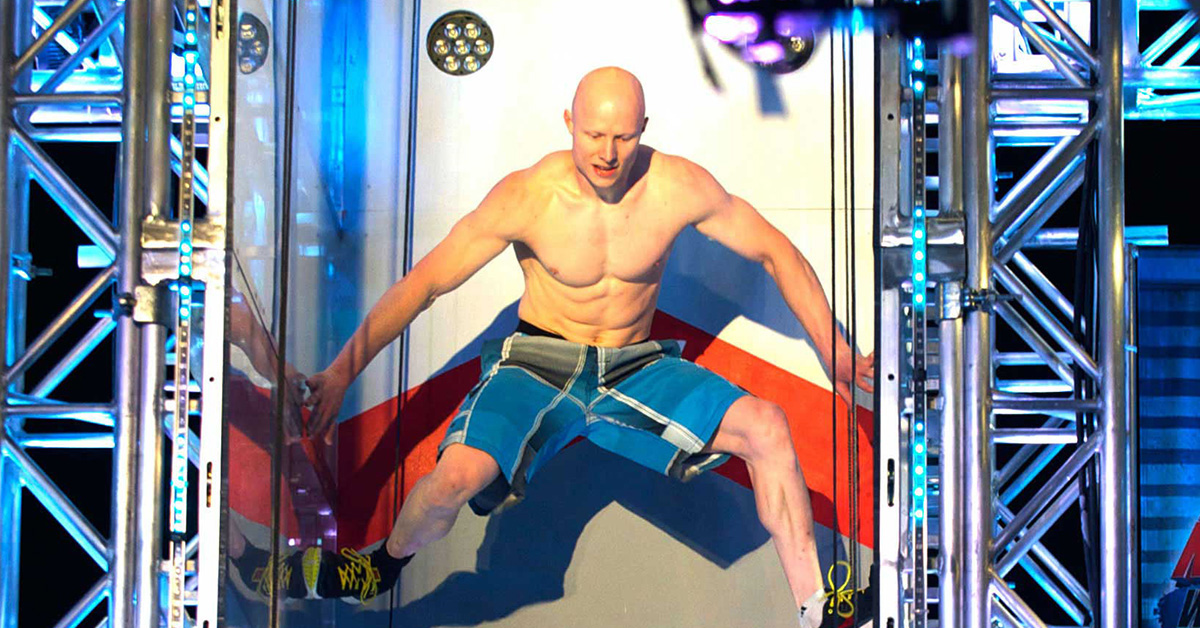
Mastering The Mental Game of Focus | with Kevin Bull, ANW


About Episode
Kevin Bull is an obstacle course racing athlete and an American Ninja Warrior superstar who has appeared on 5 seasons of the show, as well as other competition shows such as Spartan: Ultimate Team Challenge. During the day when he’s not crushing ninja courses he’s the general manager of DojoBoom in Thousand Oaks, CA. And he is also a huge inspiration to the many people involved in CAP, or the Children’s Alopecia Project, an organization that promotes good self esteem in kids who suffer from the hair loss condition that he also shares.
What Kevin is perhaps too humble and shy to include in his biography is that he is an absolute badass that approaches every course and obstacle with zero fear or hesitation. He is most famously known for the upside down flip he made on ‘Cannonball Run’ at the 2014 Venice Finals in his first season as a walk-on.
Despite his ability to move through just about any ninja obstacle with ease, in our conversation today Kevin and I don’t talk much about the physical side of being an American Ninja Warrior (although we do dive a bit into the different types of training he recommends). Where we do dive deep is how to develop the mental game of focus required to be successful, how to attack obstacles progressively one small step at a time, and the reason why it’s so important to choose obstacles in life before they choose you.
Episode Highlights
- The influence and inspiration of Arnold Schwarzenegger on young Kevin and Zack
- Attacking obstacles progressively one small step at a time
- Kevin’s historic ANW Run and how he ended up there
- Learning to seek out challenge in order to improve, “get comfortable being uncomfortable”
- Tackling the mental game of focus, when others are just focused on the physical
- Finding a way to get rid of the ego to get through intense challenges
- Choosing obstacles so that when obstacles choose you, you’re prepared
- Focusing on a variety of different types of training because ANW’s unique variability
- Searching for your first steps to improvement when discipline seems impossible
- Developing habitual mental and physical training in tandem so that they become inseparable
- How Kevin’s experience with Alopecia allowed him to become a more confident person
Useful Links
About Guest
Kevin is an Obstacle Course athlete appearing on multiple television shows, including 5 seasons of American Ninja Warrior.
He also manages DojoBoom in Thousand Oaks, CA and voulenteers with the Childrens Alopeica project to promote good self esteem in kids who suffer from the hair loss condition that he also shares.
Transcript
Zack Arnold: I’m here today with Kevin Bull, who is an American Ninja Warrior, an amazing human being, and an all-around badass. Kevin, I cannot express how excited I am to finally have you on the microphone with me today.
Kevin Bull: Thank you very much. I’m excited to be here.
Zack Arnold: I’ve had the pleasure to meet you a couple of times. You, luckily, unlike most of the ninjas, are very, very local to me. You’re actually one of the closest where I live. You’re in 1000 Oaks, California, and I’m in Woodland Hills, California. So, it’s actually fairly accessible every time I’ve come into your brand new training facility, Dojo Boom. You’ve been very opening, you’ve been very welcome. My kids absolutely love you. They ask about Kevin all the time, so I’m very, very, very appreciative of all that. What I want to do today, first of all, this is probably going to be a surprise, because I know that probably the number one thing that everybody asks you about is Cannonball Alley. Right,
Kevin Bull: That’s true.
Zack Arnold: Everybody wants to talk about Cannonball Alley. What was it like? What was going through your mind? Guess what, I don’t care about that. What I really care about, not that I don’t think it’s amazing for anybody that doesn’t know, by the way, I’m going to put a link to the video of your second run. It was the finals run in your first year as a walk-on, and you, and to this day, even though that was four seasons ago, you still most likely have the most iconic clip in the history of the show, short of maybe Casey Cat and Zara climbing either the wall or getting her finals buzzer, but other than that, you’re probably the hands down winner with what you did on Cannonball Alley. So, I’ll put a link in there.
Kevin Bull: Glad it worked out. Yeah, right. Wasn’t always sure it was going to
Zack Arnold: Exactly, but I know that everybody talks about that. What I’m more interested in is how you became the person that made the decision to do that on Cannonball Alley. So, what I want you to do at this point is just very, very briefly just kind of walk through what happened on that obstacle, so people have some basic understanding of that process, but then I want to dig really deep into your origin story to really understand what forged the person that made this decision.
Kevin Bull: Absolutely, well, the moment of Cannonball Alley was, it was a going for broke moment, for sure. I had wanted to be on the show for a long time, and I had submitted my video application for the first time that year, and it was not accepted. So, I went with some friends, and I walked on to the to the show, and I camped out in front of the course as it was being built for four days, and then I finally got an opportunity to run, made it to finals, and in finals, that’s where I came up against Cannonball Alley, as did my fellow competitors. I spent a lot of time thinking and strategizing about the course, every obstacle, Cannonball Alley, and the others. I tried to come up with different ways in my head of doing them and visualize those ways, and then one of the ways I came up with was the way I ended up using, which was to go inverted by grabbing with my legs and then doing a cherry drop back flip off the obstacle onto the platform, but I did not know for sure. I was doing that until about half an hour before my run, because it sounded like a more risky way of attempting it than some of the other options, until I saw, I believe, it was 15 of my fellow competitors go out trying to grab it with their hands.
Zack Arnold: It was actually 17, it was 17 people in a row up until this point on the show, no obstacle had just been so dominant over all these ninjas and professional athletes, like it was demolishing everybody, and then Kevin Bull, mr. Walk-On, comes along.
Kevin Bull: Thank you. Yeah, okay. 17, but yeah, it was, it was an interesting moment, and like I said, I wasn’t sure, I wasn’t 100% sure it would work, I thought that it would, but even when I, when I first released, after I pulled back and grabbed it with my legs, I didn’t have enough momentum to make it to the platform, so I had to swing back and forth a couple of times to generate in order to make it, so there was a little miscalculation in there, but we got through it, and, and I feel very fortunate that we did.
Zack Arnold: So, how then did you become the person that was willing to take such a daring chance, being the first time you’re on television on this huge brand new, like it wasn’t brand new in and of itself, but really to the world, season six is when American Ninja Warrior kind of had its coming out party. Before that, it was kind of like this underground thing. So this was a big stage for somebody that I, as we’ll talk about, I’m sure you were an athlete, but you weren’t a celebrity, and all of a sudden you’re on this giant stage. I want to know what forged the person that made that decision. So, let’s start at the beginning. So, just go ahead and tell me a little bit about kind of your, your upbringing. Like, is this something you’ve been doing since you were two years old? Like, what are some of the influences that you had growing up that kind of led you down this path of doing these types of things, becoming a decathlete, and all the other active things that you’ve done in your life.
Kevin Bull: Sure. Well, I think early on I grew up in a great area. I grew up in Santa Cruz Mountains in Northern California, so I had access to a lot of wilderness area, lots of trees, lots of varied terrain, and I was, I was spending a lot of time outdoors from a very young age. My dad had grown up in sort of enclosed environments his whole life. He actually was from down in this area, he was from Burbank, where he grew up, and I think, and then he lived in San Jose for a little while, but basically like small backyards and stuff, and what he wanted for his kids was something that was a little bit bigger, a little bit more natural, I guess, and he sort of started urging me in the outdoors, into going on walks through the woods, climbing trees from an early age, and I took to it very quickly, I remember the first time I climbed up something that I didn’t think that I could make. My dad had coached me. He said, you know, you can make it up here, just jump, and I had to jump like as far as I could, and I barely got my hands over the top of this tree, that tree branch, and then was able to scramble my way up, and from there I just kind of kept wanting to push it one step further incrementally over time, but that was, you know, a lot of my, a lot of my youth, and I was given a lot of freedom as well by my parents. There was not a lot of, don’t do that, it’s dangerous. There was, yeah, you can do that as long as you don’t get hurt. So I only got in trouble if I like fell out of a tree, otherwise I was allowed to climb as I, as I wanted.
Zack Arnold: Yeah, I can understand that. As a parent myself, I’m thinking, you know, what I really want to push my kids to do difficult things, but I really don’t want them to break their arm and have to deal with that for six months. So, and I’ve actually been there as well, where my, the time my two and a half year old son had broken his arm the day after my daughter was born. So, that was fun. That was my own little form of dealing with obstacles, which we’re going to talk a lot more about, but one thing that I’ve heard you talk about in past interviews, which I thought was really funny, is one of your kind of like mentors or influencers growing up is exactly the same as what I would consider my number one influence, and we’re almost the same age, I’m a little bit older, I hate to admit it, I am a little bit older. I was basically born and raised by Arnold Schwarzenegger, and I know that you and I have that in common. So, talk a little bit about what it was about him that influenced you growing up.
Kevin Bull: Yeah, that’s a good question. I mean, I, Arnold Schwarzenegger is kind of a fascinating character for many people, and I think it was the roles that he was playing, mostly. I mean, partly I know that Terminator Two was the first R-rated movie I was ever allowed to see, so that had a big impact on me. I was very excited, so I got to see that one, but, like, also the Konaeon movies, like, I love those as a kid, and a lot of the other stuff that he’d done, and he was always playing these like very adventurous roles, his characters were just, they were having adventures all the time, and I think it was that, that adventure that I found so interesting. And then, as a person, too, he’s very focused on, like, he’s very focused on bodybuilding, right, which is a form of sports, and that was his competition. That he took very seriously, and if you listen to some of his interviews, it’s actually kind of incredible how seriously he took it, much more serious than most athletes that I know. But that’s, I think, what it takes to be to be at the top at what you’re trying to do, and he definitely was.
Zack Arnold: Well, it’s funny, another, I didn’t even realize that we had this part in common, but the first R-rated movie that I saw was Terminator
Kevin Bull: Nice,
Zack Arnold: So it wasn’t Terminator two, but once again it shows how I’m just a little bit older, but we had exactly similar paths, similar influences, and one of the things that I love about Schwarzenegger, and he’s a very polarizing figure, not going to get into political discussions, but nobody can deny how hard he works, and how no matter how many people say you can’t do it, you’re not made for this, you’re too big, you’re too muscular, your voice just sounds weird. He was taking things that everybody said was a negative and he said, well, that’s great, I’m just gonna have to be the first one, then I’m gonna have to be the first gigantic body builder that becomes a megastar, the first one with this weird voice, and I think one of the things that’s interesting is that although you don’t quite have the build of Schwarzenegger, you’re kind of like a mini chiseled version of him, perhaps, but I know that you, yeah, a lot smaller, yes, exactly, but I know that you’ve been through a somewhat similar experience when you decided that you wanted to become a decathlete, so talk a little bit about that,
Kevin Bull: Yeah, so decathlon. I loved a lot of different sports growing up. I liked doing all of them. There was no sport that I really didn’t like. I definitely gravitated towards one or another at different times, but starting in middle school, and then definitely through high school, and continuing through college, it was really track and field that ended up being my main focus. That was just where I started to, I think, it was partly, partly just the incremental increases that you would get while you were training, you know. It was always about just bettering yourself, like one step at a time. A lot of the other sporting events, and the games, and things like that, there’s certainly that as a part of doing the sport, but the main focus comes from the team sport games, where you know it’s you and a bunch of other people working together for the same goal, and it’s not quite as clear, like the individual’s progress, I think, as it is in the more individual sports, but then what really set me on track and field was when I finally got to do pole vault in high school, and that became far and away my favorite event, but I still didn’t want to focus on just one. My pole vaulting coach, when I started to do well, was really trying to get me just to do pole vault, and there was a lot of pressure, but I just refused. I would always do the maximum events that were allowed, and I started doing decathlons unofficially, because they’re not allowed to do decathlons in, well, they don’t have competitions, official competitions in high school for the decathlon, but in high school I started doing some unofficial ones that were being run more for fun, and I just knew that I wanted to do that when I went to college, but the Catholics are usually bigger guys, they’re usually fairly, fairly big builds, because a lot of the events, it’s a varied group of events, and about a third of them are throwing events, and a lot of the strategy, because it’s so difficult to train the technique on all those, a lot of the strategy is just to build up a lot of power and mass, and then use that to your advantage when you’re trying to do those, those events, which wasn’t going to work for me. So, I had a lot of coaches try to dissuade me from doing that, but I was, I was pretty dead set that that was what I wanted to do, and I stuck with it,
Zack Arnold: And for somebody that was relatively small, didn’t really have what it took, so to speak, to be a decathlete at the college level. Tell everybody how you ended up doing as a decathlete.
Kevin Bull: Well, at the end of my career, after lots of hard work, I ended up, I was competing in Division Two for the state of California. I ended up winning the state decathlon, as well as the open pole vault that year,
Zack Arnold: And I’m assuming that that’s not, that’s no small feat, even though it may not be Division One nationals. I would think that you probably have some pretty steep competition in the state of California.
Kevin Bull: Yeah, I mean, California is a big state, and it’s, it’s definitely steeper in Division One, but Division Two is still, it’s still tough. There’s a lot of great athletes out there, and I was not leading that competition. I won in the last, in the last three events of that competition. I moved up from, I think, sixth place to first with a combination of good performance in the pole vault and my best run, probably of all time, that I’ve ever done in the 1500
Zack Arnold: What I’m really interested in, and you’ve touched upon it just a little bit, but I want to dig even deeper. Is why you are so drawn to sports in general, but also to difficult sports, and you kind of mentioned this idea a little bit of incremental progress. So, talk to me, because there’s so many different reasons to get into sports, it could be pressure from family, it could be the celebrity. It could be I want to look really good in a tank top. There are a lot of different reasons that people dedicate themselves to sport, so I would love to dig deeper into why you are so drawn to athletics.
Kevin Bull: Sure, well, I think it’s important to one of the most important things in life is to improve yourself as you go along, and that’s been sort of a philosophy that has driven me since the beginning, I think, since I was very young. Athletics is a very important way of doing that, but our average day-to-day life does not physically test us much. Everything is pretty much taken care of for us, and yet we evolved into situations that were much, much more strenuous than the ones that we face today. So, if you want to keep improving, you have to seek out challenges that don’t present themselves directly. If you want to improve physically, and I think that’s why sports have been so important to me, because physical improvement is part of that personal development. You, you really do have to seek out the challenge.
Zack Arnold: Well, one of my favorite kind of sayings or philosophies that I’ve discovered, and it’s something that I had thought about for years myself as well, but I think that where it came out perfectly is the phrase that Flip Rodriguez has on his T-shirt, which is “Get comfortable being uncomfortable, and that just basically sums up everything that I do every single day. Anybody that listens to the show on a regular basis would say, yeah, that sounds about right, because I’m always the guy that people are saying, really, why in the world are you doing that? Why would you put yourself through that? But for me, it’s all about growth, because, like you said, you’re not going to grow as a person unless you challenge yourself, and in first world society today, everything is pretty comfortable, like everybody’s got cable television, and most everybody has air conditioning in a car, and you know, so it’s much harder to really grow and find that true full potential, unless you seek out difficulty.
Kevin Bull: Yeah, and technology keeps making things easier for us, you know. I remember I have this great tradition with a few friends of mine from high school, where we go on a road trip every year, and we’ve kept that up since we graduated. And in the early years of that, we had to navigate using maps, and we had to try to remember street names, and, and it was a mess. Like, sometimes we would make mistakes and we would end up in the wrong place, which never happens anymore, because we have GPS, but at the same time you don’t have to have any special knowledge to use the GPS, and you don’t get a better understanding of where you are in the world using GPS, but studying the map and then seeing it in person gives you a better perspective on on where you are, so not that I’m giving up my GPS, but seeking out those better challenges is an important learning process, I think.
Zack Arnold: Well, that having been said, I think it’s important now to transition to the moment that you realized you have finished being a decathlete, you’re out into the real world, and you’ve discovered this thing called American Ninja Warrior, so talk a little bit about the first time you came in contact with the sport.
Kevin Bull: Sure. Well, I think it was in college, the first time I came in contact with it. It was not as American Ninja Warrior, but as the Japanese show Sasuke, which is where American Ninja Warrior originated. It was on a channel called g4 which is very popular with the college kids. When I was in college, and it was basically a channel about video games, but they started showing these episodes from Sasuke, which was like, like some of those other Japanese shows, game shows you would see where people are running obstacle courses and they’re getting like dunked in the water, and they’re getting hit by stuff and blindsided, which are funny and enjoyable. But there was something else about this one, because there was a real drive from the athletes to improve themselves. It wasn’t just somebody who came in off the street to have a few laughs and get knocked in the water. Those were people that were actively trying very hard not to go in the water, and you were watching them take it very seriously, and I just watching it, you realize this was not a game show, this was a sport you were watching, and it was because of how the competitors approached it. I remember the moment when I started thinking that this was something I could do was when they had two US Olympic gold medalist gymnasts, twins who had come on, and they were competing, and they went through a series of the obstacles, made each one look very easy, and then they came to the warp wall, and they could not make it up the warp wall, neither one of them, both of them failed at that wall, timed out, and couldn’t continue. And I thought, wow, I could make it up that work wall, I could beat those Olympians at something, and that was a moment where I thought, okay, this might be something that you know can appeal. This is a great sport, A and B, it’s something. That I think I can do well at,
Zack Arnold: And that’s one of the coolest things about this sport to me. And it’s funny that you brought up the whole when you know you started watching it when it was the Japanese show Sasuke. It was on the G network several years ago when I was getting really heavy into Spartan race training and doing Tough Mudders and really getting into the obstacle course racing. People would say, “Dude, you should so try out for American Ninja Warrior, and I thought it was like another show, like Wipe Out, you know, the show Wipeout,
Kevin Bull: Yeah
Zack Arnold: It’s like people getting bashed in the face and going in foam pits. I’m like, why in the world would I do that? That sounds so stupid, like that. I want to do something that I can take seriously, and it can really make a difference for me, and it’s challenging. Like, I don’t want to go on some dumb game show, and then a year or two later, when Casey Cat and Zara’s finals run went viral, I said, “Wait a second, isn’t this that Wipeout show? Like, wait, this is completely not what I thought it was. And that was the spark for me, and that was that was a while ago, but that’s kind of where I’d started. But then the seed was planted, it was like, “Wait a second. Anybody can do this, anyone with any other sport. Like, for me, I’m currently 38 years old. I’m much closer to 40 than I am to 30. And I started watching the show, and I said, if I want to be an NBA athlete more than anything in the world, my time has passed. If I want to play football, if that was my dream my whole life, I know for a fact, no matter what I do, that dream can never happen. But then, with American Ninja Warrior, I’m like, hold on a second, this is something that I can do someday, I can’t do it yet, but it’s something that I can approach, because it’s not just professional athletes, it’s not just people that are of a specific age or specific athletic type, anybody does it. I mean, there are people that are 70 plus years old running these courses.
Kevin Bull: That’s true. There are, I think, what what that boils down to is the sport itself. It challenges you in a way that is not predictable. You don’t know what you’re going up against when you get to the course, you don’t know what the course is going to be. You have to train for a variety of skills, so that you have the best toolbox in your possession for approaching whatever course you happen to find, but you’re not training specifically for that one thing, and what that does, unlike other sports, is it? It makes those general skills very valuable, whereas in a lot of other sports you just want a specific build, you want a specific skill set. If you look at people that are the top competitors in track and field, they have very specific body types that are suited perfectly to the event they do, and it’s not well suited for anything else, but they are fantastic at that one thing, and that doesn’t, I think, resonate very well with the average person, because the average person has an average build, but in a situation like Ninja, where you have a variety of things that you’re coming up against, and you’re not sure what those are going to be, and you need a variety of skills, but none of those skills have to be the best in the world. You just have to have a good overall set. That’s something that people of any body type can approach and can train for, and can see success at too.
Zack Arnold: And you see that every single week, where you can have, and for anybody that doesn’t know the show well, or isn’t very familiar with how it works. It’s the exact same course for everybody. It’s not a different course for women, it’s not a different course for men. There aren’t age groups. It’s one course, and you can have somebody that’s six foot five, like John Alexis Jr. run the course, and obviously there are going to be certain obstacles, like the warped wall, where he just kind of has to sneeze, and he’s at the top super easy, but there are other obstacles, because of his size and just his weight. He’s a very skinny guy, but he’s obviously still heavier, because he’s six six, that are going to be very, very difficult. Then the exact same course at the front of the line can be somebody like Casey Catanzaro or Barclay Stockett, who are five foot nothing and 100 pounds soaking wet, they have to do the exact same course, and there are going to be different obstacles that are really easy for them, but also very hard for them. So, it’s impossible to walk in there and just say, like you said, I have this one skill set, or this one build, or this one genetic gift, and that’s going to make me better than everybody else, because you have to know so many different types of skill sets to be able to survive and do well,
Kevin Bull: It’s just about finding it’s about not getting eliminated, right, it’s about not having a weak point that’s weak enough that’s going to get you out exactly,
Zack Arnold: And I think that one of the reasons that I have gravitated to you specifically, aside from the fact that you’re local, but really, the, you know, when I really got into the show, and when I get into anything, and you ask anybody that knows me, I am obsessive about it. I eat, sleep, and breathe that thing, and that’s how I become with American Ninja Warrior, and I started really studying all the top competitors, and you’ve just, for me personally, are right at the very top. Up there, and like the top three for me, and yes, you’re in really good shape, and yes, you do really well on the course, but that kind of stuff doesn’t really impress me. What I’m really impressed by, and what I want to learn more about, is the fact that you are consistent, the fact that you can consistently show up every single year to every single course, and you never just suck, like there could be some athletes that have a really great day, but they’re not suited for it over and over and over, but you just show up, and that has nothing to do – well, not nothing, but I believe it has a lot less to do with the physical and a lot more to do with the mental, and I know that that’s where you spend a lot of your time is the mental game, and that’s where I spend my time. So, let’s talk a little bit more about the mental game of Ninja Warrior.
Kevin Bull: So, the mental game of Ninja Warrior, in my opinion, is the most important part. I’ve seen a lot of fantastic athletes come out to that course and just get eaten up by it, because their mental game was not where it needed to be at the time of competition. On top of that, just like you talked about earlier, when you’re on a course like this, it’s not about just having one physical gift that puts you ahead, it really, it’s about how you take the skills that you have and put them together in a way that get through the course. We definitely have preferred ways of going through most of these obstacles as a group of ninjas, and the more we train, the more similar those techniques get, but you frequently see people deviate from those and try it in a different way that suits their body type better, or their skill set better than the people that came before them, and that can also be very effective. It’s not there’s just one way to do it, so not only having the intelligence to plan your way through the course and the strategy, but also having the ability to mentally put yourself in the proper mindset for attacking that course is very important.
Zack Arnold: Well, and I think one thing that I want to bring up that people most likely are not aware of, and I want to paint the picture a little bit, and you can embellish on this picture a lot more, but when you get on American Ninja Warrior, you’re on this big stage, you’re on television, and your run at most maybe lasts, if you do really well, three to five minutes, right, and it’s one time per year, and what most people probably don’t know as well is you’re not getting paid for this. People think, oh, well, that’s got to be cool. You’re on a TV show and they’re making money. It’s like, no, you’re paying to be there, correct?
Kevin Bull: And a lot of the competitions, yes, if you make it to the Vegas finals, they start to cover travel expenses, but for the regional qualifiers, yeah, you’re you’re paying your own way there,
Zack Arnold: So all these people are paying their own way, and the amount of work required, and I’m now saying this from a lot of firsthand experience, the amount of work required just to be able to stand there and look relatively competent is ridiculous, so it’s not like the NFL season, where you have 16 three hour games to prove yourself, and you can have a bad day. The mental game has to be so much sharper, because you have one span of maybe three to five minutes the entire year to bring your best self. So, how do you get yourself into that level, that deep level of focus to be able to get through a course and not think about, oh my god, this is it, this is my only shot, and I haven’t even run this course.
Kevin Bull: Yeah, that’s a great question, and that is the hardest part, because not only can you not afford to have a bad day, you can’t afford to have a bad moment while you’re on the course, because you will probably be in the water if you do. So, even if you make it through the obstacle you’re on, when you make that mistake, that’s going to usually cause you to fail later when you’ve burned too much energy trying to correct it, or something like that. You have to be able to build a level of focus for yourself, and I think the people that succeed the most are the people who work to eliminate the idea of self entirely from their run. This is particularly important, I think, because of all the cameras that are on you and all the people at home watching. If you try to take that in, if you attempt to like absorb that moment, it’s too much for a person to really absorb. You have to just be able to operate around it. The thing that I do is I start trying to think of myself in terms of the objective that I’m trying to accomplish. I’m not so much Kevin Bull anymore as I am just trying to get to the buzzer, and I know that for other competitors I see them using religion to do a similar thing. I see a lot of people that say, okay, I’m doing this for I’m doing this for God, or I’m doing this for a cause, or I’m doing this for something else, and, and that helps to eliminate the self. I think the people that do that tend to do better, but I think really just thinking of yourself more as a tool to accomplish something, and less of as I’m here for myself to do something. Is what leads you to succeed in the moment,
Zack Arnold: Yeah. And that’s really what has drawn me to this personally, so much, not just as a fan or somebody that watches it, or that obsesses about the show, but when I realized, like you did, wow, this is actually something I can do. And when I first looked at it objectively, I thought, all right, so my grip strength is total crap. I have horrible grip strength. I’m not very fast. I’m probably about 30 pounds overweight. I’m too old. I don’t really have an athletic background. I’ve never done gymnastics. I’ve never climbed. I didn’t even know parkour was until I started watching the show, but the one thing that I have always been amazing at my entire life is the mental game, and developing very deep, intense focus to get through whatever challenge or obstacle was in front of me, and that’s when I said all the rest of it I can do that, as long as I’m patient and I can progress from one small step to the next, just work through all these little tiny micro goals to reach a macro goal that I’m really good at, that I just suck at everything else, but I feel like the hardest thing, like you said, is the mental game, where you can be strong or you can have the genetic gift, but to be able to consistently put in the work over and over and over, that’s the part where most people fail. So, what is it for you specifically that allows you to put in the training every single day, or five days a week, or whatever your regimen looks like? Like, what are the mental tricks, or the rituals, or the systems that you use to make you so consistent?
Kevin Bull: Well, I tie.. I mean, I think I’m not sure exactly when I started doing this, but I definitely tie my workout into my feeling of self-worth for the day, like I think I think that’s a pretty good motivator. I don’t feel good about what happened that day if I didn’t have some time devoted to something athletic. I feel like it’s important for me to do that in order to be happy. I’ve tied those feelings of gratification into the workout itself, and I think that if you can stick with it, I know a lot of people struggle with consistently going to work out, but I think if you can consistently do that for a while, that you start to naturally tie those things together. I’ve just consistently done it for a very long time, so it’s hard to, hard to get rid of.
Zack Arnold: Well, I was just going to say that once you develop a habit, especially a healthy habit, it actually becomes harder to not do that thing than it is to do that thing. But the toughest part, and this is why so many people come to me, I’m, I’ve learned that I’m very, very good at working with beginners that come to something and don’t really understand it, and I’m not really into all the advanced tactics and biohacking and all these other things. What I really love doing is taking somebody that says just everything is so complicated – fitness and nutrition and sleep and all this stuff – I just don’t get it. Just show me where to start. How do I take the first step? That’s where I found that my strength is, is helping people figure out what those first steps are, and it’s easy to say, well, once you do it enough, it’s easy to not.. it’s much easier to exercise, and it is to not exercise, like, yeah, but there, I can’t, like, do it today, right?
Kevin Bull: That’s.. I mean, that’s a great question, and that’s.. that’s actually something that I may not be well suited to answer for you, because it was a very long time ago that I set those habits, and I’ve been pretty consistent with them. After I graduated college, I thought that, you know, my athletic career was done. I thought, okay, well, just nothing left to do in track and field when college is done. There’s a few people that continue on that train for the Olympics, but I was nowhere near that level in any of my events, but for me that didn’t stop my desire to work out and train. I remember I was working construction for a little while, and I would spend all day digging. Actually, we were doing the project that required a lot of digging, so for months I was just digging, and eight hours a day of digging is pretty hard work, but then I would go to the gym after that, because it wasn’t like it wasn’t a workout that was tapping on multiple skills, it was just just the workout that was making me better at digging, and I felt like I needed to do more variety, but that variety might also play into what keeps me interested when it does get tough to go to work out, when it does seem like maybe I don’t feel like doing that this day. Keeping a varied approach has really helped me a lot. I don’t always have a set regimen that I follow. I’m always aggressive with whatever I choose to do for training purposes. I always try to push it to the limit, but I like to mix it up frequently and train different things, and that’s one of the things that makes Ninja so enjoyable, is because it really rewards you for training those different things
Zack Arnold: Well, and like talking about this idea of digging a hole all day long, I think people approach so many things in their life a similar way, where they. Done the same thing for years, and they’ll say, well, I’ve got 15 years experience doing this thing, but you’re not really getting any better, you’re just laterally doing the same thing over and over, which is why, again, going back to the steam where we started, you have to choose things you’re not good at and get better at them, or specifically focus on incremental progress, and whatever it is that you’re doing, like, just because I’ve had a driver’s license for 20 plus years doesn’t mean that I’m ready for NASCAR. Like, I drive every single day, and in Los Angeles, I do a lot of it. It doesn’t mean that I’m getting better at it every single day, because I’m not challenging myself to be a better driver. I just drive. So, for you to specifically say, well, I’ve been digging for eight hours a day. Most people would say, ‘Well, geez, you must be exhausted. You completely deserve to sit on the couch and crack open a beer and have some pizza and watch TV, which I’m sure is what many of your colleagues probably did. But you weren’t looking at it as, ‘Well, I burned a bunch of calories and got a bunch of exercise. You were saying, ‘I didn’t get the right kind of exercise.
Kevin Bull: Yeah, exactly. And it was actually really good exercise. I thought that I was in pretty dark in shape when I was digging and working out, but it wasn’t something that would translate over to other things, right? So that’s been my goal always in terms of working out, is it’s never been about physique. I mean, there’s a lot of different reasons that people bring it into it. Sometimes it’s just general health. It’s never been about that. It’s never been about looking a certain way. It’s always been about what am I getting better at doing, like what skills have am I adding by doing this? What strengths am I adding by doing that? And when you look at it in that way, I think I think it becomes more rewarding.
Zack Arnold: Well, not only does it become more rewarding, it also becomes more realistic, I think, for a lot of people as well, because they’ll look at something like, for example, me saying, “Well, I want to compete on American Ninja Warrior, and I go out my first day at Dojo Boom, and I grab one of the rings, and I fall on my face right into the phone pit, because I don’t even have the grip strength to hold on to one ring, and it’d be easy to say, “Well, geez, I’m never going to be on the show, but looking at the way that you look at things, where it’s a very progressive mindset, it was all right. Well, then that means my next goal, all of my training, is going to be about having the grip strength to hold on to that ring. Okay, now we can hold on to the ring. Can I swing to the next one?
Kevin Bull: That’s a really good description of my first year at Ninja. I like Cannonball Alley was a great run, and it sort of catapulted me to the forefront of the sport, but nothing about that run was grip strength oriented. There was a couple of the Shea bars we did, and that was about it. The rest of it was other things. There was a peg board, but even on the Cannonball Alley, I used my legs to get through that one to waste and grip strength, and then I realized hanging out with some of the other ninjas and training with them that I was really far behind the curve grip strength wise my first year, and I wanted to run with it, so over the next like three month period that I had to prepare between my finals run in LA, and my next run, which would be in Las Vegas. I had a lot of work to do. I went to a competition where somebody had built the floating doors, and I couldn’t hold on to them at all. I just.. it was.. it was like impossible. I put both hands on it, jumped both feet on it, and just slid off without any sort of delay slid right off the thing, and then it was just all grip strength training for months, and I worked really hard, and at the end of that time, though, I was able to get those, get the doors, I was able to lock in and hold on, and it was like night and day difference, and it was, it was amazing to see something that was so impossible a couple of months earlier, and then to just be able to sit comfortably in completing the obstacle.
Zack Arnold: Yeah, I mean, I had the exact same experience, actually, just like this weekend, just a few days ago, where, when I first started, I jumped into rock climbing first, which I’d never done in my life, and went to Boulder Dash, a climbing gym, and like just the basic climb to the top was like my arms were shaking, and I was sweating, and one of the fears that I’ve chosen Ninja Warrior to help me get over is a fear of heights, and just the top of the bouldering wall I started to break out into a cold sweat because it was too high, and like my finger strength was abysmal, and I tried to do.. I don’t actually know what they’re called, but it’s like the thin boards, like the cliff hangers, kind of things, where you know you just use the front of your fingers,
Kevin Bull: Finger boards,
Zack Arnold: Yeah. So the fingerboard, and I mean, it wasn’t even a matter of, I couldn’t even hang there, I couldn’t pull up, I couldn’t hang, I couldn’t do anything. And that was maybe eight nine months ago, and just this weekend I was training over at Tony Horton’s house, he’s got this full full on like ninja rig in his backyard. He has a box similar to the one that you have a dojo boom that has both the monkey bars and the rings and the pegs, like it’s kind of this versatile all in one metal box. And he had these cliffhanger things, and maybe it was just the Tony Horton effect, I don’t know, but I jumped up on it and I made it all the way across. Austin, I was like, wait a second. When did this happen? Like, it’s not something I trained every single day, but because I’ve consistently been working on progressions, whether it’s finger strength or wrist strength, or, you know, like the just the grabbing strength, it’s not just about grip strength, it’s about different types of grip strength. So, focusing on these little tiny progressions, all of a sudden I did something that was completely impossible eight months ago, and I made it all the way through, and I was shocked when I was done.
Kevin Bull: Yeah, very cool. It’s a great feeling,
Zack Arnold: It is. And to me, that’s what’s so cool about it, is that if it were putting in all this time and effort just to maybe get on TV and get my two minutes of fame, so not worth it. Oh my god, this training is so not worth it, but if you can break down this giant goal into these little, little tiny goals, and every day there’s some form of victory, because you’re pushing yourself far enough to be just a tiny bit better than you were the day before, the week before, that to me is the reward that I get from it more than anything,
Kevin Bull: And I will say I use my ninja skills every day I use them to make everyday life just a little bit more enjoyable, a little bit easier, get more things done, and it’s good. It’s good to have these skills that we build. It’s good to have the added strength. It’s good to have the technique that you develop, and you can learn to apply it in some pretty ingenious ways that are helpful.
Zack Arnold: Where I want to go next, we’ve talked a lot about the training and the physical obstacles, but it’s the biggest thing about Ninja that I find the most appealing is the obstacle as a metaphor. So, yes, it’s really cool to see somebody get up the warped wall or do the salmon ladder or whatever it is, but Ninja Warrior didn’t become what it is until they started really giving in-depth stories about people’s challenges, so all of a sudden there was just some random woman that was like, “Oh, well, I wonder if she’s gonna make it through the course, but then you learn two minutes about them and you are rooting for them and jumping on your couch and screaming, not because you care if they get up a wall is because you want them to overcome some immense challenge in their life, and you are no stranger to challenges in your life. So, let’s talk a little bit about one of the biggest obstacles that you’ve had to face that you’re now very well known for, which is the fact that you have alopecia.
Kevin Bull: That’s right, and alopecia is a condition where my immune system actually attacks my hair as it’s growing, so it’s identified it as a threat, and it, it just kills it as it grows, and people get it in different degrees. I have Universalis, which is the version of alopecia that affects the total body, so I have very few hairs anywhere.
Zack Arnold: And when did that come on for you,
Kevin Bull: For me that started when I was 21 years old, so very young adult.
Zack Arnold: What I’m interested in then is knowing the person that we’ve now kind of talked about throughout this episode, and looking at things as little tiny challenges and progressing. How did you face this obstacle when it first came upon you? Because obviously you didn’t choose this one.
Kevin Bull: Yeah, this is this is one of the ones I didn’t get to choose, and it was actually a pretty big shock to me, because up to that point in life I really, I feel like my obstacles I had chosen, and it was the first time I realized something you didn’t want can happen to you, and there was nothing you could do about it. So it was difficult to address at first. I was definitely took me a little while to get my bearings and come up with an approach that that was worth taking and that worked for, I guess, the person I wanted to be, but I did go through a bit of a personal like reinvention after it happened, before alopecia, I was fairly confident, but I had a certain amount of shyness in my social interactions. I was fairly quiet, and I wasn’t super outgoing. One of the things that getting alopecia kind of spurred me into deciding was to just take control over the perception that other people had of me, because up to that point the perception was, you know, pretty normal, and I was okay with that, but I became concerned when I started to lose my hair, it ended up being a really good approach to take, because the truth is, and I think this is true for anybody, that you, in your, your body language, your, your word choices, your behaviors, actually have a tremendous amount of influence over the perceptions that other people have of you, and as I became more conscious of showing confidence in my body posture, and me being the first one to initiate conversations with someone, I found that people started to, I started to get along with people much better than I had before, and after going through that process. I became a person who was, I had incrementally again, piece by piece, as I went through this process of learning and adapting to my new situation. I had become a better person socially, and I became more confident as a result of that, and I think that was a great way for, for the story of me having alopecia to play out, and I wasn’t sure at the beginning that that’s the way it was going to go.
Zack Arnold: Now, I don’t know much about alopecia, other than just the, the obvious, like you can see somebody when they have alopecia, they obviously don’t have hair. Are there any physical effects of it that people aren’t aware of, other than just the appearance that people can see you’re losing your hair,
Kevin Bull: Not much. It’s your immune system’s gone a bit haywire, and sometimes there are other things that come along with that, but there’s no significant health risks. It’s mostly just the hair loss. Sometimes, like, I think you have a greater chance of having things like psoriasis or vitiligo, just immune system issues with the skin or the nails, but it’s not those two things aren’t directly linked or like guaranteed to be linked.
Zack Arnold: Well, the reason that I asked that question is that yes, it’s hard for somebody that’s 21 years old and that’s an athlete to lose all their hair, there are the identity issues, the way that people perceive you, but I mean, come on, let’s be honest, like, there, I think you having alopecia actually kind of makes you look more badass as an endorser. Am I wrong?
Kevin Bull: I think, yeah, for Ninja, it definitely ended up being a good thing, I think, and it’s also, you know, I’m, I do stand out in a crowd because of it, and when you’re a personality on a TV show standing out is actually a very good thing,
Zack Arnold: Exactly. And the where I want to go to next, and why this is such an important question for me, is yes, for you, you were able to find a way where you could turn it into a positive, but one of your passions in life, and one of my passions as well, is helping those with disabilities, and you specifically work with children’s charities with people that have these disabilities, and I can’t even imagine how much different it must be for, say, for example, a 13 year old girl to realize that they’re losing all their hair, so I mean, even though, like, you know, I wanted to clarify, were there other physical or health related implications, but for a 21 year old guy that’s, you know, chiseled and ripped to go through it is probably different than a young girl that’s just finding their identity. So, talk to me a little bit about some of the charity work you do, and some of the people that you work with in their stories.
Kevin Bull: Sure. Well, I mean, the Children’s Alopecia Project that I’ve been working with has been a great organization for these kids. It’s an interesting mix. There’s a, there’s a sort of a mix of philosophies I think that come from different mentors, but the project brings adults with the condition who have gone through a good adjustment process to having it into contact with kids who are, you know just most of the time they’re just starting their process, so they’re in a transitional phase of their life, which is what childhood is, of course, and there’s a slight difference, I think, between different mentors and their approach to talking to these kids. Mine has always been to, you know, take the initiative and to not hide the fact that you’re losing your hair, to always be happy to go around without a hat on, and not feel like that’s an issue, and always use the skills that I use, the body language and the conversation, showing confidence in the way you behave to sort of set the tone of the interactions that you have with people, and trust that and stick to that, so that you can be happy with the person that you are, because the truth is, the person that you are is not really dictated by how you look, but you get a lot of choice in who you are, because the person you are is dictated by how you behave.
Zack Arnold: Yeah, I mean, and that’s good advice for anybody, not just people that have alopecia and are losing their hair. I mean, one of my, one of my greatest passions, and anybody that listens to the show a lot will note that I talk about this incessantly, but for those who don’t, I want to briefly mention it, is that I spent eight years of my life directing and producing a documentary film called Go Far, that was about the first quadriplegic to become a licensed scuba diver, and the subject of the documentary was also a very close friend of mine, and he was born and raised with muscular dystrophy, so never in his entire life has he walked or jumped or run or climbed a tree, he’s always been relegated to a wheelchair, but what he learned very early on is that he had to learn how to get people to not see the chair and see him, so he developed a sense of humor and realized that I have to be the one to break the ice first, because people look at me in this chair quadriplegic, like they can tell, like it’s not just. Person sitting in a wheelchair, like you can tell this is somebody that has no real physical strength or physical form, but he could get anybody to talk to him, he could pick up women, like it was unbelievable what he was able to do, and he developed the same mindset and the similar skills, like you’re talking about, where it wasn’t saying, well, this is just me, this is my disability, it’s like, no, let me find ways around this, so people can see something different about me than just the physical appearance.
Kevin Bull: Yeah, absolutely. And that, that really taking control of your situation, I mean, that’s that’s the key, that’s exactly what I would want the kids at the Alopecia Project to see and to hear. So, he’s got a great story too. It sounds like,
Zack Arnold: Yes, I mean, it’s.. I dedicated almost a decade of my life, and it’s probably the biggest reason why I’m doing the training that I am. And it’s, you know, I know that the Children’s Alopecia Project is one of your bigger whys, and the things that kind of keep you going through doing the training every day, getting on the course at 5o’clock in the morning, which most people don’t realize is that you guys shoot overnight. I went to just go watch it, and I was like, “Man, how are these guys doing this? I’m going home. It was like 3am and I just gave up. I’m like, “Screw this, I can’t stay awake anymore. And there are still people running. But going back to this idea of trying to figure out, how do I get started, or how do I stick with something? It’s not to me just about the habits or the rituals, or whatever it’s about, finding the deeper reason why this thing is important to you, and you certainly talked about that as well. And that was why I did the documentary film, and why I’m so interested in doing this now, is to just share the story about Christopher, and like really inspiring people to step outside their comfort zones, so they can reach their fullest potential as well.
Kevin Bull: I think a lot of the time that we are concerned about something, a lot of time that there’s something there that shakes our confidence in the situation. We have a tendency to sit back and try to see how it unfolds, but just like your friend understood, is that that’s not a winning strategy. A lot of the time, like a lot of the time, if you’re uncertain of a situation and how it’s going, the better answer is to try to take control of that situation and push it in the direction that you like,
Zack Arnold: And that’s something that, for the most part, not always, but for the most part, people have some control over, but going back to where we started in the very beginning, because life has become so easy, so to speak, and all of the relative real challenges that we’ve had as human beings for most of the evolution of history have now been removed, and it’s all about making things that are already convenient more convenient. It’s, it’s hard to put yourself in the position where you’re going to want to challenge yourself and learn these things, and I think that, like, we’ve been talking about embracing obstacles and finding challenges, like you and I. I think are the kinds of people where it’s like, if it’s not hard, it’s not worth doing. By doing that, when the day comes that an obstacle chooses you that you didn’t choose, you already have the tool set to manage it.
Kevin Bull: Yeah, absolutely. And that is, that is how you get there. You never know when you’re going to need, you’re going to need a special skill, you know. So, why not make the most of your time here in building those skills up, so that when something important happens, you’re ready for it.
Zack Arnold: Well, I personally feel like I’m just getting warmed up, and I could do this for at least another two hours. However, I’m going to be very respectful of your time, but before we go, I want to make sure that everybody listening can find more information about you. They can find you on social media, and for anybody that’s relatively local to the Southern California area, they know exactly where to find you as manager and you know Ninja Guru over at Dojo Boom.
Kevin Bull: Thank you very much. Yeah, I’ve been having a blast down here, 1000 Oaks, since I moved, and opening Dojo Boom has been a whirlwind of amazingness. I’m happy to see everybody that’s come by, and if you haven’t come by yet, please do come check it out. But Zack, thank you very much for having me on. This has been awesome.
Zack Arnold: Yeah, I cannot thank you enough for your time. It really, really means a lot to me.
Transcribed by https://otter.ai
Episode Credits
This episode was edited by Curtis Fritsch, and the show notes were prepared and published by Elyse Rintelman. The original music in the opening and closing of the show is courtesy of Joe Trapanese (who is quite possibly one of the most talented composers on the face of the planet).