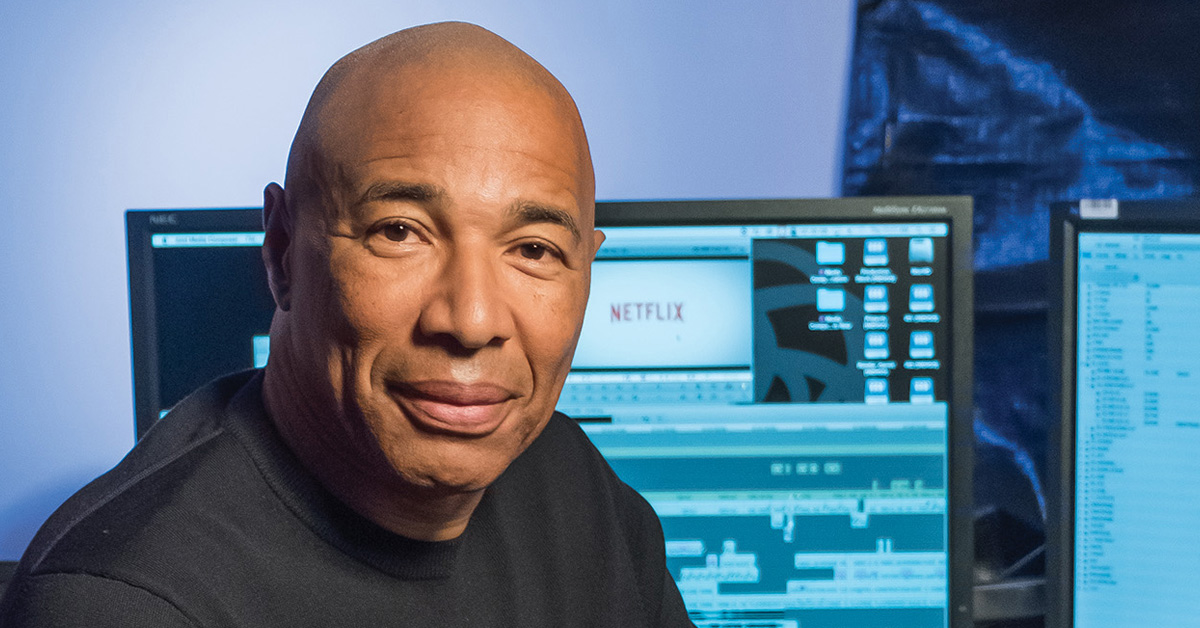
Recognizing, Mentoring, and Promoting Diversity In Hollywood | with Monty DeGraff, ACE


About Episode
“This moment is necessary as much as it is uncomfortable.”
– Monty DeGraff (Comments on diversity in Hollywood June 2020)
According to a 2019 survey of 1700+ post-production professionals (thanks to Blue Collar Post Collective), 1.5% of those surveyed identified as ‘African-American’ with over 80% identifying as ‘White.’
Let this sink in for a second…1% of people in post identify as African-American.
How is this possible? Is there a systemic reason for this? Or on the contrary, should we just accept that “it is what it is?”
Seasoned editor Monty DeGraff, ACE (Star Trek: The Next Generation, Law & Order, Daredevil, Man In the High Castle, Narcos: Mexico) worked in Hollywood post-production for 9 years before he met another black person like himself. Over the years, he’s seen very little increase in the number of black people working in post-production, largely because there has never been a real incentive to change it.
In this interview, Monty and I address some of the following questions:
- Why aren’t black people getting the opportunities they deserve?
- In the midst of the COVID- 19 pandemic where many of us are forced out of work, can we finally take the time to examine our own responsibility in the racial epidemic that is happening in Hollywood?
- Can we honestly evaluate where our internal biases have informed the status quo?
- Can we recognize that white privilege doesn’t mean you had an easy life, it just means the color of your skin didn’t contribute to your hardships?
This is an incredibly candid and uncomfortable conversation (as it needs to be) where Monty opens up about how he’s had to fight harder in this industry because he’s black, how internal biases inform the comfort level in the editing bay, and why white people need to start having these conversations with each other.
If you have been feeling sad and helpless about racism and the mistreatment of black lives, please listen to this interview to gain insight into the black experience specifically in post from Monty’s perspective and hear his thoughts on what steps we can take collectively to make true and lasting change in the post-production industry.
Episode Highlights
- The story of how Monty almost became a lawyer but realized it was Hollywood that was his true calling.
- How he never considered himself a mentor but naturally fell into it
- His advice on what assistants should be using to convince producers they can cut.
- Monty’s secret for how he fast-tracked himself from Assistant Editor to Editor. SPOILER: You have to ask.
Useful Links
About Guest
Monty DeGraff was born and raised in New York City where he attended public schools. He graduated from the University of Rochester with a B.A. in History and then headed west to California. Through a classmate he landed a job as a page at ABC and from there quickly became an Apprentice Editor in their film department. This allowed Monty to join the MPEG just as non-linear editing was beginning to reshape television post production.
Monty became an Assistant Editor on Star Trek: TNG and it was there that he received his first credit as Editor. In took 3 more years bouncing between being an Editor and an AE before Monty landed a job as Editor for Dick Wolf on Law&Order. He stayed there for 5 seasons , one of which won the Emmy award for best Dramatic series.
Since then Monty has worked on shows big ( “Daredevil”, “Narcos: Mexico “, and “The Man in the High Castle” ) and small and everything in between. Monty’s love of craft continues to grow, as does the enjoyment he gets from working with talented, passionate storytellers. In addition to the pleasure of cutting, Monty has found great satisfaction from mentoring the next generation of editors. He currently working on a spinoff of the STARZ series “Power” called “Raising Kanan”.
Transcript
Zack Arnold: I’m really glad we could finally make this happen. I’ve been hearing your name numerous times over and over, and everybody all says the same thing. You have to talk to Monty. He’s the nicest person in the industry. You got to get him on the podcast. So I’m glad we could finally make this happen, and I’m excited for what we can do talking about both just mentorship in general, but also talking about present, current circumstances too, because I think that you’ll be a strong and important voice, or for both both topics.
Monty DeGraff: So you’ve been doing outside of your editing, entrepreneurial work, encouraging others to look beyond themselves as editors. Do you consider yourself a mentor? You must.
Zack Arnold: Oh, absolutely. I mean, I’ve considered myself to be a mentor for, I don’t know, well over a decade, but I finally decided to blend the mentorship that I’ve been doing and the all the things I’ve done in the personal development world, the things that I’ve done that have to do with productivity and career advancement, and I put all of them together into a package where I’ve now taken my love of being an entrepreneur and being a mentor, and I put them together. So I’m basically building this much larger community of people that are looking for either coaching, that are looking for mentorship, or that are just looking for training and guidance on how to take the next steps in their career, especially if they don’t even know what the steps are. So that that’s a big part of what I do is just give people clarity on what is it that I even really want to do with my life that’s fulfilling? Because, as I’m sure you, you’ve met so many people in this industry that just get stuck in one area, and it’s this is a really hard business and a hard job. If you love what you do, if you don’t love what you do, it’s practically impossible. So I help people refocus on the stuff that’s actually fulfilling to them, that has an impact on others, that has a positive influence, and then how do you actually make that happen consistently and meet the right people and build relationships? And so there’s, there’s a there’s a whole lot that’s going on behind the scenes right now that I’m trying to build into a much larger program and a resource that I feel isn’t really offered to people in our industry and specifically in our niche.
Monty DeGraff: You know, I haven’t really considered myself a mentor at all. I would have never used the word. About three years ago, a fellow editor, fabulous editor, James Wilcox, asked me to be on a panel about mentorship, and I was like, why are you asking me? And he said, I consider you one of my mentors. And I was kind of surprised, because we had a very we were friends before he started editing and scripted, and we remained friends 25 years later. And then the word kind of went around, Monty is a mentor. Why don’t you talk to Monty? He’s a mentor. So when I got on the cover of motion picture editors guild magazine, that kind of cemented something that I never consciously made happen. I think it’s the role of all editors to to some degree, if their assistants are open to it, to mentor their assistants. We’re in a guild. Guilds come from the Middle Ages, and an apprentice would start in any field and work for an assistant, and then become a journeyman themselves, and then when they were a master, they would have people working for them. So the what we do as editors really works well in that way. And so I didn’t have someone that I could consider myself my mentor, but I certainly had friendly editors who allowed me to cut. I think that’s half of it. Most of what mentoring is between an editor and assistant is just modeling what an editor is for them to pick up. I don’t have a specific approach to each one of my assistants. They’re all different. One of my former assistants, I was just talking with her Sunday said, Well, I like your philosophy of mentoring, Monty. And I said, What is my philosophy? I have a mentoring philosophy. You take everyone. It’s news to me, but you said, you take everybody for where they are and what their personality type is and skill level is, and you take them as they are. Once I did become clear that I, I do mentor people. It’s very important for me to mentor women and people of color, but that is not an exclusive thing. My present mentor is a white male. I probably will have more white male assistants. I feel like life brings me who the next person is. I certainly look out for ambitious people of color and women. When I run across them, I’m open to working with anyone who’s a good personality, smart, hard working. And everybody needs something different. Some people it’s more they need how to use their personality to convince producers that they can cut. That’s a bigger challenge than actually learning how to cut. You know, after many years of experience, I now see opportunities for my assistants that they may not see themselves, because it’s much clearer to me, Oh, here’s an opportunity grab that. So I’m learning more as I do this, and I actually learn a lot more when I’m verbalizing in terms of cutting, what it is I do, how I approach creatively, the. Work that I do. So it’s a it’s a win, win for me and the assistant, it isn’t just me giving to them. They give to me by making me think deeply about what it is I do.
Zack Arnold: I love all of that. I’m gonna tell you a funny little anecdotal side story. I have a habit that I’ve learned over the years of doing, I think well over 250 podcast interviews and like, 1000 zoom calls. I always make it a habit of hitting the record button as soon as I start the call, just in case. We haven’t even officially started the interview yet and you’re already going off about the importance of mentorship. I love it. I absolutely love the fact that you just dive right into it. So what I want to do now, because I haven’t even had had a chance to do a formal introduction and talk about who you are and what you’ve done, and you’re like, here’s what’s so important about mentorship. If that doesn’t perfectly encapsulate the reason that I wanted to have you on the show, that was perfect. But what I would love to do, I want to dive into all these topics deeper. But I find it’s really important for the listener to get to know the person that I’m interviewing first. So what I would love to know a little bit more about, and we don’t have to go too deeply into this, but a little bit of your origin story. What like originally you weren’t necessarily interested in getting into film. You were also interested in getting into law. So talk to me a little bit more about your journey into this world to begin with, and then how you rose to the ranks. Because what I’m really, really curious about with anybody is, how do you become the person that you are? What are the pieces and how do they fit together? Because you have a lot of experience in the world of television. You’ve worked on a lot of big shows, Man in the High Castle and designated survivor and Narcos Mexico, and all the way back to starting with Star Trek The Next Generation. But there are a lot of people where you could on paper, perhaps compare the resumes. One of them becomes a really important mentor and helps mentor other people in their careers, and the other one just goes to work and they go home. So I think there are probably reasons why you have become the mentor and the shepherd, so to speak, that you have. So I just kind of want to start at the beginning. Tell me a little bit more about how you got into all this, so we can learn a little bit more about you as a person.
Monty DeGraff: Well, I think everybody in our industry, as children, enjoyed film and movies. I know I certainly did. I didn’t think of it as career. No one in my family, no one who we knew was in the entertainment business that was something done far, far away. But I grew up in New York City. I had three brothers. My parents raised us up in the Bronx. And after college, I got accepted to San Diego, University of San Diego law school, and the very first semester, I realized I absolutely hate it. I will never be a good lawyer, and this is so, so not a fit. Now I can also say many of the my classmates felt the same way, but they they put their heads down and went forward, and the law has one of the highest rates of alcoholism of any profession, and I sensed that I would be one of those people, because it was such a not good fit. And I came up to Los Angeles to visit a high school classmate of mine who was getting his master’s degree to be a teacher, but was a security guard at the old MGM lot. And one day he said, Hey, do you want to come on the lot at night and I’ll take you into the sound stages? And we went in, and I was like, oh my goodness, you know, I think I want to do this. And so I had to think really, really long and hard. And I told my parents, you know, I don’t think I have, I’m cut out to be an attorney. I waited till I finished my first year and did well. So it wasn’t about could I do it or not? It just wasn’t something that I wanted to do. I made my way up to LA and I got to be a page at ABC that led me into their film department. I joined the Union, and then I started my journey. So that’s how I began. And then along the way, now we’re talking the mid 80s there, I kept thinking, I’m going to meet a bunch of other black people who are doing what I’m doing. And really, for about eight or nine years, I didn’t meet any black people in post production, with one exception, a fellow apprentice of mine who ended up becoming my wife of 30 years. That was it. And so, you know, I knew there were other black people doing post production, but I just didn’t know how to connect with them and who they were. And it wasn’t until I went up for a job at Dick Wolf’s that I met Arthur Forney, who has been with Dick Wolf for many, many years and is black and very, very talented, very, very smart. He hired me for a Dick Wolf Show New York undercover. And then I switched over to law and order, and that show really kind of solidified me in the industry as a real editor, and my career has jumped off from that.
Zack Arnold: One of the things that I find interesting when you go a little bit deeper into your resume, when you started in television, you don’t have a whole lot of assistant credits. That’s pretty unusual, unless you’ve come from the feature world and made the transition. So if you were to extract one key takeaway or one reason or one strategy that you use to make the transition from assistant to editor so quickly, what do you think that might be?
Monty DeGraff: You know, looking in the moment, I didn’t know, but I think looking back, it was I was focused on editing and editing on the best shows that I could early on. As soon as I became an assistant, I asked to cut. You know, most people said no, but I still wanted to do. So I was focused on, I’m going to cut as soon as I get the opportunity. I’m going to let everybody know, every pa I run across, every assistant to the EP, so on and so forth. So I just was focused like a laser beam that I’m going to learn to cut before I really knew how to cut. And so if anything, that’s probably the reason I was able to do that. I was also a little bit older than a number of the assistants and apprentices who started at the same time with me, because I had gone to law school and I had taught for two years Elementary School. I think that’s that’s pretty much it.
Zack Arnold: Did you find that when you were trying to make this transition. First of all, I think that the if I could extract one key takeaway from this, and I’m sure you’ve told this to many people over the years as a mentor as well, you have to make your intentions clear. I’m sure you’ve talked to many assistants that are struggling to make the transition, and you ask them, Well, have you told your editor or your producers or your directors that you’re interested in editing? Well, no, I guess not. But don’t they know that already? Don’t they just kind of assume I’d want to make the transition. They’re like, they got other things to worry about. You got to make your intentions known. And like you said right out of the gate, day one, Assistant Editor, hey guys, I want to cut that makes all the difference in the world, making your intentions clear and making you know, bringing confidence to that. That makes all the difference in the world. So it sounds like that that was a big thing that you didn’t even realize you were doing. And I’m sure you’ve talked to other people that have made this mistake as well.
Monty DeGraff: Yeah, I think anybody you see doing anything they’re doing, they were, if it’s at a high level, they probably were pretty clear they wanted to do that. And the clarity is not just on cutting. I also wanted to cut a really good show, so I never got pulled into doing smaller, bad shows that were, you know, well regarded, simply because I kept my eye on the prize of working on the best shows, even as an assistant that I could possibly do no EPS do not know their their assistants, Assistant editors on shows, those as people in the background, you have to actually step up and present yourself for people to take you seriously. Even with an editor pushing you, it’s still 90% has to come from the assistant themselves, and that’s how you make it happen.
Zack Arnold: Yeah, making your intention known is a very, very big part of it. Going back to the kind of the the introduction of the interview, saying that we didn’t formally get to jump into this, one of the things that I wanted to let the audience know is that you and I have actually been trying for about three or four months to make this happen. So we’ve had a bunch of emails going back and forth. I think it was right before the pandemic hit, and then as soon as the pandemic hit, it was like, Yeah, I’ve got a whole bunch of other things I need to worry about. Not going to do any podcast for a while. So I wanted people to know that originally my intention was to have you on the show just to talk about mentorship and career development, all of which we can still get into. But I think based on present circumstances, there’s another voice and another level of experience that you have in this industry that I think is incredibly important for people to hear and for people to listen to, and that’s as somebody that works as a person of color in the world of post production and in the world of filmmaking. And you already alluded to the fact that you got into this world and said, Well, I’m just gonna, I’m gonna find the other people like me, and we’re going to rise up together. So there’s nobody else that looks like me in this industry, and I don’t know statistically the way that it looks, but I know that there have been some surveys, whether or not they’re statistically accurate, I don’t know for sure, but what I heard is that roughly 1% of post production is African American, would you wholeheartedly disagree that that’s terribly far off from your experience?
Monty DeGraff: Well, two things, it probably is true, but it’s 10 times more than when I started. So when I go into hallways, post production, hallways, and I see. A black assistant, a black editor, about a black AP, I’m heartened by that growth. Could there be much more, of course, where 10% of the population now I’m, I’m not 100% clear on is editorial, is post production, an area that that blacks in film school, aspire to necessarily, but I, I, I worked on a show for Netflix five years ago, and there was an AP who is very, very talented, a young woman who’s now on The Walking Dead as a producer. And she lamented the fact she was a Hispanic woman, that nobody would give her a chance. She wanted more than anything in the world to be an editor, and she had Moxie, she was attractive, she was really, really smart, and She asserted herself and could not get an opportunity. And it hurt my heart to hear that somebody who really, really wanted to get in wasn’t recognized by the people around her, the producers and the editors around her. I don’t know how much that is going on right now. I do know that the people of color that I’ve met in post production who are working right now are very, very focused. They’re very, very optimistic in their own abilities and their ability to move forward, and part of that is by seeing others before them. But also, you know, most people now have gone to film school or studied some film in school, so they’ve been thinking about it in a way that I wasn’t. I was a history major, and that kind of fell into it. So, yes, it’s probably 1% I mean, most shows that I work on, I do not work with other black editors. I work with sometimes black assistants. But that is slowly changing, because there’s so many black producers, so many black directors who are looking to hire blacks in post production roles. And I’ll be honest, a lot of white producers want a more diverse crew on every level, Writing Room, post on the crew. So it is not a hostile environment, but it’s sometime in a different environment.
Zack Arnold: So talking about this idea of, well, it’s not necessarily hostility, and it’s more indifference. The big question that I had that really, I think, kind of frames this larger discussion is, why is the percentage so low? And I’ve wondered this ever since I heard it. It was a realization that I had come to, maybe, I don’t know, five or 10 years into my career where, I mean, frankly, the first five years of my career, I just was in a little bunker all by myself, just working on indie film. So I really, I wasn’t in the industry, so to speak. I wasn’t going to networking events. So and the first, first feature film that I did was an urban comedy with a largely black cast and a black female director, so I just assumed that this was diverse and everything else was diverse. Then I started to rise in the ranks. I’m like, wow, there are very few people of color and minorities in post. Why? Like? So I don’t really even understand where that starts, and I know that you have had this conversation before on panels and you’re a member of committees. Has anybody even been able to figure out why this is at all like, if it is a matter of just indifference, if it just is what it is like, what’s, what’s the prevailing notion about why there’s so little diversity in post production?
Monty DeGraff: Well, you know, that question presumes that there is a reason. And of course, nothing is that simple. It’s, probably a combination of a number of things. Having said that, you know, I just recently saw the IATSE covid statement to the membership in this moment, and they mentioned what they didn’t mention. They talked at length about the George Floyd moment, and how I oxy is dedicated to diversity and inclusion and and I believe that everything in that statement was sincere and true. However, when I joined the Union and so within the last 40 years, the role of the unions has changed fairly dramatically. The editors guild was in the 50s and 60s and into the 70s, very much a father son business, that is to say, people who are in who were doing it, passed it on to their children, and it was very insular. And it wasn’t just editors, it was camera. These are well paid union jobs, and so people protected them, and they protected unions. Often played the role of protecting white privilege. Mm. So there was an actual barrier for people of color getting in past that, that huge obstacle when that started to break down, that is to say, when it became easier to become a union member, not based on race, just the requirements to do so that’s when some of the change happened. It didn’t happen to increase diversity. It happened because the rules that were excluding people were kind of outdated. So it went from not so much outright hostility, but wanting to protect for those we know, to indifference, that is to say, there’s no drive within IATSE or any segment of our industry to really, really make diversity happen. Or should I say they’re small pockets. Netflix is incredibly committed to diversity in their workplace and in the productions that they sign on, and they have a person in their high up in their organization dedicated to that. But for the rest of the industry, it’s kind of, we’re well meaning, we’re liberal, but I’ve got a lot on my plate, and that’s not a high priority. That’s that’s how it appears to me. And if I happen to come across a super talented writer, director, editor, cameraman, composer, I would hire that person, but I’m not going to spend a lot of time energy thinking about it or trying to make that happen, and I think that’s how we got to this point now, now I’ve seen change. That is to say, I’ve seen productions consciously want to have female directors directing. The DGA has done a real strong push for that, and it’s taken many, many, many years of resistance, but now there are more and more women directing television, and it’s still not at parity, but it’s a good sign that hasn’t happened for people of color. And in a certain way people of color have to initiate that. But as it’s true in the largest society, this is really something that white citizens have to take on. Blacks did not create it, and blacks cannot solve it. We’re we are truly a small minority, and so we’re in this moment, we’re struggling with, I think, as a nation, of how do we start to repair the fraught history that we’ve had up until this moment and make ourselves a more perfect union, and I think all citizens, black and white, are being challenged by that in this moment. What does that mean for me as an individual in this moment going forward? Let me ask you this, Zack, now that you are, you know, more integrated into the industry in terms of consciously being aware of a ton of your fellow editors and people in posts and so on. Prior to George Floyd, Did you sense any concern, interest, energy in increasing diversity?
Zack Arnold: Me, personally, you mean,
Monty DeGraff: Yes,
Zack Arnold: I would say that it wasn’t indifference, but it certainly wasn’t a matter of like I was a strong advocate specifically for making sure that minorities, people of color, were able to get the positions that they needed. But it definitely wasn’t just indifference. One of the reasons that I created this coaching and mentorship program was to give people the necessary skills and tools that they need to move themselves forwards. And I have multiple people of color. I I would say that as far as male to female, the ratio is vastly different than it is as an industry standard. I probably have almost half women in my program, multiple minorities, people all over the world. So in my own little way, with the small statistical significance I have of people in my program, I’m actively reaching out, and I’m including any demographic that I can, as far as being an editor, being in the world of post production, I mean, there’s no question that anytime that I would go to a mixer, go to a panel, go to any kind of event. I mean, it’s, it’s largely older white males. I mean, I remember going to one event, and it just, it really struck me, like, wow, like, there’s, it’s just kind of like the same type of person, and what is it that causes this? And some of what you’re you’re saying, really makes sense. Sense to me, but there’s still, there’s a lot of unknowns for me, where it just, it’s perplexing that there’s such a small percentage in general in this industry. But for me, like I, I’m in a an interesting position, where my upbringing was, I grew up in a very small rural town in northern Wisconsin. It was as red as red gets. However, my father instilled values in me to make sure to understand that everybody was equal. And I’ve heard stories growing up. For example, when he was in the Navy in the early 20s, I had posted about this on Facebook, and I had one inconsistency, but the story goes that when he was in the Navy, he went into a restaurant in Jacksonville, Florida, which is almost the same as the way that things were in Alabama. And he sat specifically in the section only for colored people, because he didn’t believe that people should be separate. And then he also, when he was a young teacher in Ohio, integrated the first school in that area, because, once again, he believed that everybody should have the same opportunity. So that’s what I grew up learning. That’s what I grew up seeing. And I was, I was born and raised in a general community, in an area where, out of, I mean, there’s only 700 people in my entire school, K 12. So it was rural, but there was one black kid that was it. So it was all 99% white, so I was used to seeing that around me, but also feeling like there’s something about this that doesn’t feel right. Then I went to the University of Michigan, where it’s just diversity everywhere. And then I moved to Los Angeles, where, again, there’s diversity everywhere, that, to me, just feels more comfortable. And then in the post production world, it was like, Wow, a lot of that diversity isn’t being reflected. But all of that to say that, have I been a staunch advocate? No, I haven’t been. And I think that’s one of the things that I’ve realized, and so many other people have realized as well, is that we have more of a responsibility than maybe we didn’t realize that we had before, and that’s a responsibility that I’m very willing to take on, which is one of the other reasons I wanted to have you on this call, is that I’m not sure I know how to do that, so it’s just having a very honest and open conversation about me as somebody that is white, that is male, that has had all of the opportunities that I’ve needed to get where I need to Get, and I want to be part of the solution, but there’s a part of me that isn’t sure what that looks like. And I guess one of the areas where I get stuck, and this is an argument that I’ve heard from a lot of people, is they say, Well, wait a second, let’s say that I’m an editor and I’m hiring an assistant, and I have two people that are equally qualified. One of them is white. One of them is non white. Well, yeah, in that situation, I can see wanting to really be able to forward the career and provide opportunities to people that might not get those opportunities otherwise. But I’ve heard many directors, especially, I hear this a lot from directors, where they say, because of all of the programs to either get female directors or directors that are minorities, that are people of color, they feel that people are being hired with a lot less experience, and there are people with more experience that are not getting the opportunities because of this. So I’m hearing this from both sides, and to be perfectly honest, I’m not sure what it is that I can do as just me as an individual, but also what we can do collectively. So that’s what I wanted to talk about today, just having an honest and open conversation about figuring out, how can we be part of the solution. Because I’m not sure what that looks like.
Monty DeGraff: Well, I you know, my question to you initially, Zack, wasn’t so much, what are you doing? And you know, what’s your journey in that, though it’s interesting and it’s helpful to hear that it was more if, if you are in this industry as a white person, how do you perceive it when you are interacting with other white people in this industry? In other words, do you sense a desire among whites who are in this industry for change. Are they? Do you sense any hostility or or any indifference, or do you see it differently? Because every time I’m in a room, I’m a black person in the room. So I’m interested in, when white people are in the room together, how do they perceive it? And I don’t believe that, you know, white people are secretly talking in rooms about black people, you know, on a regular basis. I’m not suggesting that. I’m just, what is the energy when you go into shows and you meet show runners and you meet fellow editors and you meet producers? What is the energy that you are perceiving? I do know. I’m a member of the DGA also, and the white male directors are very adamant that they are losing work to unqualified women and minorities, and they have been one of the most resistant guilds to inclusion. Within the DGA, they started the numbers. How many episodes did you do? How many were done by women or people of color? And they published those as almost a way to embarrass certain shows that year after year only had white male directors, and it was, it’s interesting, because a number of those shows were like, We don’t care. We’re not embarrassed. We just going to keep doing what we’re doing. But as I say, I think that is changing, and so something is going on at the Directors Guild. Maybe it just got enough momentum that it’s starting to change. I see writers rooms changing in that way too. The crews for television shows are hired in a in a different way, and there’s no there’s no feedback as to what’s going on with shows and how many people of color or how many women are on them, and because there’s no feedback in that way, and maybe that’s something that the motion picture editors guild could really start emphasizing. Producers are not they can be non thinking about it. They have a million things. I think show runners have the most difficult job in entertainment. They’re juggling a lot of stuff. And for this to be on their radar, they they have to be nudged strongly. And I don’t see that happening right now. So in this moment, up until this moment, at least, it’s individual blacks who and Hispanics and others who decide, I love this, I want to pursue this and take on the challenge of finding their way in and up in this present environment. But more would need to happen to increase those numbers, so that someone like the young woman I had mentioned, who was on a show I worked on, who was, to my mind, that’s the kind of person you would want to help not because she was a woman or Hispanic, but because she was really bright and energetic and smart, and so, you know, I would think people would want to hire anybody who was like that, but clearly that’s not the case. I think maybe I recognize that in her, because I’m a person of color, and it’s possible that white people aren’t don’t easily recognize talented people of color that are in front of them. I don’t know if that’s true or not, but I suspect it might be.
Zack Arnold: That’s an interesting theory to go back to the way that you reframe the question. If I were to answer it, saying, you know, like you said, You’ve, you’ve always been the black man in the room, so you don’t know what the conversation sounds like when you’re not there. And I would say, I’ve never once been in a situation where I sensed any hostility whatsoever, where there’s some active conspiracy to to make sure that post remains white and non inclusive, like I’ve never been in any kind of conversation like that. But I think indifference is probably the best word, because, as you know, just surviving the world of television and a TV series once you’ve actually broken in, which, in and of itself, is near impossible. Once you get there, you just want to get through the day, finish your dailies, get your cuts out, and you just want to have at least a semblance of a life outside of that. And I think that for most people, there just isn’t enough room in their brains to actively think, well, now that I made it on the show, my first priority is, how do I bring in as much diversity as possible? So I think it’s just a matter of indifference and just not not prioritizing it, because it has not been part of the conversation. And I think that’s one of the amazing things that’s happening out of all the horrible things that have been happening, is that it’s a very important conversation that we are now all having, but before, it was just a matter of indifference and just survival. But again, I think my experience is somewhat unique, and that I have worked with so many female directors and multiple black directors. And I mean, I was on Empire for two years, so I saw a very I almost saw it from the opposite perspective, where the assumption was that because I didn’t understand the specific world of empire, that I wouldn’t be able to tell that story. And to a certain extent, that’s kind of true, because I couldn’t really relate to the culture exactly as it was, but that doesn’t mean that I couldn’t tell the story and I couldn’t edit it, but I needed additional support, so I needed to have multiple conversations. Like a good friend of mine is Wendy Calhoun. I don’t know if you know of her. She’s a showrunner and writer, and she’s been a good friend of mine since basically I got into the industry. And I would have conversations with her to help me better understand what might I not resonate with in the story because I’m white and you’re black. So I would, I would use that as a way to listen and learn more. But the immediate assumption was, well, I probably wouldn’t understand how to tell the story. And I proved them wrong, and I did a great job cutting that show. But if you flip that on the the opposite side. Look at somebody that you mentored, Kelly Dixon. Because Kelly Dixon is black, does that mean that she can’t tell the story of a white chemistry teacher in New Mexico? Like that’s absurd to me. So it’s, it’s, it’s a really hard question to answer. There’s, I have never sensed any hostility, but there’s a lot of indifference. And I’m hoping that if there’s one thing that changes radically because of what’s going on, that indifference goes away, and the people that really want to make a difference choose to make that difference. And it’s really about continue to answer the question, yeah, but how do I actually do that?
Monty DeGraff: You know, I my wife and I were at a protest Saturday, and it was in Koreatown, and so it was kind of interesting to me to see a lot of Korean Americans holding Black Lives Matter signs, because in the Rodney King riots, and those were real riots, 66 people were killed and a billion dollars of property was destroyed. At that time, there was a very fraught relationship between the black African Americans and Korean Americans, but here in 2020 many young Korean Americans were holding signs saying black lives matter. And I thought, Wow, that’s a double edged thing. And it’s not equally double edged. That is a profound acknowledgement of something, but it also means prior to this moment, Black Lives did not matter. That is not to say that anybody wanted black people to be killed. It was just when those killings were happening. Blacks felt great anguish in that moment white Americans were able to go that’s horrible, but they’re kind of one off moments, and life goes on now that’s changed. Now this the clarity of the George Floyd killing has deeply affected the consciousness of the nation. And so I think part of the possibility, part of the potential of this moment, is African Americans are being seen as human beings in the fullness of our human beingness, where, to be honest, I don’t believe we were earlier I met Kelly Dixon as an assistant. And she was bright, she was funny, she was she had an incredible memory of movies. She could tell you movie lines. If she saw a movie one time, she’d give you dialog. And what I sensed was nobody would be interested in hiring a black woman who looked like Kelly to edit their shows. It wasn’t until Lynn Willingham took her under her wing and really mentored her how to overcome that on Breaking Bad that her incredible talent could be seen by the world. So what I’m saying is, if you don’t see people, it’s hard to to get them kind of you know. So it’s natural that black people can see the value in another black person as it is a white person see another value in another white person, but it doesn’t always translate across race, and it’s possible that in this moment, that will be modified, and hopefully more than modified.
Zack Arnold: So I guess that my my response to that is that, for me, personally, I can’t even fathom making a judgment about Kelly Dixon or anybody else based on the way that they look like. I can’t even imagine being in the position if I were a showrunner, a fellow editor, lead, editor, Director, whatever it is, and not valuing her talents and her abilities equally because of the way that she looks. But again, that’s that’s just such a foreign concept to me because of the way that I was brought up, but I think that.
Monty DeGraff: Let me stop you there. Zack, I think all of us have internal biases that we may not fully own or even be aware of. Let’s get off a race for a second and just say two people are very, very talented before you, and one’s very overweight, one’s not, you know that overweight person is going to have a difficulty. Nobody says, I don’t like overweight people, and I won’t hire them, right? But that reality is something that’s embedded in a lot of us, so that we judge without full. Going, that’s why I’m making this decision. On that level, I would think it’s because we somewhat do not want to own that. So I think on the issue of race, the majority of people in our industry are not, you know, I will not hire a black woman nobody. I don’t think anybody consciously or even subconsciously, kind of feels that, but there are other levels of bias that inform us, and we’re constantly making decisions on who we want to hire, who we want to work with, and so on and so forth, and those things play into it. Sometimes it’s as simple as recognizing that, and then it’s like, Whoa, did I really think that? And once you’re aware of something, you know, it kind of loses its power. It’s more when you’re not aware of it, that it can be active,
Zack Arnold: sure, yeah, I can very much understand that. And when it’s interesting, that use the weight analogy, because I’ve actually had this conversation with multiple people in my program. One specifically, I won’t bring him up by name, but we had the very honest conversation about how, if you’re going to be doing and he was somebody that would say he’s pretty overweight and he’s he’s had health problems in the past, and if he’s going to be a technician that runs from one job to another, and he’s going to be on his feet all day long, whether or not he likes it. There is going to be some bias and judgment about, is this guy actually going to be able to do it, like there’s some heavy lifting, and is, is he going to be in good enough shape that I can see and I guess the again, the the thing that I just I still can’t fathom, is making a similar bias or judgment about somebody’s ability based on their heritage or the color of their skin. However, what I have learned beyond the shadow of the doubt is that because I’ve seen the world that way, I just kind of hoped, assumed, that people saw things the way that I did, and now that I’m realizing that’s not the case, I’m realizing that the way that I’ve seen it is also in difference, and I also need to stand out and be much more proactive about making sure that people that don’t get those opportunities have the the chance to be heard and be seen and be recognized, which is the reason that we’re doing this, and I’m hoping to be able to do more in that realm as well. But there’s, there’s still a part of me that just can’t compute the idea of having a bias that for the specific job that we do in post production. I’m not I can’t even imagine making a choice based on somebody’s skin color, just versus whatever they’re back
Monty DeGraff: Let me come in at it. Another another way. Zack, you know, in sports, pitching, in baseball, quarterbacking and football, those were, for many years, considered white positions, because strategy, particularly for quarterbacks, is so a part of it, and it was long assumed that, you know, blacks could be running backs and receivers, but to actually run the team, we feel much, much comfortable with a white quarterback, and some coaches would could articulate that most you know, as time went on, knew that that was fraught territory. So let’s not not say state that. But the same goes with if you’re a showrunner and you are really trying to do ambitious work, and you need really smart editors who are highly creative and also intellectually get what you’re going for. You may have an unknown bias that only certain people can do that, you know, and I have three positions for this show, and I want to make sure I have the very best editors on that. And so, you know, nobody says, well, blacks aren’t smart enough, so they’re not going to, you know, do that, but it plays a role in in that. And as I say, I think there’s a possibility that in this moment that’s being challenged, and I don’t mean being challenged by black people, even though it is, but I mean I think whites are starting to ask themselves about their own, you know, decision makings in that way, I’ve gone to tons of interviews, and you know, my general personality is I’m comfortable in interviews, and I’ve become more and more comfortable as years have gone on in them. I like meeting people, so even if I’m not going to get a job, it’s like I’m meeting some new people in my industry. But early on, particularly I remember going in rooms, and my name is monte de graph. My real name is Jan amont DeGraff, so you wouldn’t necessarily expect a black editor is going to come in. And when I come in, I could actually see the surprise on their face, not shocked, as in, oh, this is horrible. But I. Wow, I really didn’t expect that. And and then the adjustment from that, like, like, it’s like, you have to take a breath. And after seeing that multiple times, it reinforces that this is not a conscious thing that we’re talking about, and that’s why it takes a horrific moment to excavate what’s going on underground in our in our society. You know, all of us have to pitch in to do this difficult work of moving our country forward, and part of it is examining our prejudices, even those of us who say we have none, of course we have some, because we live in a prejudiced society. So how could we not have any? Anybody who’s attractive has a much better road in this world than somebody who’s not attractive. Nobody says that right? Nobody says, I only hire attractive people, but if two people up for a job, and one person’s more attractive than another, the one person is going to get that job. You know, all things being equal, otherwise. So it’s, I think, naive to believe that we all don’t have prejudices. That’s not the issue. The issue is, can we, in this moment, start to check ourselves out? Because it’s not about Ku Klux, Klan guys in robes. It’s more about the mundane, moment to moment decisions that we all make of what we like and what we don’t like, and we think those are independent decisions, but they are informed by the world we live in. I think the work that you do, just in helping people overcome some of the internal barriers to advancement and success, is highly critical, because I do feel many blacks feel that they’re going to encounter hostility in white working environments, and it creates a reticence, and it slows down advancement so learning skills on how to reach out to people with effective emails and how to interview well and how to ask for advancement, I think those are highly critical skills that anybody In the industry needs, but certainly minorities need because they are internally carrying some some burdens, and externally they’re facing, as I say, indifference.
Zack Arnold: Well, one of the things that came up as you’re talking about this, and I appreciate the kind words about the what I call the soft skills, because I feel like regardless of whatever race or color or heritage, like just across the board, I feel like soft skills are so underrepresented and the vast majority of educational materials are here’s the latest version of avid and Premier and compositing and hard skills are important. But it’s the soft skills that really move the needle more than the hard skills. But I think that one, one thing that came up in my mind when you were talking about this idea of the internal biases that we don’t see, one thing that we talk about as far as a soft skill when you’re reaching out to somebody is finding common ground and finding relatability. And I think maybe one of the things that we’re touching on, if we’re looking at whatever system was in place, whether, you know, from the Middle Ages, or from the beginning of the the guilds, or we’re talking about the IATSE, you know, being the this father son relationship, however we got here, where we are now, is that predominantly the people that are hiring, the show runners, the Director, maybe not the director so much, but the producers and showrunners, at least in television we know, are predominantly white. So maybe one of the biases is it’s not even about skill. It’s just, am I going to have enough to talk about in a dark room for 12 hours a day with this person if I feel like I can’t relate to their background and their heritage and I just, I want to, I don’t want it to be weird. I don’t want it to be a challenge. I just, I want somebody that had the same upbringing as me so we can have similar conversations about sports and about movies and whatever, and like, oh, I don’t know if I can have a conversation with somebody if our backgrounds are different, sure, maybe that’s one of those internal biases where it’s just about trust and comfort, and somebody sees you come in in the room and they’re not expecting a black man. It’s like, oh, like, wonder if I have anything in common with this guy. Like, do you think that that maybe resonates?
Monty DeGraff: Oh, 100% you know, even among Black people, you know, if a black show runner is hiring, you know, editors and they. Have four black editors come in, the ones that resonate most with them, and nobody says what you just posited, which is 100% true. Am I going to feel comfortable with this person because they don’t have the same background? I grew up in a ghetto. I grew up in an all white area. Am I going to be able to talk to that person? Those are, those are human. That’s human reaction across the board. And I definitely think it plays a role. If you take race out of it, you know, it’s still the same thing. Am I going to be comfortable in this room with this person for if I have, if we have to struggle with the episode for four hours? Am I going to enjoy that, or is it going to be a drag? And, you know, shared sense of humor, we’ve all seen the same movies, we’ve read the same books, we went to the same types of schools, all those kinds of things bond people together. So yes, and I don’t even know if that’s necessarily prejudice, as much as that’s the the desire to be with people like you in terms of your interest and background, so that can’t be overcome entirely, but once again, just awareness of that. Can you know show runners fire people all the time. And if they fire a white person, they don’t say, Oh, my God, I don’t know if I can hire white people now, but if they fire a black person, they it’s almost like, Gee, I don’t know if I want to hire another black person because I had to fire that black person. So that’s a weird thing, you know, now I’ve been fired twice from shows so you know, as many editors have, and I don’t think race played any part in it at all, but I can understand how it could make a white producer sensitive, like I don’t want to hire a black person, and if I have to fire them, I’m a racist, and so on and so forth. All these things can play in somebody’s head. I get that, but I’m hoping that we find a way past that, partly by talking about it, by making it explicit. It’s less of a challenge. It’s less of a personal challenge. You realize we’re all in a society. We’re all embedded in this society, and we’re holding up a lantern trying to walk out of the darkness, so everybody’s not going to be on board. But you know, I sense young people are definitely in a different place than baby boomers are, and that gives me hope.
Zack Arnold: Well, one of the the interesting things that I thought of while you were saying all this was I can think of perhaps one of the most unlikely friendships humanly possible in this industry, and maybe I saw it differently than this person did. But if you were to put my background on paper, and you were to take Lee Daniels and put his background on paper, zero commonality, right? And he and I worked together on Season One of empire, and at first, I think there was a fair amount of friction, because we didn’t have those commonalities. We didn’t have the same backgrounds. Could not have been more polar opposite, but the more that we talked and the more we just got to know each other as people like he and I had a great time in the editing room, and he may characterize it differently, but I mean, like, Man, I learned so much from working with him, and learned so much about his background and why he was making the show he was and why His stories were important. But at first, there was a lot of friction. And I think, like you said, it’d be easy to say, well, there’s not enough commonality here. So is this person a good fit? But I think that the other thing that’s so interesting that you said that never really occurred to me is, what are the consequences to me if this doesn’t work out? And this is something that I talk about all the time in my program, my coaching, a mentorship program, is it never has anything to do with race. It has to do with pigeonholing.
Monty DeGraff: Sure,
Zack Arnold: It’s this idea that if I want to transition, for example, from reality TV to scripted TV, the person that’s doing the hiring wants to cover their own ass, and they want to say, well, if it doesn’t work out, I don’t want it to be because I took a chance on somebody that doesn’t have scripted experience, because, on paper, they don’t have the experience necessary. So it’s all about building the right relationships, so somebody vouches for you, gets you in the door, and you can prove yourself. But what has now just occurred to me that you, I think you hit the nail on the head is if I’m a white show runner or producer and this editor doesn’t work out, and it has nothing to do with their race and just to do with their storytelling abilities, or maybe they’re they can’t meet deadlines, just basic stuff that would make them not fit for the job. Are people going to think that I let go of them for other reasons? And that’s dicey territory right now,
Monty DeGraff: Sure.
Zack Arnold: So that’s a really interesting bias that never occurred to me before, is the repercussions of things not working out for just completely banal reasons. What this also reminds me of that’s very relevant to our times. I. I’ve been hearing from a lot of people over the last maybe year or so that because of the ME TOO movement, they’re very reticent to hire attractive female women, because they’re afraid if there aren’t enough people around that they might do something that they perceive as innocent that’s going to get them in trouble, that’s magnified by everything that’s happening in culture. And I feel like maybe a lot of people are in a similar position, thinking, if this doesn’t work out for whatever reason, they’re just going to assume that I let this person go because of their color.
Monty DeGraff: I do think the female thing is more fraught than even than the race thing, because people can interpret sexual harassment differently, and there’s no common we think there might be, but there really is no common ground on you can’t say somebody feels harassed that you’re not harassed, you know? I mean, that’s a personal reaction to an event. So that’s very dicey territory, but necessary because cutting rooms have been dominated by men, and in our industry, men have had power to to really get away with a lot of stuff. So this moment is necessary as as much as it’s uncomfortable for people. And so yeah, I know some attractive women have to pretend that they’re that they can roll with it and everything’s fine, and nobody wants to be harassed, nobody wants to be uncomfortable at their workplace, so it’s a real challenge for them, but, but for black people, you know, I think what you experienced with Lee Daniels is, when we talk about background, we’re talking about, you know, where you grew up, and how much money you had, and your parents had, and so on and so forth. But really what connects us to people is, do we share a sense of humor? Do we like you know, I’ve had assistants who I really, really loved working with, but they weren’t, they didn’t like talking that much. They weren’t verbal conversationalist. And then I’ve had those who love to talk, and I love to talk. So there are things beyond our superficial differences that connect us, and this may be the moment when we can start seeking out those things, and not the superficial like you grew up in upper middle class area, and I grew up in this kind of area, and you went to that kind of school and I went to those but do we both like Marvel Comics? You know, that could be more of an area of com, you know, of commonality than the superficial stuff that seems to separate us. It’s a lot of work. Let me, let me just add this, Zack, it’s a lot of work for black people to navigate white worlds, and they we have to be very conscious of a lot of things that white people, up until this moment, were free To be unconscious of. And I think that is what is really going on right in this moment, that white Americans are not all, but many are starting to become conscious of more of what’s in their head and heart, and they want to have the conversation you and I are having more. I think white people would want to have that conversation. And you know, because black people, right in this moment are so hurt and so angry. I’m not sure that everybody’s up for the full conversation. But I can say this, Zack, I think it’s really a moment for white people to be talking to one another about your own internal discoveries and journey in this moment. You know, I think that’s very, very valuable, because everybody’s going through it, so why not talk about it? It doesn’t have to be across race. It could be, you know, with your white colleagues talking about it, not in general, maybe some specific aspect, like what goes through your mind hiring assistants, I think that would be very, very helpful in moving this, moving us forward.
Zack Arnold: Well, I mean, that’s exactly the whole reason that I have you here today, and that is to be able to have this conversation, knowing that, just from a statistical perspective, the vast majority of people that are listening to this conversation today are. Most likely white. That’s just the the cross section of the demographic of people that work in post production and that listen to the show, just by default, not by any choice of mine or anybody else’s. But that’s the reality of it. And I’ve had multiple conversations with other people that are white, and it’s just, it’s it’s been the same conversation over and over, which I’m very heartened by, which is, I didn’t really see all this until now, but now that I see it, what can I do about it? It’s not just, oh, this is just a bunch of BS or it’s a hoax like I’ve I pride myself on reading and keeping up to date on things from both sides. So I try to remove myself from the echo chamber of everybody saying the exact same thing, and I read on both extremes of the news, the far right, the far left, the middle. I want to get all the perspectives, but at least I know the people that I’m having conversations with that I know personally, everybody’s asking the exact same question, what is it that I can actually do about this? Because I think, like, for me, like you said, if I see the LA riots on TV, like, I was in Wisconsin when that happened. So it’s like it wasn’t even real to me. It was just something that you see on the news for five minutes, but then you see all these other incidents that have been happening collectively, over and over and over, and it’s always the same reaction, like, how can the world be like this? This is ridiculous, but what can I do? Right? What can I do as one person about it. I think we’re all realizing, Oh, that was part of the problem. It was that viewpoint that what could I possibly do now that we’re all collectively having this moment on a global scale, saying, Oh, crap, maybe we should have done something now, at least the conversations that I’m having is all about, how do we be more proactive? But those that are immediately jumping in with solutions or opinions. Those are the ones that I would caution them to do, which is what I’ve been doing since all this started, which is just sitting back, reading and listening to the viewpoints that I think are important, then devising a plan of attack and saying, like, big picture, how can I approach it? Rather than, well, I’m just going to put up a social media post, and then that’s it, like, there it’s, it’s, it’s much deeper than that at this point, and I don’t want to just jump in and start doing something until I really understand the playing field and where I can truly make a lasting impact. And the first step of that is I just, I need to understand the playing field better and just listen to people’s experiences, which is why you and I are here today? Because I just, I’m not sure how to approach it yet, but I know, with very great, deep resolve that I want to do something, but I don’t just want to jump in and half heartedly be like, Yeah, well, I’ve tried, you know, I really want to have some lasting impact, and I’m not sure I have enough information yet to make that happen, but I have the resources to be able to listen, whether it’s talking to you, whether it’s talking to other friends of mine that are going through this as well, just just understanding it and learning like I I’ve been basically from their mind. My My kids are 10 and eight, and I’ve just been running them through the ringer, showing them all these movies, like we watched salmon, we watched lean on me, and I’ve got a whole list of other things. And my son was like, can we just, like, watch an action movie with Schwarzenegger or something like, he’s 10. I get it. But like, I had talked about this in a Facebook post, in an email I sent out when he was asking about the rioters and the protesters, and I had explained him what’s going on, and he even said this today, again, he’s like, I don’t get it, didn’t we figure all this out already? It’s like, Dad, no, like, and why? Why have we just not figured this out? It just seems so simple, but it’s so not simple, but. But what I’m what I’m encouraged by, is
Monty DeGraff: It’s not simple. And I would just say, you know, we, we even from what you’re saying, Zack, it’s kind of like, what are the things I can do out in the world to help change this? And my suggestion is, at this moment, it’s much more important not to figure that part out as to this is a point of looking into our own minds and hearts and taking our time with that over the next year or two, or three or four, just what what’s in my mind and heart as I react to the world around me and be in the world around Me, I think that’s really how change happens. And in New York now they’re talking about ending chokeholds and so on and so forth. That, of course, is part of the moving forward, but that’s not the important part of moving forward. It’s really us all checking out our own hearts and minds. And as a black person, I’m always like, Why does white America have such disregard for black lives? You know, that’s not something I can answer or solve, but it’s always a question. So I think in this moment, it’s really about people just checking themselves out and talking about whatever it is that comes. About when you check yourself out with the other people who are close to in your life, those you work with, those you live with, those in your neighborhood, and so to support not stopping people on the street and asking deep questions, but when you have that opportunity, when it’s natural, and more importantly, just checking yourself out, once you start checking yourself out. You can find out things about yourself. You know what I mean, that have always been there. And I’m not speaking specifically talking to you, Zack, I’m just talking in general. Most of our prejudices are unconscious or so justified in our heads that they don’t even seem like prejudices. Just seem like that’s the way it is. You know, like 1015, years ago, a friend of mine said, fellow editor white, you know, it’s just the way it is, that black people are more criminal than white people. And I didn’t make that happen. And, you know, I got it. That’s how the world appeared to him. But yeah, so I, I would caution against, you know, joining an organization and doing a specific thing, or so on and so forth, not to say, Don’t do it. But it’s really, what do I carry in my heart and and, well, how does that make me see something like two people can see the cops abusing somebody, and they can see it totally different. You know, that’s why I turn on Fox News. I’m after something horrific happens. I want to see how Sean Hannity responds to it, or Tucker Carlson. You know, part of what they do is showbiz, but I believe that on some level, that’s how are they really feel. And you know, like really, you could look at this video of this man being murdered and see something else that’s amazing to me, but I don’t think the rest of the country can do that. And so it’s not so much about talking to black people. I think at this point it’s about talking to one another, and let me just add one last little bit. It’s not about black people only. I know a number of super talented Hispanic editors, and I know their careers have been thwarted by the fact that they’re Hispanic, and it’s when they go into the room, are they embraced or not? And I think they find a tougher road than African Americans. So that’s something that I just look at myself like, would I be prejudiced about a Hispanic assistant editor or whatever coming towards me. Now, you and I both know a fabulous Hispanic editor, Joaquin Elizondo, who I work with on Narcos Mexico, and by my calculation, he should be far forward in his career, because he’s an incredible editor, and I’ve worked with a lot of editors, he’s going to go far as he has already, and he’s going to go much further, because he’s determined, as I was, but it just kind of hurts me that somebody has to do more because of their race. You know, I guess after 30 years of being in the business that still kind of hurts me to kind of know, like, wow, somebody really talented, you know, is just still struggling here in this world. So I’m hopeful, I’m optimistic, and maybe that’s why I’m in this business, and maybe that’s why I’ve been able to get ahead. But I do want to see change, and I’m grateful to be able to have this conversation with you, Zack, and obviously it’s obvious to me that you want to see change too. And I’m hoping those that listen to this podcast discover that journey for themselves
Zack Arnold: Well. And that’s that’s the whole idea. I just I had these conversations to start other conversations, and at first I just thought that I was screaming into an empty microphone, just doing it for my own need to get things off my chest. And as I see over and over, you have this conversation, other people have it, and then other people have a similar conversation. And you know, six years later, everybody’s at standing desks, right? So the same thing can be, can be said for not eating in front of your desk or talking about, you know, more inclusion and more diversity. Like it all starts with a singular conversation, and then it becomes another conversation, and then it just it expands beyond and beyond and beyond. And I think it’s funny that you brought up Joaquin, because that’s exactly where I was going to go, next to where he’s somebody that I’ve known since college. And you know that again, that’s it’s somebody that I believe he’s the same age as. Mean, if he’s not, he’s close to the same age. But if you look at my resume versus his, he’s obviously not nearly as far along as having the credits that I do. Some of that is just the fact that he went to New York instead of going to LA, got into promo. So there’s some. Constancy stuff, but yes, I would also agree that there were probably some that have to do specifically with his race, and that’s that’s not fair, because I love the guy to death, and I’ve done everything I can to help him, and I know that you’ve done the same thing, but that’s frustrating. And I think that if there’s been one realization that has, there have been a couple of realizations, like you said, looking into either your own biases or just the way that you see the world, where I’ve never believed in my heart that there’s any racism or judgment whatsoever based on somebody’s color. But the one thing that I really learned that hit me deep on an emotional level, is and I think I saw it in a meme of all places, but there’s been a lot of backlash against the this term white privilege, that’s obviously been talked about a lot over the last couple of weeks, and a lot of the people specifically that I grew up with, or people in rural communities, say, Well, my life was hard too, and I grew up poor and blah, blah, blah, blah, blah, but the thing that really hit me at a deep emotional level is that white privilege doesn’t mean that your life hasn’t been hard. It just means that the color of your skin is not one of the reasons that it has been hard. And man, did that hit me like, wow, I get it now. And I think that’s the conversation that’s really, really important that we need to really acknowledge, is that, you know, I came from a very poor community, the poorest community in the entire state of Wisconsin, which is a pretty poor state, as far as the other 50 I mean, I went to school with kids that didn’t have floors, that had dirt floors, that had to come to school to get the shower in the gym because they didn’t have running water. So I saw poverty firsthand, and I always thought to myself, Well, I came from nothing, and, you know, I ended up being the, you know, top 3% the University of Michigan, and my hard work and my work ethic, or what got me to LA and I just worked and worked and worked. But all of this has made me realize, well, yeah, but there were, there were certain advantages that were invisible, that I didn’t realize, that I had, that other people have in order to get even close to where I am now, if I endure a lot of things that I never even really knew existed for them, and seeing that has been a really eye opening experience for me, where, again, like I said, I don’t know how I contribute yet specifically, but I think The the the area where I feel like I can lend value is those that are dealing with some of those disadvantages that I maybe never had, especially those just coming into the business, the younger ones. How can I give them an unfair advantage just to get them back to the same starting line as everybody else? So that’s that, if there were one place that I’m trying to really crack the code and figure out how to do it. It’s that because that, that realization, really hit me hard. So I don’t know if that’s the I don’t know if that’s the right direction to be going or not. I’m still trying to figure all of it out. But that’s that’s why these conversations are so important that we weren’t having even just a couple of weeks ago, that I’m hoping will will lead to some real and lasting change. On that note, this has been an exceptionally eye opening and wonderful conversation to have with you today. I can’t thank you enough. I know that we’ve gone well over the allotted time that I promised we would, but if this, if this starts more conversations, I think it was well worth it. And I can’t thank you enough for being here today and being so, so so honest and open.
Monty DeGraff: Thanks for having me. Zack, it’s a real privilege. Thank you, guy. Take care.
Transcribed by https://otter.ai
Episode Credits
This episode was edited by Curtis Fritsch, and the show notes were prepared by Debby Germino and published by Glen McNiel.
The original music in the opening and closing of the show is courtesy of Joe Trapanese (who is quite possibly one of the most talented composers on the face of the planet).