What Five Near-Death Experiences Can Teach Us About Living | with Dr. David Fajgenbaum


About Episode
As we’ve learned over the last several weeks (or is it months? Or years? I’ve lost track), there is very little we have control over in life. But if there’s one meta-lesson I hope to take away from current events it’s that although we have no control over what happens around us, the one thing we do have control over is how we react to the circumstances in our lives.
And now more than ever, we could all use an injection of inspiration!
Dr. David Fajgenbaum, the author of ‘Chasing My Cure,’ is no stranger to adversity. As a former Division I college quarterback, a state-champion weightlifter, a holder of multiple degrees such as BS from Georgetown University, an MSc from Oxford, an MD from The University of Pennsylvania, and an MBA from The Wharton School of business, you’d think that David simply has it all (not to mention that he’s been featured in The New York Times, Good Morning America, CNN, The Today Show, amongst others).
But what you wouldn’t know simply from reviewing David’s accolades is that he was stricken with a deadly disorder known as “Castleman Disease” during medical school that nearly killed him not once, not twice, but five separate times. And when you’ve spent this much time contemplating death, you spend an equal amount of time contemplating life.
In this episode David and I talk about his harrowing experience being on death’s door, but more importantly we take an optimistic approach to understand how his circumstances can help us rewire our own perspective on what is truly important in life (and how to tackle the problems we can control while no longer wasting energy on those we cannot)
NOTE: This interview was conducted shortly before the pandemic struck (early March, 2020), so as you’re listening keep that in context when we briefly discuss the virus.
Episode Highlights
- Dr. Fajgenbaum’s “Santa Claus Theory of Civilization” and why it’s so fundamental to many of the challenges we face in society.
- The incredible story of how David went from the pinnacle of health (a champion weight lifter) to being so frail that laughing too hard might kill him.
- How a rare disease led to FIVE near-death experiences.
- The moment he realized there was no drug out there to save his life and how that led to him dedicating his life to identify treatments for the disease.
- How living in “overtime” – knowing the clock is ticking has helped him focus on what’s most important.
- Why constantly being so close to death not only gave him clarity, but also manage his fear in ways we can all learn from.
- 3 lessons he learned in his pursuit of a cure that could help you overcome almost anything.
- Why it’s so important to take ownership of your own health care.
- Practical advice on how to talk with your doctor and what questions to ask.
- How David became such a good storyteller. (His book is superbly well-written! A real page turner.)
Useful Links
About Guest
David Fajgenbaum, MD, MBA, MSc is one of the youngest individuals ever appointed to the faculty at Penn Medicine and the author of Chasing My Cure: A Doctor’s Race to Turn Hope Into Action. After spending months hospitalized in critical condition, having his last rites read, and having four deadly relapses of idiopathic multicentric Castleman disease (iMCD) during medical school, David decided to fight back by conducting research and creating the Castleman Disease Collaborative Network (CDCN).
He is now in his longest remission ever thanks to a treatment that he identified and began testing on himself. One of the top 1 percent youngest grant awardees of an NIH R01, he has dedicated his career to discovering new treatments for deadly disorders like iMCD and spreading the CDCN’s ‘collaborative network approach’ as a model for other diseases.
Dr. Fajgenbaum has been recognized on the Forbes 30 Under 30 list, a cover story by The New York Times as well as by Good Morning America, CNN, and the Today Show. Dr. Fajgenbaum earned a BS from Georgetown University, MSc from the University of Oxford, MD from the University of Pennsylvania, and MBA from The Wharton School. He is a former Division I college quarterback, state-champion weight lifter, and co-founder of a national grief support network.
Transcript
Zack Arnold: I’m here today with Dr David Fajgenbaum, who is a physician scientist at the University of Pennsylvania. He’s the co founder of the castleman disease collaborative network, and he’s the author of the book chasing my cure, a doctor’s race to turn hope into action. So David, it is awesome. I cannot tell you how awesome it is having read your book to have you on the other end of this microphone with me today.
David Fajgenbaum: Zack, it’s such an honor to be on with you as well. Thank you for having me.
Zack Arnold: So one thing that you didn’t add to your little brief intro that you provided is the word humble, because I’m going to just step out on a limb and I’m going to do an extended version of your bio, because, my friend, you didn’t do. Yourself justice. You have also been recognized on the Forbes 30 under 30 list. You’ve had a cover story in The New York Times. You’ve been on Good Morning America CNN, The Today Show. You have multiple high level degrees, including degrees from Oxford and MD from the University of Pennsylvania. You have an MBA from the Wharton School of Business. And by the way, if all of that wasn’t impressive enough, you were also a former division one college quarterback at Georgetown, a state champion weightlifter. God, I’m losing my breath. I have to, like, catch my breath just to finish your bio. And you also founded a grief support network. So my first question is, how the hell do you even have time to talk to me today?
David Fajgenbaum: Well, I’m thrilled we’re chatting today. I think that the reason that I’ve been able to get some of those things under my belt is really just hyper focused, something that you and I can really bond around. It’s, you know, each of those things were, you know, one task at a time, and just, you know, focusing with everything I had to accomplish them.
Zack Arnold: Yeah, hyper focus is something that I can absolutely relate to. Many people just assume that it’s a superpower, but what I have to explain to them, and it is very much also a Kryptonite if you don’t know how to manage it properly. And from what I’ve read in your book, and I’m sure, as we’ll learn today, it’s probably a little bit of both for you as well.
David Fajgenbaum: That’s exactly right. And it’s about, in my opinion, is about figuring out, how do you, how do you manage it? You know, it’s if managed, it can be, you know, really, really helpful. But if not managed, then it can be actually debilitating.
Zack Arnold: So what I want to do is, I want to introduce people to your story first. There are so many themes and takeaways and threads that we can pull on this, and there are just a multitude of lessons that people can learn about life. But I want to just start with the story, and I guess the the place that I want to start is asking you a question that I doubt anybody has ever asked you on your show before. Maybe they have, but what’s your deal with Santa Claus? What have you got against Santa Claus?
David Fajgenbaum: So I’ve got nothing against Santa Claus, per se, but what I an issue that I have is with what I call the Santa Claus theory of civilization. And I actually put this in the very introduction to my book, because it’s, in my opinion, so fundamental to many challenges we face in society. So Santa Claus theory civilization is that many of us, myself included, have this sense that for every problem that there most surely must be a team of people working diligently to solve that problem. Kind of imagine Santa Claus and his elves working together diligently to deliver a solution for whatever your problem may be. And I think that Google kind of reinforces this misnomer. Because I feel like for every question you can ever think of, if you type it into Google, not only does Google know the answer, but Google actually finish your question for you, and you’re like, Oh, wow. I guess this isn’t a new question, and thankfully, someone else must be thinking about it. But what I found is that in medicine, particularly for rare diseases. And actually all across medicine, there are many diseases where there’s actually no one working on solving the problem and there are no answers whatsoever. So we can’t just assume that if you Google it, there’s an answer, because actually for many problems in healthcare, the problems are not Google able. And unfortunately, there is not a team of people that are working together diligently to solve them.
Zack Arnold: Yeah. And I think that what can even be scarier than Googling something and not getting an answer is the more more likely approach, which is you Google something and get completely the wrong answer, and you’re going down the wrong rabbit hole, much of which I know you’ve done yourself, and we can definitely get into a little bit later, this idea of taking back the control of your own healthcare, or just your own life in general. And like you said, not waiting for this, this team of elves to just ensure that the presents are going to show up every Christmas morning, right? But where I want to start is the transition that was happening in your life, from where you were essentially bench pressing two human beings at once, about 375 pounds. If I remember, you were a state champion weightlifter, and in a relatively short period of time, you had gotten to the point with your health where you could have literally been killed, either by a stethoscope bumping your head or you laughing too hard. So walk me through that transition, because this is a pretty unbelievable story,
David Fajgenbaum: Sure, so I was a healthy third year medical student. I was training to become a cancer doctor in memory of my mom, who had passed away just a few years before, and over the course of just a few weeks, I started noticing I was getting more tired than usual. I noticed these lumps and bumps in my neck. I noticed fluid accumulating around my legs, and I knew something was abnormal. I didn’t know what. I eventually went to the emergency department, and they ran some blood tests and told me that my liver, my kidneys and my bone marrow were shutting down, and they didn’t know why. And so they hospitalized me right away, and started running tests, and I got. Really sick really quickly. So I had a retinal hemorrhage that made me blind in my left eye. I gained 70 pounds of fluid. I was drifting in and out of consciousness, and I needed daily transfusions to keep me alive. And this is, as you said, kind of in such stark contrast to being totally healthy. You know, just weeks before, in fact, I was actually so sick at that stage that my doctors encouraged my family to say their final goodbyes, and my family brought in a priest to administer my last rights to me. And I’ve really, you know, it’s hard to put it into words just how scary that was, but I’ve really felt and considered that moment when I had my last rights read to me to be the start of what I like to call overtime. So this time, I didn’t think I’d have that I’ve been trying to make the most of thankfully, right around that time, I was diagnosed with idiopathic multicentric castleman disease, this awful immune system disorder where basically your immune system attacks your vital organs. But thankfully, with the diagnosis, I was able to be started on chemotherapy, and the chemotherapy saved my life. But unfortunately, I would go on to have relapse after relapse after relapse.
Zack Arnold: Well, I think it’s funny that you put it as a relapse after relapse after relapse. Because people think, oh, you know, it’s kind of like cancer, where you’re in remission, but then you get it again. I would say your story is just maybe a hair more dramatic than that. I’m not sure if in my life, I’ve talked to anybody that has had a near death experience to the point that you have, but I know for a fact I haven’t talked to another human being ever in my whole life that has had five near death experiences. So I think relapse is probably understating it a little bit. So I would love to hear just a little bit more about what this process looked like over the course of these few years, when this is just get just kept back and pummeling you over and over and over,
David Fajgenbaum: Sure, so you’re exactly right. It was terrifying, and it was there was just so much uncertainty. So I finally got the diagnosis. I got chemotherapy, it saved my life. But as I said, I just a few weeks later, I was back in the hospital again with another life threatening relapse, where I was drifting in that unconsciousness and where I was on dialysis because my kidneys weren’t working. I mean, I was as sick as you can get, and nearly died again. This time, they gave me a combination of seven different chemotherapies because the one chemotherapy that saved my life previously didn’t work and that fortunately saved my life. And at the time, I was started on an experimental drug, a drug that was the only drug to ever undergo a randomized, controlled trial for my disease. And I was really hopeful this drug was going to keep me in remission, that maybe I could, you know, have a future. This is a deadly disease that I have. About a third of us die within five years of diagnosis, and another third will die within 10 years of diagnosis. But, you know, in my mind, I kept saying, well, but no one’s ever been on this drug before. This is the solution. This is going to save my life. I’m going to live a long life on this drug. So I went back to med school, I went back to training to become a cancer doctor, and then I had this deadly relapse on that experimental drug. And that, for me, was probably the lowest point that I went through, to be on kind of to have all this hope that, you know, this drug is going to save my life, to then realize that no, this drug is not going to save my life. And in fact, there are no more drugs that are in development. Santa Claus and his elves have nothing else to deliver. In fact, there is no Santa Claus because there were no researchers out there doing research, and that was absolutely terrifying. And basically on my deathbed now for the fourth time, I told my dad and my sisters and my girlfriend that I would dedicate my life, however long that may be, to trying to identify treatments and maybe even a cure for my disease. So I got chemo again. It saved my life, but then I was back in the hospital again a year later, and I nearly died for the fifth time again. I mean, each one of these relapses is like playing Russian roulette with with probably two or three bullets in the chamber. And you know now I’ve played it five times, and by the time you get to the fourth and fifth time, you you really don’t think you’re going to make it, but thankfully, I did. But with number five, I had begun, begun conducting research, and actually experiments I ran in the lab at Penn, which is where I was in medical school, led me to believe that a drug that was developed 30 years ago might actually be able to treat my disease, and I was started on it, or I started myself on it, and have been thankfully in an extended remission.
Zack Arnold: Well, there’s a whole lot of pieces in between that have to do with you piecing all that together, like you so casually are like, yeah. So, you know, I found this medication from 30 years ago, and I took it and I got better. Well, that’s only like 100 pages of the story, and, like, the most compelling part of it, I definitely want to get through all of that, but where I want to dig in a little bit deeper for. First is this fact you’ve been through not one but five near death experiences. And really, the quantity doesn’t matter as much as the quality of the experience. And we hear so often these platitudes and quotes and, you know, Instagram cards like you never really, you know, start living until you you know, recognize your mortality or whatever it is, but you’ve really kind of been there at a very deep level, and you’re very open about this in the book, and despite how painful and awful and just physically agonizing this process was, one of the things that really stood out for me was that you said nothing was ever worse than just settling in to die. What does that mean? That’s
David Fajgenbaum: right. So with the very first time that I was struggling against this disease, there was a point where I gave up mentally, where I had been in the hospital for weeks, and I had basically knife like pain all over my body because of the organ failure. It’s hard to really even describe I mean, I played college football. I’ve broken many bones. I’ve undergone many surgeries. The pain that I was feeling in the hospital, that was just all day, every day, was was hard to describe. And there was a point where my lungs were completely filled with fluid. So I had water completely filling my lungs due to all the organ failure. And so any breath felt. It’s hard to describe how painful and difficult each breath was. And so yes, there was a point where I did not want to breathe any longer, and that moment, I think, of really giving up and realizing that you’re giving up, I think, is what’s so painful for me. You know, as I was writing this book and I was reflecting back on on my journey, there were a lot of things like that feeling that I had really buried away in the back of my brain. And as I was, you know, writing it and putting it onto paper, I could just pull out these feelings and and it really was this low point being like, oh my gosh, like realizing that you’re giving up. But thankfully, my dad and my sisters were by my side, and I remember two things. One is my sister Gina saying, just breathe. And somehow it like, got me out of this trance where, like, seeing my sister, seeing my my other sister, and my dad, and then, like, it became okay. It’s not just I’m not just breathing for myself, but I’m breathing because I don’t want to put my family through what they just recently went through with my mom, and so that gave me this kind of extra, extra fire to keep fighting. And the other is something I said that I don’t remember saying, but my sister tells me that right around that time, I told her, I said, you can withstand anything for a day. And I think that what was so tough is it been weeks of the pain, but, but all of a sudden I started shifting my mindset from like, weeks of suffering, weeks without a diagnosis, to like to today. And just as you said, that’s kind of a cliche, you know, one day at a time, but for me, really focusing on like, I’m going to suffer for today and then tomorrow, I’m going to suffer for one more day and then one more day. And that was kind of like something I could handle, as opposed to this concept of, you know, you know an uncertain timeframe
Zack Arnold: well. And I know that you also mentioned several times that you got to the point where you were doing these injections or transmissions, or whatever the right terminology is, every three weeks. And you said, I basically don’t plan my life more than three weeks ahead at this point.
David Fajgenbaum: That’s exactly right. I was getting that experimental drug, and I had relapsed at that stage. I had nearly died three times, and I didn’t realize that I was about to have a fourth one coming up. But because of what had happened already, I just knew that, that I couldn’t plan more than three weeks in advance. So you’re exactly right. I literally would not put anything on my calendar more than three weeks ahead, and I wouldn’t schedule anything. I wouldn’t there was, in my, my opinion, I could not schedule anything more than three weeks out, because I didn’t know if I would be here more than three weeks out. And I was living in such a state of just being present. And I mentioned it earlier, the concept of overtime, and that really, it really speaks to me the concept of overtime, because, as you mentioned earlier, I played college football, and I played in a lot of overtimes, and in overtime, there’s this sense where you can just totally focus on what’s important. You know, if you make a mistake in the first quarter of a game, you can make up for it later on in the game, but if you make a mistake in overtime, the game’s over, and as a result, you’re just so locked in on the most important things, you know exactly what the play is, what who your teammates are, where they are, and you’re, you’re just, you’re locked in. And I think that that is a great analogy for how I live life, day to day. And it’s, it’s that, you know, my clock is ticking. I literally know that I’m in overtime. But being in overtime, it hasn’t made me afraid of things. It hasn’t made me anxious. It actually has just helped me to focus in on, what are the things that are most important, what are the things that are not most important? So I can, can, you know, move them out of the way that I spend. My time well,
Zack Arnold: and speaking of the things that are most important, I realize this is probably a very overly asked question and possibly cliche, but at the end of the day, I think it’s one of the most important questions to ask somebody that’s been in your position, which is, when you get to that point where you really have given up, or even if you haven’t given up, but things don’t really look good, and you’ve lived many months of your life in that state, what are the things that you really think about that become the most important and acutely that you acutely focus on? For
David Fajgenbaum: me, it was definitely the people in my life that I love and that loved me, that that was very clearly number one was just all I could think about was, you know, who I love, and the people in my life that love me and and really the emotion that came with that was just sadness that I wasn’t going to be with them much longer, and that I just wanted to kind of soak up any moment that I could with those people that I loved, my close family And friends, the next place that my mind went to was around the things that I didn’t do or that I didn’t say in my life. And it’s interesting, because the first time I nearly nearly died from this disease, I really was looking back on my life, and I was kind of in my mind almost going through like an obituary, but really also just reflecting on my life. And what I realized very quickly was that I wasn’t regretting anything that I did do or anything that I did say. The things that I regretted were things that I didn’t do or did not say. And it was a really important realization for me that many times in my first 25 years of life, I had come up with a good idea, you know, I should say this to someone that I love, or I should do this thing, but I talked myself out of it. I’d said, you know, you’ve got all the time in the world. You’re 25 years old. You start that thing later on, or tell that person what you want to tell them later on and and there I was at 25 you know, having my last rights, right to me, and realizing that actually I didn’t have all the time in the world, and really regretting the things I didn’t do. So when I left the hospital, I came up this new motto that I that I like to, that I think about a lot, and then I like to share with others. And that’s think it, do it. And it’s that if you think about doing something and it’s not a bad idea, I’m not encouraging doing bad things that are not good ideas. But if it’s a good idea, don’t let yourself, don’t talk yourself out of it. You know, do it. If it’s whether it’s telling someone that you care about how you feel about them, or it’s starting something from scratch that you dreamed of doing, but you’d kind of always said, Oh, I can do that later. I think that it really helped me to realize that those were the things that I really regretted.
Zack Arnold: And I think that that’s such an important theme, and I’m sure people have heard it before, and it’s in books and on TV and whatnot, but really, the greatest regret that just about anybody has on their deathbed, and there’s plenty of research to back this up, is it’s always the things you didn’t do. It’s never the things you did do. It’s not all the stupid things that you messed up or the things that you failed at. It’s the things that you were too afraid to fail at. That’s exactly right, right? And I think that when you were going through this, this mindset of, well, you know, I was at this point where I was talking myself out of doing these things. It’s not so much you talking yourself out of it, it’s fear that’s talking yourself out of it. And it seems like going through this process, for you, kind of eliminated that fear. How does that work?
David Fajgenbaum: Yeah, I think you’re exactly right. The fear was eliminated because I think I just objectively recognized that my time was running out, and that that that there was kind of no room for missteps. And then it was that I almost felt like confidence in my decisions, because I could say I’m going to do this, because it’s what I want to do, and I don’t have much time left, so I’m not going to second guess it. And I think it was kind of almost more like, you know, following my heart a little bit, and again, I keep saying homework homework quotes, but I really was that I felt like liberated to follow my heart, as opposed to feeling like I needed to kind of do the things that I’m supposed to do, because that’s the stage I’m at in life, or that’s the stage I’m at in my career of my training.
Zack Arnold: So having been through this process, and also having worked with a lot of other patients that have gone through this, and being in the medical community in general, I’m guessing you see a fair amount of people that go through these same phases. But the last thing I want is for somebody to think, well, I have all these fears, all these inhibitions, all these things that I want to do, but I’m too scared of I guess I’m going to need a near death experience to be able to really accomplish anything like, obviously, we don’t want that for people. So do you have suggestions for somebody that’s saying I have this fear of just talking to people, and I’m very introverted, or, you know, like, an example in my world is that I decided a couple years ago I’m going to be an American Ninja Warrior. Like, that’s crazy, but it’s, you know, and that’s a world you probably know a little bit about, just because. You know, the mutual person that connected us Is it very much ingrained in that world, and I can so identify with for years was, Oh, that would be so cool. I would love to do that someday, right? And then one day I was like, No, I’m going to do it now. And I’ve had that overtime experience where in that sport, it’s all or nothing. You slip and you’re done, and you get up to the starting line, and it’s just like, oh my god, this is it. I’ve never once in my life experienced more hyper focus than that. So, you know, it’s certainly not in the life and death situation that you were in, but I’ve I felt that viscerally, that adrenaline rush where you’re 100% present, but without going to extreme levels of life or death or, you know, athletic competition. How can we help people overcome some of these fears and inhibitions? It’s
David Fajgenbaum: a great question for me. I think that you know, sharing those experiences, you sharing your experience, me, sharing my experience, and kind of the revelations that I had being in that position, the revelations that you had being in that position, I think, is really, really important. I mean, frankly, I wish that I could, you know, listen to your podcast and get these lessons that I’ve learned from my deathbed without having to go through, you know, all that, all that I went through. I wish that I could kind of have gotten the cliff notes without having to go through all of the pain and the challenges that my whole family went through, and that’s really one of the main reasons why I wrote chasing my heroes. Because I just felt like, oh my gosh, if I’m going to survive this, I have this like, I like, owe it to to life itself, to say, Guys, these are the things that that I picked up, because I don’t want you to wait until it’s too late to learn them, and so I do hope you know, listening to your podcast, you know, hearing about your experiences, hear about my experiences, can help others to put themselves in that position and say, okay, you know, I don’t want to wait until I’ve gone through these sort of things to start taking these action steps That could really make a big difference in our lives.
Zack Arnold: Well, I want to go now back deep into the the details of the story. And this was that I had alluded to earlier, where you said, yeah, so I found this experimental drug and had been used 30 years prior for something else, and I took it now I’m fine. Big, big part of the story. And without going into any of the, you know, the really deep details, as far as, like, all the different, you know, the various medical terminology, I want to talk through this process of how you strategized and found your way to this cure, because there are so many takeaways for people that, again, going back to this idea of the Santa Claus theory of civilization, and without going into current events right Now, I mean, we’re talking about this on a global scale. We just assumed that somebody else, somewhere there, must be figuring this out for me. And at one point you even said that there really weren’t any researchers and there weren’t people figuring this out. And one of my favorite lines in the book is when you said it was basically like Santa Claus himself was telling me there was nothing else that could be done.
David Fajgenbaum: Yeah, and that Santa Claus is my physician, Dr van ree, who was really the world’s expert. And so there he was telling me that there was there were no more solutions, and that there was no one else doing work that could help to find something that could maybe help me. So if I had to boil down my approach and how I thought about fighting back to a few kind of key aspects. I think the first is that I recognized that working on my own, there was no way that I could make the progress that I wanted to make by myself. I fully recognized up front that I would need to build an amazing team of people. And so the first step was to bring together as many people as I could, whether they were patients, physicians, researchers, anyone who had any interest in castleman disease, connect them online, first through discussion board, then through in person meetings. But I wanted to build a community. I also, once I built that community and connected them. I wanted to get ideas for what research questions we should ask, what are the kinds of studies we should do with the idea being that I wanted to, even if those people weren’t doing castleman’s research, maybe they could give us ideas for castleman’s research. So it’s build a community, crowd source that community for ideas. And in the midst of this effort of building the community and crowdsourcing, is when I got really sick for the fifth time and and knew that I wouldn’t make it to my fiance and I’s wedding date. I’d so hoped that I could make it to our wedding date, and I knew that if I wanted to that I would need to identify a drug that could keep me in remission. And so I had this amazing community that I was building, and I had my own samples that I’d been collecting on myself, and I performed a series of experiments, and from those experiments, I identified this particular signal in the data that basically told me that this one communication line in the immune system was turned into overdrive. And. I went through this giant database of drugs to understand, of all the drugs already available in the world, is there a drug out there that can actually inhibit this particular communication line that I found to be elevated in my samples? And I found that, in fact, there was this one drug, it was developed 30 years ago, had never been used before for castleman disease, but it was FDA approved, and therefore it was actually at my neighborhood pharmacy. It literally was around the corner from my house. But of course, no one had ever thought to try it. And so recognizing that I had this amazing community of castleman disease physicians and researchers, and also recognizing that now I had this, the data that was pointing me towards maybe trying this drug, and really knowing that there were no other options, I decided to start trying this drugs, sirolimus, the first time ever a patient with my disease to receive it. I think that the really, I think key lessons are, you know, searching the world for anyone and everyone who might be able to give or share a good idea. You know, I think it’s about harnessing the crowd. I think that’s a really important lesson from that. I think that it’s about digging and kind of not stopping until you have answers. So just, you know, working relentlessly. And then I think it’s about asking a third question, which is really important, and that’s, is there a solution that’s maybe hiding in plain sight? This drug had always been around, but no one had ever thought to try it. And if I wanted to develop a drug based on my research, I would have needed to spend hundreds of millions of dollars. It would have taken 10 years, and I most certainly would never have survived that long, and I never would have raised that kind of money, but knowing that there was a drug out there, I realized there was a shortcut to finding a treatment for me. And I think these are, these are really important lessons that can be applied to any sort of solution, whether it’s life or death,
Zack Arnold: yeah, and I think that the one of the details that I think is so important for the listener to understand right now, my assumption is anybody listening is thinking, oh yeah, I’ve never heard of castleman’s disease, so either you’re the first to ever get it, or it’s one in a million. And of course, that’s why there wasn’t any research being done. But when you really get into the details, it’s a lot more terrifying when you gave the statistics about the fact. And I’ll let you go into this deeper, but basically, the number of people that are afflicted by this disease every year is the same as one of the most well known ailments on the planet that gets millions upon millions of dollars of research go into that a little bit deeper and explain how exactly that happens.
David Fajgenbaum: Sure. So there are 7000 rare diseases that affect 30 million Americans, so one in 10. So each rare disease, by definition, is rare. But when you combine them all together, because there are so many, actually one in 10 Americans have a rare disease. And just as you said, most listeners will say, Well, you know, if it’s super rare, then that makes sense. You know why there may not be a drug or there might not be research? Well, 95% of those 7000 rare diseases that affect one in 10 Americans do not have a single approved drug. 95% so it’s actually very common for these rare diseases, which unfortunately are not all that rare, to not have any options whatsoever. And so, yes, you know, on an individual basis, there may not be that many, but collectively, there are very, very many. So there are about 5000 patients diagnosed each year in the US with castleman disease, which is about the same incidence as ALS. You know, as you mentioned, ALS is, you know, one of the diseases that thankfully has a lot of awareness, because it’s another one of these awful rare diseases. But there’s obviously a big difference in public awareness of a disease like ALS versus many of the other 7000 rare diseases. And so I’m really trying hard to raise awareness about rare diseases, generally, through sharing my story, but also about this concept of drug repurposing, specifically because there are 1500 drugs that are already approved by the FDA for for over 2000 conditions, but there are also 7000 conditions that don’t have any drugs. And so what I’m really interested in is trying to understand how many of those existing drugs might actually be effective treatments for all these diseases, like mine, where there aren’t any options
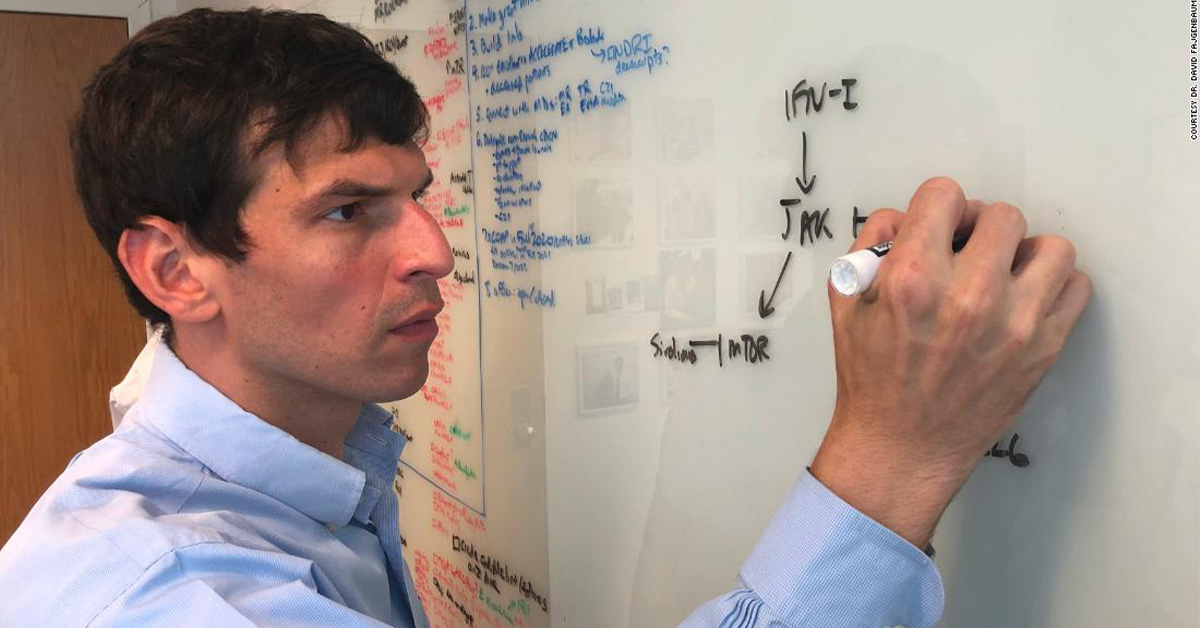
Zack Arnold: well, and I think that thinking about all the various diseases, whether they have cures or whether they have medications or treatments or they don’t, talking about your situation specifically, the only thing that I could imagine, and I can’t imagine, being your position, because I haven’t been there, but I can imagine the only thing more terrifying to me than somebody saying there’s nothing that can be done is somebody saying there’s an answer out there somewhere. We just don’t know what it is, because then my brain would go into overdrive saying, Oh, my God, the answer exists. I just have to find it. I would lose my mind. I can just I can see. Myself doing exactly what I’ve seen pictures of you doing, which is window after window and whiteboard after whiteboard of mind, maps and arrows and like I would lose my mind. But if somebody just said, We’re sorry, it is what it is. You can accept it, but you absolutely refused to accept it.
David Fajgenbaum: That’s such an interesting comment. It’s such an interesting point. I actually had not even thought about that point, because you know when, when you have one of these awful diseases, and if you know one option may be that we have a drug for you, and that’s obviously the best option, right? 5% of rare diseases, there is a drug out there. Another option is, we don’t have the drug. We don’t have a drug for you that we know of, but maybe it’s out there somewhere. And then a third option would be, we don’t have a drug for you, and there’s definitely nothing out there. And thinking between option two and three, I guess I’ve never thought about that the, you know, no one could have told me with any sort of confidence whether there was a drug or not. I mean, I guess an analogy would be to think about like, you receive this like treasure map, and it says that there’s, you know, gold hidden somewhere. And they tell you, well, it might, there might be gold, you know, at the end of this treasure map, or there might not be, you know, we’re not certain. That’s kind of where we were, which is, like you got this awful disease. And, you know, maybe there’s a solution at the end of this trail, but there also might not be a solution there. And you know, what do you do? Do you run after it? Do you, you know, follow the treasure map to try to get to this treasure? Or do you say, you know, there’s probably nothing there, so, so I’m not going to run after it, and I’ve never thought about how it actually, you know, knowing that there might be something at the end of this, end of this road could actually almost be, like even more challenging to deal with mentally, than if someone just said, look, there’s just no way there’s anything out there.
Zack Arnold: Well, I think that the other wrinkle to add to this analogy, and I love the analogy, is they say to you, we’ve got this treasure map. There might be gold at the end of it. There might not be but here’s the wrinkle you might not survive to find out.
David Fajgenbaum: Yes, it’s actually, it’s in you will most likely not,
Zack Arnold: Yeah, most likely. You’re never going to figure it out in time to know.
David Fajgenbaum: So you’re going to go on this chase, and you’re going to get, at best, halfway there, and you know that’s, that’s Yeah, and you know what? And actually, there’s even another wrinkle, and that’s that you might get to the end and you’ll find something, but it’s not going to work. You know, it’s going to be fool’s gold, basically, you know, your God.
Zack Arnold: This is the worst game ever.
David Fajgenbaum: And it’s exactly the other game that I that I’ve been living and that I chased after, and you’re right, and it’s, you know, you might get something, you might say, from your data. I think this drug is going to work. And when I found the date when I, you know, found this signal in my data, if you’d asked me what percentage likelihood, I would have said, I think probably this is going to maybe a 10 to 15% chance that this is going to work. But of course, I had no other options, and there was no time to do it further testing, and so I just had to go right to testing it on myself. So how long has it actually been since you’ve had a relapse? When was the last time that you experienced this? So yesterday marked six years and two months since the last day that I was in the hospital and since starting this treatment. So just for perspective, in the first three and a half years, I nearly died five times. Now it’s been over six years that I’ve been in a complete remission on this drug, and I try not to ever the reason I went to yesterday, and that’s the future, is that i i try to never round up, because I don’t know if I’m going to make it to the end of this month. I don’t know if I’m going to make it to the end of this year, surviving and also on this drug. But I also don’t like to round down either, because, you know, we worked really hard for every aspect of this remission. And earlier, I mentioned this amazing group of people that have worked with me, and I should call them out by name. It’s a foundation called the castleman disease collaborative network that I started back in 2012 and they’re just so many amazing volunteers, donors, friends, family, patients, loved ones, researchers, physicians, that have all been part of this, this fight, and I titled my book chasing my cure. But I really think that I made a big mistake by titling of that it really should have been chasing our cures, because it really has been this collective effort chasing after treatments. And again, not just for me, it treatments for other patients with my disease, and equally as importantly, trying to share this model for saying, let’s understand what’s going on, and then let’s look for existing drugs that might be able to treat this tomorrow, instead of 10 years from now. I really want to share this to many, many more diseases
Zack Arnold: Well, and I think that it’s so important to even bring that into a broader context beyond like, you’re you’re a doctor, and you’re trying to figure out, you know, first, your own cure, and now you’ve dedicated your life to helping to find or, I mean, you’ve gotten to the point where it sounds like at least from. Your book, you’re already saving a lot of lives, of people with castle in this disease. And yes, you haven’t found the magic bullet, per se, but you’ve made a pretty significant dent, probably more than just about anybody else, right?
David Fajgenbaum: We’ve made a huge dent, absolutely. And, you know, it’s, it’s interesting, when we first started out, I think I would have been like, you know, any patient we help that’s going to be, you know, amazing. I mean, we’re going to measure our success based on the number of people that we help. But now that I’m in it, I almost find myself measuring our success, or lack thereof, by the patients we’re not able to help. So because we’re able to help a lot of people with castleman disease, we’re now in a position where it’s those patients that we can’t help. Here, I’ve got in my office on my wall a picture of a number of patients who, despite all of our best treatments, despite the drug that I’m on, that’s saving my life, we weren’t able to save their lives. And so it’s it’s those patients, it’s the patients that that we weren’t able to save that really motivates me and my team. We’ve got a lab that is constantly running experiments, constantly running studies, running studies, running trials, when we’re able to to try to find more solutions for more patients with this disease, and as I said, for more patients with many other diseases. You know, let’s figure out of all these drugs that are already out there, you know, what solutions and cures may already just be, you know, hiding in plain sight. And it’s the people that we can’t help that you know that we think about a lot, and that, you know that are up on our wall. It’s not necessarily the ones that we that we do help, it’s the ones that that we don’t help. Because there are, unfortunately, you know, many more patients that are going to keep coming down, down this pipeline, if we don’t figure it out.
Zack Arnold: Well, the reason that I wanted to go even more broad beyond just the disease, and, you know, talking about the fact that you’ve now, maybe not like we talked about curative but you’re down this road is, I want to pivot a little bit, and want to go to this idea of ability versus experience, because I know that you hit a wall multiple times where you’re ingrained in this community, in the politics of medicine. And again, going back to the Santa Claus theory, once again, the assumption is, well, all doctors exist for the greater good, and they’re all working together in these workshops, and they’re all talking to each other, and they’re communicating in their different sciences, and they have all the information aggregated in one place. So clearly, if they don’t have the answer, it must not exist. So we have this idea in our society that if they have the white coat, that’s close as we’re going to get to our answers, and I think that it’s eliminated our own ability to take over our own medical care to a certain extent. Does that mean that if you have a life threatening disease, or you get hit by a bus, or you break your arm, that the Western medical system isn’t amazing? Absolutely it’s amazing. But I think one area where it falls short, and I don’t want to get too political, but I know that you speak a little bit to this in your book, is this idea that we just put so much faith in them that we don’t prioritize our own wellness? Yes, and we just let this entire industry make sure to take care of our sickness. So being inside this political world and the way that this machine works, can you talk a little bit more about that.
David Fajgenbaum: Sure, you bring up such a great point. And it really, you know, I was already in the medical world. I was a third year medical student. I got sick, and I still felt like my eyes were just so opened up to the healthcare system when I became the patient. And it really was quite shocking for me. There’s definitely this sense that Western medicine, you know, has all the answers. And just as you said, if you talk to one doctor within Western medicine, you’re either going to get all the answers or maybe you just need to find another one who has the answers. And there’s this real sense that, like, the answers are there, I just need to find them. I think what is somewhat lost? I think there’s two things that are somewhat lost. One is that sometimes I think people think that if my doctor is not giving me the answers, or if all the doctors I talk to aren’t giving the answers, it’s because they have it, but they’re hiding those answers. It’s just that they they don’t want to share those answers with me. But what I think the reality is is it’s somewhere in the middle. It’s it’s not that doctors have all the answers and it’s not that it’s not that doctors have the answers and should just trust them blindly, and it’s not that doctors have the answers and that we should not trust them because they’re not giving us the answers. But it’s actually that that medicine and disease and the human body is so complex that for many diseases, no one knows the answer, and even for some diseases where some people do know the answers, there aren’t actually great systems in our healthcare system that are put into place so that, so that the information is shared easily and freely between these different doctors. So you might actually have a doctor in one town who’s using a drug that’s saving people’s lives, and that information is actually not getting to a doctor in another town and so and it’s not because of anyone’s phone, it’s because the system could really be improved. And the you know, in medicine, we talk a lot about a learning healthcare system, meaning that a system where that learns from what works, learns from what doesn’t work and isn’t totally reliant on doctors, you know, having to read journal articles and stay up to date. I mean, there are millions. Millions of publications every year. So it’s impossible for anyone human to stay on top all of that. And so I think that we as as people in our society, we need to appreciate, just as you said, that there’s an amazing healthcare system, for sure, but we need to also recognize that these are people within the healthcare system that make mistakes that cannot be expected to know everything. And even worse, there are these are diseases that even the world’s expert doesn’t know everything there is to know about them. And so I think that, I think, if anything, that should empower us as people to say, I’m going to ask questions and I’m going to keep pushing for answers, and I’m going to recognize that for some diseases, there aren’t going to aren’t going to be answers for me, but for the diseases where there aren’t answers, it’s not the health care system versus me. I’m going to figure out ways that I can help the health care system. I might. Maybe I’ll arrange a meeting of castleman’s doctors, or maybe I’ll raise some money for my Rare Disease Research. It’s kind of realizing that that there’s work to be done.
Zack Arnold: Well, I think that one of the most important things that you brought up in all that is this idea of asking questions. When I look at my own healthcare journey over the last 15 to 20 years, it’s been a very bumpy one. We talked about the hyper focus a little bit, and I had been diagnosed with adult onset ADD and ADHD in my mid 20s, and at the time, I was just like, You got to be kidding me, like I was the valedictorian in my high school class and, like, top whatever, three, four or 5% of the University of Michigan, I got all my assignments done. I’m like, There’s no way I’m add. But at the same time, I couldn’t do my laundry and prioritize dishes and take out the trash without, just like, being in a puddle of tears saying it’s too much. I can’t do it right? But of course, I thought there wasn’t an issue, but the hyper focus is what got me through so much of my life. And I had all these other things that were kind of like they were underneath the surface. And in hindsight, it was like, Well, duh, but I hadn’t seen so many of them as I was growing up. But what I learned specifically from my my health practitioner, I have a functional medical doctor, what I learned is that I really have to feel empowered to take over my own medical care. To the extent that I learned what are the questions that need to be asked so I have no formal medical training whatsoever, other than I’m good at using Google and PubMed or whatever, but I’m not diagnosing myself. I’m figuring out what are the questions that I need to bring to the professionals so they can give me better answers. And when I was reading your book and you were saying so I just went on Google, I was like, Oh my God, there’s a doctor going on Google too. It’s like, oh my god, we’re doomed, right? But it really is all about, how do I just ask the right questions? So what are some of these larger questions that even if somebody has no medical training can help them to become more empowered to take care of themselves.
David Fajgenbaum: Really, really good questions, and I laughed earlier while you’re sharing an anecdote about your experience, just because I can totally relate. I can picture myself in your exact shoes, and I’ve been in your shoes, and so I’m really can relate to that. I think that it’s really important when you’re experiencing health challenges to start to if a lot of times doctors, I think, feel two things. They feel that they should assure the patient that everything is going to be okay. And I think sometimes they feel like they should have the answers for everything. And what I would encourage someone who’s going to see a doctor to do is to almost let the give the physician permission to not feel like they need to reassure me. Because I don’t want my doctor to reassure me. I want my doctor to tell me what’s going on. You know, if it’s not good, I want them to tell me it’s not good. And if it is good, I want them to tell me it’s good. But I don’t want them to feel like they need to, you know, make me feel better about about the symptoms that I’m going through. And I also, and I tell my physicians this, I don’t want them to think that I expect that they know all the answers they have the answers I actually like it if they tell me I don’t know, and then we can, you know, we can try to go on a journey together to see what the answer is. And so it’s almost giving physicians permission to to not feel like they have to tell me it’s good, everything’s going to be all right, and that they don’t have to have all the answers for me. And when I do that, it’s not always easy, and it doesn’t always result in in that happening, but I think it starts. It helps the physician to realize that, like me as the patient, I’m not expecting them to be infallible, and I think that that’s important for all of us. And it took me being, being a medical student, seeing all of my classmates, and be like, wait a minute, this guy is going to be a doctor. Wait a minute. I thought doctors had to, you know, had to know everything. And had to, like, you know, have all the answers. But I’m like, okay, you know, if I can be a doctor, then anyone should be a doctor. Is kind of how I felt. And so I think that you know, asking questions, recognizing that you don’t always you don’t want your position just to just reassure you, because that might be what you want, but really you want. You want truth about everything. And I think just always asking, is there another? Is there? Another explanation for this is there maybe another physician who might have a different perspective, just as you said, is there a functional medicine physician who might have a really important perspective that might be able to help in my case?
Zack Arnold: Yeah, because I think what happens so often is that, like we talk about, the assumption is, well, this is what I’m dealing with, and this is my sickness, and their job is to cure sickness, and they know all the information and all the books and all the diseases. So this is the solution. But I think the biggest question that the physician doesn’t ask the patient is, well, where do we think this is coming from? It’s always about, how do I treat the symptom or the disease, not how do I treat the patient? And you went through this training system, and I’m assuming you can attest to this,
David Fajgenbaum: 100% you know, you learn, you learn exactly about you come up with a problem list, what are the problems with that person? And then you target each of those problems as opposed as you said, you don’t say, you know, you don’t focus on the person that has things wrong with them, and focusing on treating the person. And I think that that’s a problem in our healthcare system, but it’s something that as an informed patient, it sounds like you’re doing this already, but as an informed patient, you can recognize that that is a part of this, and you can try to encourage your physician toward a more holistic approach.
Zack Arnold: Yeah, and an analogy that I like to use all the time. You can correct me if you think this analogy doesn’t fit, because it sounds like with your treasure map. Like with your treasure maps, you’re, you’re really good in analogies, too. Maybe it’s a hyper focused thing, I don’t know. But when I talk about this, sometimes people get well, I don’t know what you mean by treating the symptom and not the person or the origin. So the analogy I use is you were to go to the doctor and you were to say, I have water all over my floor. Oh, okay, well, that’s interesting. Let’s, let’s let’s look into the root of the problem. You’ve got water everywhere. Oh, you know what I think it is. You’ve got a leaky ceiling, so it looks like your roof is leaking. So the solution is, I’m going to get you a pot, and I’m going to make sure that we catch all that water. Problem solved. You don’t have a wet floor anymore.
David Fajgenbaum: That’s right.
Zack Arnold: And any idiot would be like, moron, fix the hole in the roof, right? But that’s not the way that Western medicine approaches problems, and it just drives me absolutely crazy because they don’t have the time. And I think it’s important for people to understand it’s not necessarily the physician’s fault that they can only see you for 15 minutes and not get to know you as a person first.
David Fajgenbaum: I think that it’s a great analogy. I would add another wrinkling to it, that it’s not just that they don’t have the time, because that is a huge part of it, but it’s also that for a lot of those physicians, that they don’t actually have something to patch the ceiling, like there isn’t actually a tool that we know of yet that can actually fix that root problem. And so it’s a combination of they don’t have the time to think through what could fix the problem. But also, for a lot of medicine, we haven’t yet figured out, especially for these rare diseases that, you know, affect small numbers of people that are just really challenging to treat. We don’t even know what it is, you know, we don’t, we don’t know how to, how to get on the roof. We don’t know how, you know, we don’t know what to sort of material to use to block up that, that hole.
Zack Arnold: And I think in a way, it’s even it goes a lot deeper than that, where it’s not about I don’t know how to patch the roof or how to fix it. I don’t even know where the roof is, where’s the house. I can’t even find the house right now, right? I think when it comes to your world, when it comes to all these rare diseases, I absolutely understand that. However, where I’m going to push back a little bit is when we’re talking about wellness versus sickness.
David Fajgenbaum: Yes,
Zack Arnold: I think that a lot of people know where the roof is and they know exactly how to patch it, but they’re coming in with lethargy, or they’re coming in with, you know, type two diabetes or cardiovascular disease or whatever it is. We know where the roof is and we know how to fix it, but the doctors aren’t even trained to fix the roof. They’re just trained to make sure you don’t get water all over your floor.
David Fajgenbaum: You’re exactly right, and I 100% of an agreement for those chronic conditions where we know absolutely the role that lifestyle choices play, the role that you know, the small role that other things, like genetics play. Those are the things that you’re exactly right, where we know how to fix them, but, but you’re right, the time just isn’t available,
Zack Arnold: Yeah,
David Fajgenbaum: Or it’s not made. It may be available, but it’s not being made
Zack Arnold: Well. And I think that the the point is that the time isn’t available for a doctor to sit down with you and tell you everything about your lifestyle that needs to be fixed, because they need to interview you for hours and hours, and they need to observe you at home and understand all of your choices. Which brings me back to the theme of all of this, which is that you have to empower yourself to figure it out you are, in the most extreme case humanly possible, to take over your own health care, because your life was literally at stake in your relationship with your girlfriend and then wife and your family, but I think that what we’re all kind of the frog in boiling water, so to speak, where it’s like, well, you know, things aren’t great, but it’s just, these are just the chronic aches and pains or whatever that you deal with with, quote, unquote, getting older. But there’s nobody that’s going to hold your hand through this entire process and give you all of the solutions. Make you well unless you take the initiative to learn, what are the things that I could be doing, and what are the repercussions if I don’t do that,
David Fajgenbaum: You’re absolutely right. It’s, it’s, it’s taking away from my journey, as you said, that just kind of an extreme of quote, unquote, finding your cure and realizing that, wait a minute for many, for many people, listen to this podcast, the chat, the health challenge. There most of the they most likely will face in the future, is something that actually is very much within reach, and that’s eating, well, exercising, stopping smoking. These are things that actually, you know, it’s very clear you know that this, this actually will lower your risk of many diseases that are, you know, likely to affect you? And so, yeah, I totally agree. It’s, you know, it’s realizing that, you know, my doctor may not be telling me exactly what to do, because he or she doesn’t have the time, but it’s realizing that and saying, but you know what? For a lot of these things, I can figure out what I need to do, not for everything, but for a lot of things. And I’m going to take the action, you know, to make it happen. In the in the book, I talk a lot about hope, and how I was very hopeful when I thought about, you know, the Santa Claus theory of civilization, but then I realized that what I really needed to do is I needed to turn what I was hoping for into action. I needed to say, what is it that I want? Okay, if I want a treatment, then what action can I take to get me closer to that treatment, and I think that that’s a lesson that is really broadly applicable, far beyond castleman’s and my disease, but it’s, you know, what are we hoping for as people and whatever we’re hoping for, you know, that should probably guide what we actually do on a day to day basis?
Zack Arnold: Yeah, I couldn’t agree more with all the things that you just said. I want to be very respectful of your time, but I do have one more kind of a little bit off the beaten path question for you
David Fajgenbaum: Sure,
Zack Arnold: I have to admit that when somebody had reached out to me and they said, Oh my God, you have to interview David. You have to read his book, I get a lot of people that send me their books. I’ve got a whole bookshelf, versus of stuff where people want to do interviews, I’m like, Oh God, like this just is not my wheelhouse, not my thing. And then they sent this. I’m like, Okay, well, this kind of looks interesting. It’s not completely in my world. Oh, it’s written by a doctor. Oh, that’s going to be a smooth read. So I have to ask, where did you become such a compelling storyteller? Because this is so well written. Like, I was shocked. I was like, Oh, my God, a doctor telling a story about a cure. Like, I’ll give it 20 pages, and we’ll see what’ll happen. Eight straight hours of my life I didn’t put it and it even says that, like the quotes from the the other authors, oh, it’s a page turner. Can’t turn it down. I’m like, Yeah, right. Eight straight hours of my life gone. I couldn’t put the book down. How did you become such a good storyteller?
David Fajgenbaum: Well, first off, thank you. I appreciate you saying that. I think that. I think there’s a few things I would say the first that, unfortunately, my story and what I went through is unfortunately for me, but maybe fortunately for the book, you know, so dramatic and so so many highs and lows that I think that you know, it actually, you know, there’s, there’s a lot of content, I guess is, what I would say is that it was so challenging that there was a lot to work with Because of all the ups and downs, I’d say that’s number one. I’d say number two is that I spend my life trying to cure castleman disease and rare diseases, and as a result of that, I spend a lot of my time sharing stories about myself and about patients and about the research process with people to try to explain to them why this is important, why research in rare diseases and deadly diseases is important. And as you know and as your listeners, who many of them are storytellers themselves, you can present all the facts and all the data you want about a problem, but if you really want someone to care about it. You need to share a story, and you need to tell that story well. And so I think that it typically had been, you know, me orally, telling my story and not writing it, but, but I’ve really been doing storytelling for years now to share about rare diseases and about the importance of treatments, and I think that that probably helped me when it came time to write the book. And then I think maybe the third thing I should say is because of the way that I hyper focused, I spent so many hours working on the book every Saturday and Sunday for a whole year, I would spend between eight and 12 hours each Saturday and each Sunday of completely uninterrupted time, completely focused on this book and my amazing wife, so I made it to our wedding day. I shared earlier we were engaged. My amazing wife was so supportive to me as I worked, you know, so intensely for that year and but she she wanted me to work that intensely because our daughter was born two weeks after I completed the book, and we knew that I needed to complete the book before My sweet daughter, Neil, would be here and and I was able to get it done just in time. So I had some real time pressure to help to get it done,
Zack Arnold: Got it so you basically went through the labor process and delivery twice in two weeks.
David Fajgenbaum: I think that’s a good way to put it, and
Zack Arnold: I think I know which one was more painful for you.
David Fajgenbaum: Yeah. Yeah, well, one was more painful for me, one was more painful for my wife,
Zack Arnold: Exactly. Yes. Well, there are so many other rabbit holes I would love to dive down and chat about, and I could talk about this stuff for hours, but I want to be very respectful of your time, because literally, your time is saving other people’s lives. So I cannot tell you how much
David Fajgenbaum: Zack, it means the world to me that you’re helping to spread our message of hope with the world, and also just helping to raise awareness about the challenges that we’re facing and fighting every day. So thank you for everything that you do, and thanks for helping to elevate stories like this.
Transcribed by https://otter.ai
Episode Credits
This episode was edited by Curtis Fritsch, and the show notes were prepared and published by Glen McNiel.
The original music in the opening and closing of the show is courtesy of Joe Trapanese (who is quite possibly one of the most talented composers on the face of the planet).