


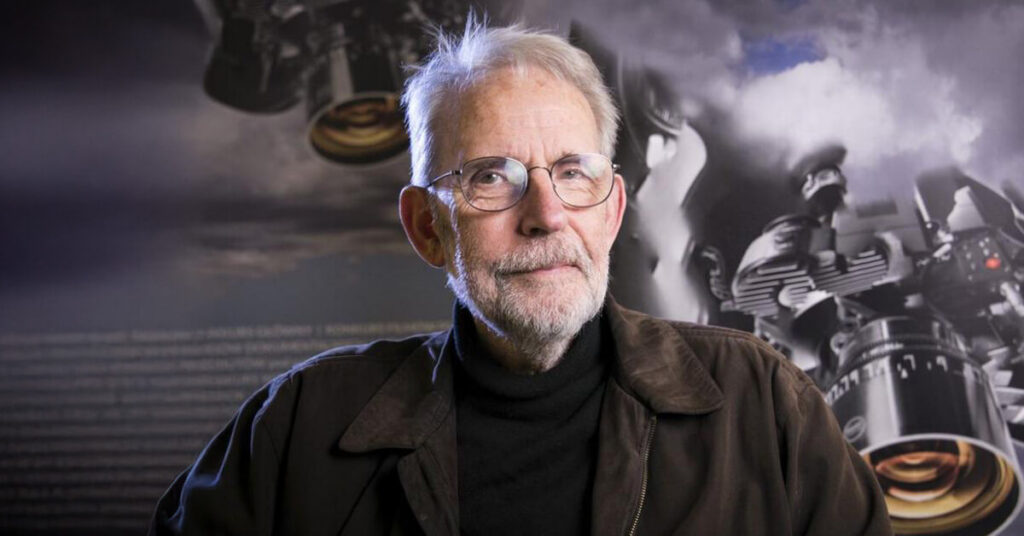
Why the Machines Will Never Fully Replace the Creative Process | with Walter Murch, ACE
Walter explores why creative disruption is cyclical, what endures in storytelling, and how to adapt without losing your footing in the age of AI.
Let's create things that matter. Together.

Is AI really going to replace you or is something bigger happening beneath the surface?
In this episode, I’m joined by Brian Merchant, technology journalist and author of The One Device and Blood in the Machine, who writes at the intersection of innovation, labor, and society. We dig into how we got here, where the future of work is heading, and how to define this new version of normal. If you’ve been wondering what artificial intelligence means for the workforce and your place in it, this conversation will help you better understand what’s actually at stake.
Brian Merchant is a writer, tech journalist, and the author of a bestselling book about the iPhone, The One Device. His most recent book is Blood in the Machine: The Origins of the Rebellion Against Big Tech (2023).
He has been the Los Angeles Times‘ tech columnist, an editor at Motherboard, VICE’s science and technology publication, and the founder of Terraform, its online fiction site. He founded Automaton, a project that examined the human impact of AI and automation, for Gizmodo. He currently serves as Journalist in Residence, AI Now Institute.
Brian is also the co-editor of a print anthology of Terraform stories, called Terraform: Watch/Worlds/Burn (2022). His work has appeared in the New York Times, Harper’s, Wired, the Atlantic, the Guardian, Slate, the Washington Post, Fast Company, Fortune, and beyond. He lives in Los Angeles.
Zack Arnold: Brian, I must say, it has been a long time coming that you and I have gone back and forth trying to have this conversation, and I’m a big believer that things happen for a reason. Originally, you and I were supposed to do this, I think, over a year ago, and at the time, I was so bummed that our calendars didn’t cross and we couldn’t make it work. But now, given the present circumstances and the fact that I can have you speaking for this summit all about navigating the future of entertainment, I’m so glad that we could not connect the first time, because I think the timing is infinitely better this time. Having said that, I just want to thank you so much for being here and for offering your expertise and your presence for my audience.
Brian Merchant: Oh, well, it’s my pleasure, and sorry to be elusive, but there’s just been a lot going on. I have been just about everywhere, crisscrossing, talking to people about AI and work and all the stuff that I imagine we’ll be getting into today. So great to be here, glad to be here finally.
Zack Arnold: As am I. Given you’re at the epicenter of the conversation on all things AI, all things job displacement, what’s happening with the economy, and what’s happening in business, it does not surprise me that you’re busy. For those that are unaware, you are a former LA Times writer. You now write at Substack, and it’s called Blood in the Machine, named after your book of the same name, which is not only just a book, but dare I say, a historical tome to help people better understand the history of technological shifts.
What I wanted to bring to today’s conversation were a few things. First of all, I wanted to take a step backwards to help people understand how learning about history can help us somewhat predict the future. I think there are few better to help us understand technological shifts, whether it’s the Industrial Revolution, the Luddite movement, or otherwise, to get a better sense of, is this unprecedented, or are there lessons that we can learn from the past? You’re also one of the best at knowing what’s happening boots on the ground right now and connecting with the actual people that are being displaced.
I have no doubt we’re probably going to stir the pot and talk some shit about the evil empire and the dark side. With this summit, I want it to be different in that we are going to be talking about the quiet parts out loud, but hopefully, I always want to leave my viewers with a sense of hope and a sense of what I can control to move myself forwards.
All of that to lay the foundation for our conversation, I actually want to start with the end. In the afterword for your book, you said the following: “Is a robot jobs apocalypse coming our way? Well, on the one hand, the answer is no. The predominant threat to stable employment is not a mass automation, but a perennial shortage of good jobs to be had, period.” Here’s where it gets really interesting. “On the other hand, there is an endless torrent of talk about artificial intelligence and shiny new robotics in warehouses and grocery stores and factories. So the answer there is also no.” I’m curious, having said that way back in 2023, which feels like it was 25 decades ago, how do you feel about that, given that we are now in a post-ChatGPT world? Do you believe a robot jobs apocalypse is indeed coming our way?
Brian Merchant: No, I don’t. But the point is not that we shouldn’t be worried about our jobs or employment or the nature of work. The point is that it’s being characterized incorrectly, and incorrectly on purpose, to benefit people who are selling those tools. The way that we hear about this in the media all the time is, “Are the robots going to take our jobs? Is AI coming for our jobs?” In all of those cases, the answer is no. It’s not AI, it’s not robots, it’s not some nebulously defined technological force that has no face. It’s management. It’s people, it’s bosses, it’s the companies selling these products in the first place.
Very recently, Dario Amodei, who is the CEO of Anthropic, maybe the number two guy in the space to Sam Altman at OpenAI, made some headlines for saying that pretty soon, half of all entry-level jobs are going to disappear to AI, and then 20% of all jobs are going to be taken by AI. He’s making these kind of apocalyptic statements, and the question isn’t whether or not we should be preparing on the policy level for that, which we should, but it’s, what does this guy have to gain by selling this vision? We have all these guys out there in Silicon Valley who are forecasting the jobs apocalypse, and at the same time, they’re trying to sell automation software.
I think we have to understand the composition of the threat that’s happening. There is a new tool, and it can do a lot. I’m not saying we should not be worried about what’s happening right now—I think we should be very worried—but we have to understand that it’s not some force of nature. It is, to some extent, what’s always happened. There’s a new technology being sold with a promise that it can cut labor costs by X percent, and it’s coming down the pipeline by people who are eager to see those cuts happen. We have to understand that these guys—Altman, Amodei, Anthropic, OpenAI, Google, Microsoft—they’re salesmen for AI software. And in some cases, that software can do the work that we like to do, and it can be used to degrade our working conditions and replace some creative jobs in scary ways. But it always can be traced back to a decision, and that’s a manager saying, “I want to have AI do this instead of you.” We have to understand that those are each points that we can contest. We can resist that.
Zack Arnold: Don’t you understand this is just the inevitable march towards progress? This is one of the things that I loved about your book, is that you pointed this out so eloquently: it is management, it is our bosses, it is those that are making the hiring decisions that are going to replace us, not the bots.
This really is about understanding this inevitable march towards progress but also how we are a part of it. A few years ago, it felt like there was maybe this small, tiny window where we thought, “Is there a way to stop this before the snowball starts to roll downhill?” It’s very clear the horse is out of the barn. Now it’s not a matter of “we must regulate so there’s no artificial intelligence.” Clearly, that’s not going to happen. When I was telling people that three years ago, I was a heretic, and I still have the scars from the flaming arrows that were shot at my back. I’m trying to better understand what our place is in this, so that we don’t lose our humanity or our creativity.
I believe to better understand where we’re going, we have to understand our past. That’s why I found your book and said, “This is the guy that I want to talk to.” So let’s dig into a little bit of a history lesson. I’m sure everybody here has heard this term before, but they probably don’t understand the real meaning behind it, which is anybody that’s objecting to using new technology is called a “Luddite.” Something tells me you have something to say about that.
Brian Merchant: That was really one of the catalysts for the book in the first place, setting the record straight about this group that has become not just maligned and misunderstood in history, but purposefully so. A historian named Theodore Roszak said, “If the Luddites didn’t exist, then they would have had to have been invented,” just to make these figures that you can blame for fighting back against technology as being backwards or standing in the way of progress. It’s a straw man so you can dismiss legitimate criticisms of technology, which has been a constant for the last 200 years.
I wanted to go back to the beginning. The Luddites were quite justified in doing what they did, and they have been purposefully misunderstood by history and by power, by people who are hoping to control the narrative. We see that starting right from the beginning of their uprising.
Zack Arnold: I would say a quick five-minute history lesson would be great, just to really understand the basics of this movement and then how it applies to the Industrial Revolution, so we can see the parallels to the time period we’re living in today.
Brian Merchant: Yeah, it’s really quite uncanny. The Luddites were cloth workers at the beginning of the Industrial Revolution, at a time when cloth work was the biggest industry, apart from agriculture, in England. You have hundreds of thousands of skilled cloth workers—weavers and framework knitters and people making lace and silk and stockings. It’s the biggest part of England’s economy, and that’s what allows the Industrial Revolution to happen.
You have all these skilled workers who are used to working in what’s called the “domestic system,” or the cottage industry, where workers use machines at home or in small shops. Notably, they are technicians; they work with technology every day, the technology of their time, which is looms and frames. When the Industrial Revolution, as we understand it, begins at the turn of the century in the early 1800s, it’s less about the technology and more about the organization of factories. There are some new technologies that can do early automation, but most of this technology has been sitting around. The spark that lights the Industrial Revolution is the beginning of organized factories.
You start to have entrepreneurs and factory owners build these operations that can use this machinery. They start to staff them not with skilled workers, but with precarious workers that they can pay less, often with children. This starts to lead to a situation where you have worse cloth being produced in larger volumes and in worse conditions, and all of the profits are accruing to the factory owners. Meanwhile, the skilled workers who are making better and more durable stuff at home are seeing their wages just deteriorate. It’s different than it happens today. Usually, you have a town that produces wool, and then a factory owner comes into town and says, “Well, I’m just going to build a factory over here, staff it with children, and take all of the market share.” As the proto-Luddites would call it, it looks like theft. This guy just moved into town, he’s taking all the work, he’s undercutting you, and you suddenly can’t feed your family.
The cloth workers spend about 10 years protesting and petitioning Parliament. They say, “Hey, these new machines and the entrepreneurs who use them are not following the laws. They’re ignoring it all.” Might sound familiar to us today. “This is a new technology; we don’t need to follow the old rules.” They’re driving down our pay. We can’t feed our families. We’ve got to have things like a minimum wage. They get laughed out of Parliament. They can’t form unions because of something called the Combination Acts. Parliament eventually tears up the laws, giving them no protections. Their wages are going down. Factory owners are the only ones who are profiting.
Finally, with their backs against the wall, the Luddites rise up. They take matters into their own hands. After 10 years of peaceful protesting with policy ideas, they’re totally ignored. So they write threatening letters to factory owners, saying, “Take down these machines, or you’ll get a visit from Ned Ludd’s army.” If they don’t take down the obnoxious machines, they’ll slip into the factory at night, hold the overseer up at gunpoint, take a giant hammer they called “Enoch,” and smash just the machines that are automating work and tearing up the social contract. All the machines that were used before, that do not degrade jobs, they leave alone.
Luddism explodes. They make up a figure called Ned Ludd, who becomes their Robin Hood. The first Luddite movement is in Nottingham—Robin Hood, Ned Ludd. They’re drawing from the same tradition of resistance. It’s a huge, well-organized, immensely popular movement that’s fighting for the working class. People cheer them in the streets. There are songs about the triumph of General Ludd. They’re celebrated. Sometimes the magistrate will sympathize with the workers and watch as they smash the machines in broad daylight. A lot of factory owners reduce prices or take down their automating machinery because they don’t want any trouble. But eventually, the state won’t allow for that. They make it a crime punishable by death to break a machine. They send in more troops than at any point in England’s history to that point to occupy the industrial districts to fight the Luddites. Eventually, many Luddites are hung, others are gunned down in battles, and the Luddite movement is stamped out.
Zack Arnold: What a place for us to start. My goodness. There are a lot of parallels there. Without getting too deep into the politics of it, I firmly believe in our ability to protest and share our thoughts, but I do not advocate for any form of violence whatsoever. If we look at history, we would say, “Well, clearly that didn’t work,” because we have modernized throughout the Industrial Revolution. But if you replace the words “wool” or “textile” with “creativity” and all the other things we’re looking at now, it’s fascinating.
We go through these historical shifts that reshape society, but then all of a sudden, when it happens, it’s like it never happened before, and everybody says, “This is absolutely unprecedented.” My response is, just read a little bit of history. I’ve talked with multiple people throughout the summit, and what we believe to be unprecedented is not what’s happening, but the amount of different historical things that are shifting and the speed at which it’s all happening. So what are your thoughts about how much of this is unprecedented versus parallels to the past that we can learn from?
Brian Merchant: Well, first, I’ll put a little caveat. We like to think that this was a blip and that everything has been modernized, but it hasn’t really. Most of our clothes now are made in poor working conditions in places like Cambodia or Bangladesh, often by looms that are not so much more advanced than they were 150 years ago. Sometimes technology is used to scramble working arrangements, and then sometimes permanently. When the Luddites lost, they lost that battle somewhat permanently. It’s really hard to make a middle-class living as a cloth weaver.
To your other question, yes and no. The one way to look at AI, especially as it’s affecting creative industries, is that it’s an automation technology. This is the way that it’s being used materially. The bulk of the way that it’s interfacing with society is to automate the production of various, usually creative, artifacts. It’s automating production in a similar way to how technology has been used to automate production in the past. To this point, we can anticipate the way that automating technology will be used, given that we have a very similarly organized economy. We can and are already seeing a number of rather predictable use cases for this stuff.
With AI, we see the basic desire to reduce labor costs. That’s what it’s about, and that’s what studios and executives are oftentimes hoping to achieve. It seems to be getting pretty good at editing video, so maybe I don’t need to hire a video editor or a storyboarder. You can see a lot of the chatter already surfacing this way. That’s a real concern, and that’s why it was the focal point of the strike a couple of years back with the WGA and SAG-AFTRA. I don’t think anyone’s really thinking that AI is going to replace screenwriting wholesale. Nobody wants to read an AI-generated script or hand that to Martin Scorsese and say, “Here’s your next movie.”
But it’s understood, just like in the Luddites’ day, that if somebody makes a script and starts off with the raw materials, the boss can retain more ownership and charge less to rewrite it, maybe keep the IP for himself. You see some of the same risks: more quantity over quality, eroding conditions, and justifications to push down pay. “We don’t need to pay you as much because we could just have the machine do it.” We see leverage to justify paying folks less. Plagiarism is a huge concern with AI now, as it should be. Back in the day, they would have machines that could make what they would call “knock-off goods” that were just cookie-cutter type stuff, made to look like the higher quality stuff that artisans were making, but that they could produce more cheaply and then undercut them on price.
We see all of these trend lines. This is just what happens when you have an automation technology introduced into an industry. To some extent, some of these things are predictable. I’ve been talking to writers and artists, and there are industries that are uniquely vulnerable to AI right now. Just like there were parts of the cloth trade in the Luddites’ time where a machine could do that whole job. What do we do when there’s a person that has a job that a machine can do? Today, I see illustrators are really fighting with this. They’ve seen their work hollowed out already because for corporations and internal presentations, you can just have Midjourney do that now, where you used to have to hire an illustrator or a graphic designer.
Zack Arnold: There are so many threads in here that I want to pull on. I’m having an upcoming interview with Sean Cushing, a visual effects artist, and we talk a lot about what things are highly automatable and repeatable versus the more generalized, highly creative skill sets. I also talked with Matt Nix about what I would call “the end-shittification of creativity,” where, like you said, hundreds of years ago, all of a sudden there was much crappier clothing coming out.
One of my bigger concerns is the speed at which AI allows us to now generate, quote, “content.” But I feel those that are high-quality storytellers with a real vision won’t necessarily be replaced. I’ve been saying since very early on that creatives are not going to get replaced by AI; creatives will be replaced by creatives that are using AI. The Luddites may not have won outright, but it was their resistance that helped find a middle ground where they weren’t just completely displaced. I feel like we’re in a very similar place. For those that are saying, “No AI, we must abolish all of it,” number one, that ship has sailed, and number two, it’s never going to happen. But if we just give up and get replaced, it’s just the march of progress. We have to find that middle ground.
I want to get deeper into the stories you’re hearing today. You’re saying this is what’s happening right now. You’re talking about AI already killing jobs. So what are you seeing right now? What are a few of these stories that help us better understand who’s in trouble, who’s protected, and how do we figure out the next act of our creative careers?
Brian Merchant: Unfortunately, creative industries are more exposed than others. It is going to be a challenge and will necessitate new thinking. As a journalist and a writer, I would count my industry as one that’s also threatened. I have an ongoing project called “AI Killed My Job.” Some people have been replaced wholesale, usually when a management department decides to get rid of every worker in a department and try to replace it with AI, as part of a broader downsizing initiative.
Duolingo is a great example. Most recently, Duolingo came out and said, “We have an AI-first strategy. We’re going to increasingly use AI to generate all of the written materials that our app users interface with.” It turned out that they had already laid off scores of people. Their AI-first initiative was quite real. I spoke to workers there who were just let go.
The scariest thing for creatives is that we are all susceptible because of the “good enough” principle. If you’re working for a storied magazine that only wants to put out the best images, you’re going to be okay. Or if you’re working for a prestige TV show, you’re going to be okay joining the writers’ room. But if your work is something that management at some level can determine is “good enough” and can be replaced with Midjourney to save a couple thousand bucks, then we’re seeing a lot of that. I’m seeing really talented illustrators lose their clients because they were doing work that fell victim to the “good enough” principle. It’s definitely not better, but it’s just a cost-cutting measure, especially for stuff that’s not public-facing.
For internal stuff, which is how a lot of creatives make their money, doing work for advertising companies, marketing companies, copywriting gigs, that bulk of work is what’s really vulnerable to AI. Translators are getting it really, really hard right now, visual artists, writers, copywriters, and to some extent, tech workers and coders.
I don’t know how permanent a lot of this will be. There are a lot of bosses and managers who are very excited about enterprise AI. I think some of it, especially in non-creative fields, will come back because they’ll realize that it was actually messier to automate. I think our real risk right now is in the creative fields. People with relationships that already exist, who know the editor or the producer, those are the ones who are going to be safer. It’s a rough time for folks who are just starting out.
Zack Arnold: You and I are definitely beating all the same drums. A core concept that I have in multiple conversations is that the future of your career will be dictated by the quality of your relationships. If it’s just, “This is my one skill, my one craft,” you are hugely vulnerable. But if you start to diversify who’s aware of you and your skills, that’s where I see the future going.
I want to come back to what you’re calling the “good enough” principle. What I said as soon as ChatGPT came out is that artificial intelligence is going to kill the careers of the mediocre. Before, we would always say, “You got fast, cheap, and good—pick two.” But now they can say, “I get fast, I get cheap, and I get good enough.” I can have all three. That’s where I think the true danger is.
I want to use you as an example. There is a world where I could go into ChatGPT right now, and I’m sure your content has all been scanned. I could say, “Write me a 2,000-word Substack article in the voice of Brian Merchant about our future with artificial intelligence.” It’s probably not going to be the worst thing ever. But the reason that I want to follow you is because of your taste, your choices. You know which articles to point to, which people to talk to. AI is not having conversations with displaced illustrators and former Duolingo employees. It’s you knowing how to connect the dots and recognize the patterns. There’s no chatbot that’s going to replace that. So why in the world would you, Brian Merchant, be worried about your future? But I also realize that’s a little bit of a myopic point of view. What are some of your existential fears about your future as a journalist and a writer?
Brian Merchant: I’m not so worried for myself. I’ve been in this field for 15 years. I have those relationships, I have a head start, I have an audience. I do think that there is an emergent sub-economy for human-first stuff, and it’ll be interesting to see where it goes. People are talking about an “AI-free” type of label, like a “no GMO” label. It’s an interesting thought, a reflection of where the culture is at. It’s not going to be sufficient to sustain it, but it is something to be aware of. There are going to be editors and clients who are just like, “We’re not going to do AI.” So it’s worth finding folks who are really interested in the human-first principle.
My concern is that my job is just going to follow the same trajectory as a lot of other jobs. As we feel like we have to compete with AI that is now surfacing snippets of information on Google overview, people might not click on the link that it pulled that information from anymore, depriving us of meager clicks. We have to work ever harder, create more parasocial relationships with our readers, and hustle more and more. My worry is not that AI is going to replace me, it’s just that it’s going to continue to degrade the economic conditions that I have to live in.
When I got laid off from the LA Times as part of the last mass layoff, some of the younger reporters were just like, “Maybe I’ll just go to law school,” because the conditions are so harsh. As a practitioner of journalism, if anyone who’s not already well-off or established, can I say, “Go do this trade”? I’ve talked to my illustrator friends who teach at an art school, and they’re like, “What are we teaching? Where are the jobs going to be?” You can’t hustle your way out of this. It’s a macroeconomic issue.
My concern is that I’m just going to keep having to hustle and not feel secure the way that I would have if I had just kept that newspaper columnist job, which was the best job I ever had. I’m worried that there’s no end to it. It’s just hustle all the way down. And I think AI really just greases that wheel and accelerates it. Everybody’s going to have to hustle. And that’s exactly what they want. Even if they don’t replace you, the AI companies want everybody to feel like they can be more productive, so you win if you buy their enterprise software.
Zack Arnold: This ongoing theme of going back to the hustle is something that multiple guests at the summit have talked about. Even those at the top of the ladder are doing the kind of hustling they didn’t have to do five or ten years ago. The most difficult part of all this is what I’m seeing happen to craftspeople in Hollywood. A few years ago, people were reaching out to me, saying, “Do you know any good editors or assistant editors? If they know how to open Avid and they have a pulse, they’re hired.” And now it’s, “We’re going to take away all the time you need, have you work more hours, and give you less money. If you don’t want to do it, fine. There are 500 people on this pile of resumes that would kill just to have a job right now.” We are seeing exploitation of the workforce like we probably haven’t seen in our lifetimes. That, to me, is the biggest fear of this, not that we’re all going to get replaced and automated. It’s the change in the workforce, the conditions, and the expectations that scares me the most.
Brian Merchant: 100%. And we also want stories about our storytellers too. You can’t have that if it’s just an AI that made this. We follow celebrities, even writers, because of the attendant stories. People connect to them. The value of the story as told by people is not going to disappear, far from it. It’s exactly what you’re saying: those economic conditions that underlie it make it so challenging to deal with. It’s never been a cakewalk to be a creative person.
That said, I do think that there is a material difference with AI, in that we’re dealing with creative products that can be conceived and produced wholesale with a few clicks of a button. The scarcity of those things is somewhat artificial. It’s intellectual property; it’s the connection to the people that are creating them. That is one of the marked differences from the time of the Luddites when you were making real cloth. There’s no limit to how many stories that AI can generate. There’s a clear limit to how many people might want to read them, but there is this new, limitless volume that can be created, and that is a powerful tool that management can wield. I think it’s going to be very dependent on the nature of an industry and what workers do around it. But I do fear for the younger people who have to contend with all this and say, “Where do I even start?”
Zack Arnold: Just to hit one of those points home, it’s not like pre-ChatGPT, it was easy to break into Hollywood. It’s always been one of the hardest industries to break into. It’s just now that there is literally no path. There’s no sense of, “Where do I break in? What do I have to learn? Who do I have to know?” My theory is that we’re witnessing, and this is where I want you to bring in the historical context, the transition from being highly specialized craftspeople back to being generalists. Your ability to say no when somebody says, “Sorry, this is what you’re going to get paid,” depends on your ability to have other options. When you have other options and they really want you, you have a little bit of leverage. Those options require diversification of your skills, interests, knowledge, and network.
If we were to look historically, whether it’s at the Luddites or other movements, do you agree with the assertion that we’re transitioning back to our pre-Industrial Revolution roots as generalists? If that’s the case, what can we learn about what’s going to future-proof our creative career paths?
Brian Merchant: What happened last time, and what would have happened sooner if it was even possible, was they had to get organized together. It has been argued by folks like the historian E.P. Thompson as sort of the birth of the very concept of the working class. Before that, people didn’t really draw the connections always between a saddle maker and a cloth maker. This really drove home the point that they were all facing similar economic threats, and the scope of their grievances was very much aligned. It consolidated this class solidarity.
I wonder if one thing that might happen today is, the creative industry is very atomized. You have people working at home on their scripts, you have illustrators here, writers there, designers over here. What I think needs to happen is we have to find ways to build more solidarity among workers, among creatives, to better understand the nature of the threats we’re facing. How to keep the power to use AI in the creator’s hands is ultimately the important thing. The WGA, in particular, won a really interesting contract, and we don’t hear enough about it. Basically, the studio can’t use AI to write a script that’s going to compete with the writer. If the writer decides that there’s an interesting way to use AI in the scriptwriting process, that’s up to them.
How do we keep the power in the creatives’ hands? The only way we get there is through hard work, solidarity, and organizing. It’s through understanding that now we’re facing a new plight together and that we are all staring down the barrel of a very similar threat. But we can overcome it.
Zack Arnold: That’s exactly why I worked so hard to get you to be a part of this summit. What you just said is giving very clear, concrete action steps about how we can come together to hold the power of these tools with the creatives. The one piece that I want to really hammer home is that we need to think outside the silos. Where are the editors? It’s not just the editors; it’s the picture editors, the sound editors, the visual effects artists, the art directors. In these collective bargaining agreements, the reason that, for example, IATSE has no power is because we’re all wanting our own individual things, and we never say, “No, we are the filmmakers. We are the film workers.” We need to band together. We have to strip our job titles away and realize we’re the creatives, the artists, the storytellers. If we continue to live in these silos, we are going to get destroyed.
Brian Merchant: I think that’s really well said. Every creative worker deserves to have a protection like the WGA won. How do you universalize that? I think this is a moment where, one of the reasons the strikes resonated so deeply is because a lot of people are feeling that, even outside the creative field. They’re fighting for a way that we can stop it, or at least find equal footing at the bargaining table. I think this is an opportunity for people across the creative industries to all work together, to understand that we are all facing these similar threats, and we can find a path forward if we do unite, if we do fight it together.
Zack Arnold: Agreed. Collectively, all of this is tremendously useful. To wrap it up, individually, I am one person watching this conversation. I agree with this idea of collective bargaining. If I’m one person, what can I do after this to start making change happen for me and everybody else?
Brian Merchant: Get in the comments sections of this chat, or find whoever. We’ve got to get back to just meeting. That can be not only for generating solidarity or organizing, but learn what other people are up to. Build creative communities again, inside or outside the confines of a job. We can find forums where we’re on the same page, but if we can get into rooms, start talking to each other, whether or not it’s about a specific organizing goal. Just start talking, start understanding each other, get out there, and start spreading the word. The more that we talk, the more that we understand the universality of this plight, the more that we are going to be positioned to address it. Network, but network with an eye towards understanding that it’s not just about advancing your career; it’s about advancing the prospects that this career will continue to exist in 20 years.
Zack Arnold: All I can say to that is, “Hear, hear.” That is so well said. I could not wrap this up in a more succinct fashion. I’m so glad we were finally able to make this happen. For those that are here now that want to interact more with you, your work, and your writing, where’s the one place you want them to find and follow you?
Brian Merchant: Find me at bloodinthemachine.com. That’s the newsletter I do. The comment sections are there, my email is there. Reach out. I’m also on Bluesky and Twitter.
Zack Arnold: Gotcha. All right. Well, thank you so much once again, Brian, for your time, your expertise, your presence, and for giving us a ray of hope in this massive amount of chaos and uncertainty.
Brian Merchant: Thanks for having me, and best of luck to everyone out there. Cheers.
Edited by: Curtis Fritsch
Produced by: Debby Germino
Published by: Vim Pangantihon
Music by: Thomas Cepeda
Walter explores why creative disruption is cyclical, what endures in storytelling, and how to adapt without losing your footing in the age of AI.