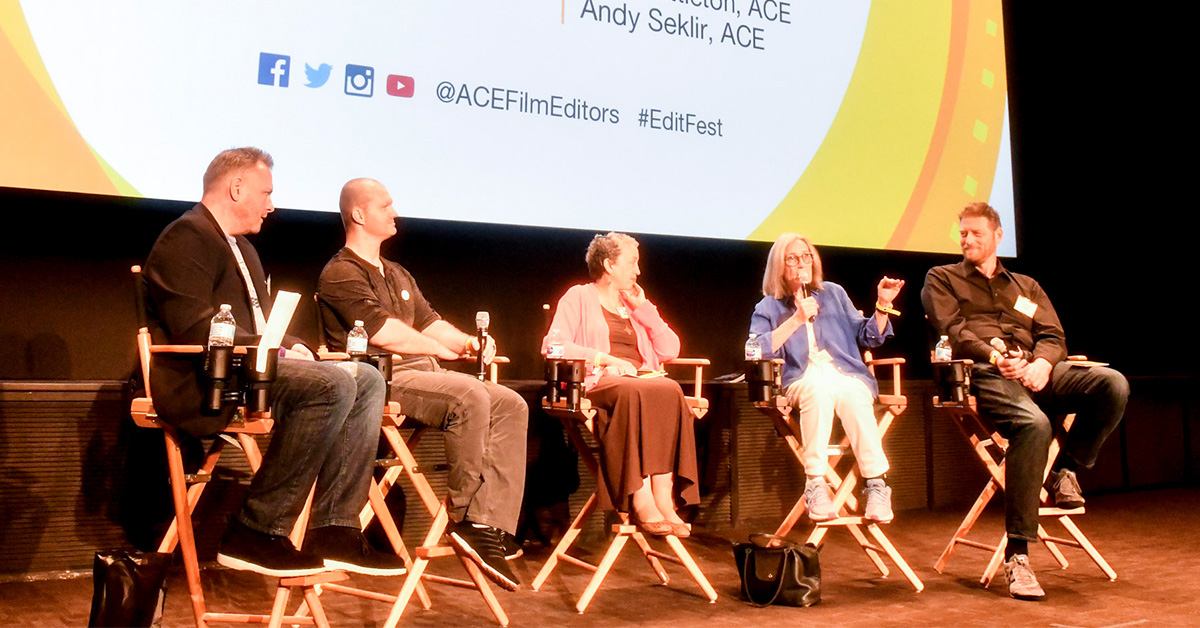
EditFest 2018 Panel “The Extended Cut: How to Survive and Thrive In Editorial”


About Episode
This bonus episode is a raw recording of my recent appearance at the wonderful event Editfest in Los Angeles where I was on a panel sponsored by Avid Technology titled, “The Extended Cut: How to Survive and Thrive in Editorial.” The panel was moderated by Matt Feury of Avid Technology, and in addition to me the panel also included Lillian Benson, ACE (ACE Officer and co-chair of the diversity committee), Carol Littleton, ACE (Member of the Boards of Governors of the Academy, Past President of the Motion Picture Editor’s Guild, and award-winning film editor), and Andy Seklir, ACE (Award-winning editor of Westworld as well as one of the architects of the “ACE Best Practices” Pamphlet).
This panel was a brutally honest and open look at what it really takes to not only survive but thrive in Hollywood as a film editor. We talk about the brutally long hours, bouts with depression and burnout, issues with diversity on both an ethnic and gender level, office politics, and the importance of not letting anyone steal your creative passion. This was a ‘No Holds Barred’ conversation where no topic was too taboo.
NOTE: This is a raw recording of a live event so I apologize for any inconsistencies in audio quality. No editing has been done to this recording…this is LIVE and UNFILTERED.
Episode Highlights
- Facing the question, “I love my work, but is it worth all of this physical pain and mental anguish?”
- Focusing on your own wellness in order to enhance your storytelling power
- Fighting the status quo of unhealthy working conditions for editors
- Being a woman nin the industry and the quietly malicious ways you are discouraged from asserting yourself
- Finding, refining, and protecting your moral center while discerning whether a job is good for you or not
- How to process being fired and facing other tough workplace confrontations
- Being disrespected will rob your of your passion, you owe it to yourself to protect it and your identity
- Recognizing when “paying your dues” is related to you growing stronger rather than simply being mistreated
- Breaking the cycle of harmful cultures of competition in the workplace
- Learning to give and receive criticism without jeopardizing your job
- Reinforcing patterns of physical movement in your day in order to reduce tension and toxicity
Transcript
Matt Feury: And thank you all for being here today. Thank you, Ace, for giving Abbott this opportunity to host this panel. I consider myself fortunate that I get to do a lot of these things and talk to a lot of different editors, and I can honestly say I don’t know how this one’s going to go in a very good way. It’s there, could be some brutal truths that come to the surface. I hope there are. Steve did a great job of teeing everybody up, so that saves me the trouble of doing that, but I’m going to just redo it a little bit anyway. And you might notice, as we do this, going to try and make a conscious effort not to talk about the films and television shows and documentaries, and all the great work that you’ve done as individuals, because this panel really is about the career in general, and about extending and having a nice, long, and fruitful, and hopefully happy career. I can say that I’ve been talking to a few editors this week as I’ve been here, and I don’t recall them being this pissed off. I’ll say that
Andy Seklir: We’re not going to take it anymore.
Matt Feury: Yeah, it was.. it’s pretty unsettling, and I don’t like to hear that. So, I’d like to see everybody much happier myself. Seat right next to me, of course, is Zack Arnold, and among the distinctions that Zack has is his program, Optimize Yourself, that he is the visionary behind something you’re going to be hearing more about, and it’s a great effort and wonderful that he’s doing that. Carol Littleton, so we’re out of order here, so you’ve got to stay in order. Lillian Benson, Lillian, not only she a member of the Academy Motion Picture Arts and Sciences, an ACE officer, co-chair of the diversity committee, but she’s also the first African American female editor selected for membership in the American Center of Editors, and I think that is an amazing thing. This is, as I, as I teased her, this is a mantle she wears with grace and dignity, and one I’m sure she wishes somebody else held much before her. Carol Littleton, member of the board of governors of the Academy, past president of the Motion Picture Editors Guild. Maybe MPEG will come up a little bit today. And member for the ACE Board, Carol, also co-architect of the fantastic yellow pamphlet, the ACE Best Practices Guide that mr. Seckler has on his knee over there, and of course, Andrew Seckler, the other co-architect of the ACE best practices guide. Well, for our purposes, you’re the architect. It’s okay now, Zack. I want to start with you, because you’re one of the first people that I talked to, and one of the driving forces behind the way this panel came together, and this panel did not come together very organically. It was one of those things that sort of just sort of went in different directions till it all came back together as being this big picture thing about physical wellness, mental wellness, diversity, inclusion, how to take care of one another, how to take care of yourselves as editors, how to speak with one voice as editors, which apparently is a very needed thing right now. So, Zack, what prompted you to start this Optimize Yourself program? Why did.. what was the.. was there a single defining moment where you said to do something about this, or was it just gradually over time?
Zack Arnold: Well, there’s a single defining moment for me as a person, or me as an extension of my machine, so to speak, because that’s really where it all started. And for anybody that has listened to the podcast or read my blogs, you’re gonna be like, “Oh my god, we know your story already, but there are probably some people here that have not heard it. So, basically, I was about 25 years old, I was editing my first feature film, which was a huge opportunity for somebody at that age. I was just two years out of college, and I was working with a director for 16 hour days, seven days a week, so. I was working out of my home, which I thought was a good thing, until I realized that it basically chained me to my workstation 24/7 She would knock on my door at 9am she would leave at 1am We would work through lunch, work through dinner, and I did this for seven or eight weeks straight. And as soon as I got a break, I started to have a complete, total, and mental breakdown, and I reached a point of suicidal depression, and I just remember sitting in my little office slash edit suite, really late one night, the lights were off, and just thinking to myself with my head in my hands, I cannot live like this anymore. However, I love what I do for a living. There’s nothing more exciting than sitting in front of an empty timeline, and playing Tetris with colored blocks that translate to people’s emotions. We play Tetris all day long to make people feel something. I love doing that. I’m so passionate about it, but I got this wake-up call that, oh my god, is this really what it’s like to be an editor? Like, this is not what I expected at all. And I decided that what I wanted to do was stop treating myself like a Ford Pinto all day long, and I wanted to start treating myself like a Ferrari, but how do you do that? What does that actually mean? So it was really a journey of over a decade trying to learn everything I could about not just being a fantastic editor and a storyteller, but how can I be a high-performance machine, which ultimately makes me a better storyteller, makes me more creative. And then, as all the pieces started to come together, I would start to have colleagues come to me, and they’d say, How do you have so much energy, and how are you working these long hours? And you, you just seem fresh all the time, like that’s not fair, like we’re all exhausted. And I realized, oh, maybe there are some people that you know I can talk to about this. We started a hiking group, and I said, “Oh, maybe I should start a blog. I didn’t know anything about a blog. I didn’t even know how a website worked. It was just this big giant disaster of a learning experience for a long time, but then I realized that I wasn’t the only one. I realized that there were a lot of people coming to me saying, “I’ve been so afraid to talk about the fact that I’m anxious and I’m depressed, and it’s so hard going into work, and I’m exhausted all the time, but if I tell people I’m tired, I feel like that means that I’m weak. There’s something wrong with me, and they’re gonna, they’re gonna replace me, they’re gonna hire somebody else. But you’re talking about the things that nobody else wants to talk about, so people just.. it’s just this thing that came out of nowhere. I really didn’t intend for this to be a thing, it was just me getting on my soapbox, and I made the joke to a bunch of people that if there were more room on the stage, I literally would have brought my soapbox and started standing on it, because I’ve been screaming about this stuff for years, but the conversation is really, really starting to happen, which to me is so exciting that we’re here today talking about it, hundreds of us, not just looking at clips, which is great, not just learning about storytelling, but how can we become better storytellers by focusing on this being the operating system and the machine that we really need to optimize, not just the hard drives, and not just the computers, and not just the NLES, so to speak.
Matt Feury: So, what? Well, said, you know, the best practices guide that you have there, Andy. There’s definitely there are components of it that talk about the working conditions. What about the stuff that Zack talked about? I mean, does it, does it touch on that? Are there avenues there within that best practices guide where you can get into discussions with the people you’re working for about, hey, listen, I need, you know, for my own physical wellness, and to give you a better, I think one of the things that we need to touch on is this. Also, plays back into the creativity, I mean, the quality of the work will be better if I’m better conditioned, if I’m feeling better, if I’m being able to get out and go for a walk, or whatever it is I need to do to not just sit in that chair all day.
Andy Seklir: Yeah, well, I mean, that’s what that’s really what it’s all about. I mean, we’re artists, we’re storytellers, and we’re very passionate about what we do. You know, it’s a wonderful thing to be, to be able to go into a room every day and create, right? That’s why we got into this, and my philosophy is that if you’re healthy, you know, psychologically healthy, physically healthy, if you feel good about yourself, about your, your working conditions and your life, you’re going to do better work, right? You’re going to bring more energy, you’re going to be more relaxed, you’re going to be open to things, you’re going to be more spontaneous, and, and that’s really what it takes to thrive as an artist, right. And so, yes, I mean, it’s so, in short, yes, the best practices book does touch on things like ergonomics, you know, the fact that you should, you know, in the last, say, five years, you know, and more editors have been standing, right? You have, we have these sit-stand desks now that are becoming standard within the industry, but some productions don’t want to pay for them, or some studios say, ‘Nah, we, you know, these are the tables we have, they’re sit, they’re sit-only tables, you know, things like that. There’s other things like being able to open a window, or even have a window, you know. Let’s let sunlight into your, into your bay, you know. I mean, it’s, it’s scientifically, medically proven that, you know, if you’re deprived of sunlight, you know, you can get depressed, right. And that’s not good for creativity, so a. Um, it’s really about, you know, taking a stand on issues where, you know, when I got into this, I thought, wow, it’s amazing. There’s a union for editors, you know, there’s someone out there that’s doing collective bargaining, that’s, you know, looking out for our best interest in terms of wages, in terms of our hours, that’s providing, you know, a foundation for us to build our careers on, but what they don’t touch on, what the union doesn’t fight for, are things like working conditions, and so you know, coming up in this industry, you know, I started as an AE, and you know, sort of, sort of worked my way up, and worked in a lot of crazy environments, you know, at studios, where, you know, on the ground floor of the editorial building was the fiberglass manufacturing plant, where they would turn it on at, you know, 9:10pm and you’d be in there sinking dailies, and the fumes would be coming up, you know, and you’d start to feel lightheaded, or, you know, you work in the former stables, right, you work at a studio where the editorial building used to be the stables for where they kept the horses for the westerns, right, and there’s no windows in there at all, and you can work in these places for years, and this was these are things that are accepted, you know, like, and a lot of these things happened for very practical reasons, you know, like when when film started being shot, you know, you needed a dim environment, you know. If you’re looking at something on an upright movie, Ola with a 30 watt bulb, you know, you can’t have a big window behind, you’re not gonna be able to see the screen, right? But these things then sort of stayed the status quo for a long time, for, you know, for editor. Well, that’s where the editors go, they go in that building over there, and you know, I mean, there was a, I’m six nine, right, so there’s a building I worked on where the ceilings were like six foot, you know, that doesn’t work, so you know it’s just, you know, like there’s so, what this booklet is, it’s not the minimum of what editors need to thrive. It’s sort of the ideal, right? Like, I think it was. It’s important that we say, what are.. what would be the ideal conditions? You know, how would we really like it to be? And it’s very hard when you go into a job, you know, as a single person, they’re setting up a post-production department to lay down your list of demands, to say, you know, we should have a kitchen, we should have a bathroom, you know. We should have maybe a communal room where we can all eat lunch together and talk about our episodes, you know, the things that these guys were talking about earlier. You know, it’s that there’s a culture on every show, and the hope is that when you’re working with other editors and other assistants, or you know, in a multi, you know, editor, multi assistant environment, that you’re all sharing ideas, talking about the shows, talking about your lives, you know, have a forum to do that. A lot of, lot of post production, post production departments don’t, that doesn’t happen because there’s no forum, there’s no place for it to happen, you know. So these are all things that we talk about in this book, and the idea of forming the committee and having Ace kind of put this together is that when you go in, you can say, well, it’s not just what I want, but it’s what Ace, what American Cement Editors says is the ideal for us to do our best work, you know, and the hope is that the more editors that ask for these types of things with the backing of Ace, that eventually some of these things will become institutionalized, you know, maybe some of these studios will say, well, maybe we should raise the ceilings a little bit, you know, in that building, or whatever it is, because they realize, you know, it’s it’s time, time is, you know, changing, you know, like technology, look at the pace of technology, right, it’s accelerated so fast, the camera technology, the editing technology that’s now available to us, and yet a lot of these environments are staying the same, or getting worse, you know, or the hours are getting longer, you know. We’re still fighting turnaround, we’re still fighting for things that should have changed a long time ago. So,
Matt Feury: So I guess for Lillian and Carol, where does the friction come from? Where is the resistance when you’re trying to raise these issues about working conditions, about diversity, about inclusivity about health. What is who’s arguing, and what is the argument that they’re making?
Lillian Benson: Well, I don’t argue, and I say that, you know, it’s funny, but it isn’t. I grew up in a neighborhood where if you got in an argument, you could get killed, so that’s probably too much information, but I actually had a director who, a while back, and I said it to her, and I realized that that was indeed my nature, that she loved to fight, she loved to argue, her family must have been that way, and it’s the only director I’ve ever turned my back on, and I said, ‘Oh, you’re not going to change anything. I said, ‘So I’m going to go back and do it exactly the way you want it. I’m done. I said, ‘I don’t argue, and I turned my back like the cats turn their backs on you when they’re done with you and. Don’t want to talk to you, and I just went to my avid, and I kept working, and that show was one of the best shows I’ve ever done, but it wasn’t because that was a kind, decent director, I had a kind, decent executive producer, assistant, everybody around me, but that director was not a nice person. I do think that there’s probably other people can bring these things forward about certain kinds of changes. Being a woman, people are always there. Are many, many people who will look at you like you can’t do the work, who will judge you differently. You just have to, I believe, concentrate on the work and encourage people as you are coming up, because people encourage me. I saw one African American female editor when I started, and she was, to my knowledge, the on the East Coast, the only one, one of my other mentors, she was not a mentor, my one of my other mentors, John Carter passed away this week, he was the first African American member of ACE, the second person of color, John So, was the first Korean American. He was the first African American editor hired in New York City. So, you learn from those people, you learn from all the other people that you work with, either what you will do or what you won’t do, and sometimes it’s behavioral what you will not put up with, and sometimes you have to quit, which is not the best solution. The union does does protect you in union situations, but I worked, although I’ve been in the union for 40 years, I worked in many situations that were non-union, primarily because they were documentaries. People are people, and they’re good ones, and they’re bad ones. And you don’t realize who you help by being a decent person in that workplace. You may be the only decent person that assistant knows, and then that assistant hopefully will pass it on when he or she becomes an editor, but I think as long as you encourage people, and that’s part of what the diversity and editing mentoring committee is doing is you encourage people as they’re coming up, you help them connect with each other, connect with job possibilities. The first person who got me a job was a white woman, and it was a woman, and I think that was the area of commonality, so you don’t know who’s going to help you, and it could be anybody. The person who helped me the most as a director was an African American woman, and then a white man, one, two, and a key critical point in my career, but you have a moral center. Everybody here has a moral center, and I think that is the hardest thing to protect along the road. It will be challenged from the time you are 25 and if you can keep that together, you will perhaps intuit the best jobs for you, and, and if they’re not right for you, and I say this, not having always been done what I say you should do. If it’s bad, leave, because there will be something else. Every job I’ve stayed in, where it was difficult, I paid a price, and you don’t get the time back. I told a young editor where I’m working now, I said, you never get the time back. You think you do, you never get it back. And, but there have been many joyous times too, and I can tell you what you know. I could go through a list of 15 things right off the top of my head, of assistants who helped me, directors who helped me. I had a director who would bring flowers, one in 40 years. She would bring flowers to editorial
Matt Feury: Time to get that in the guide. Andy
Lillian Benson: Yeah, so I mean, and that worked for me. I mean, I an assistant who’s now a member of ACE. We were working together on this film in 91 and she said, ‘Oh, we saw each other recently. She said, ‘Oh, I remember so and so. She used to bring us flowers, and she was telling another producer, and I know.. Producer who she had worked with had never brought her flowers, and it was another woman, you know, it just didn’t occur to her, and it’s a style thing too. If somebody’s style is not your style, try to learn when they are actually complimenting you, because sometimes something that’s so low key to you doesn’t seem to be a compliment, but in fact is all they’re able to do because of their own personality, you know. You might be an effusive person, or you might need that, but or they, they don’t think you need to be encouraged, so but I think I can’t. I’ve accepted that I can’t change people. I’ve accepted that, and I, you can work toward change, but there’s no guarantee that if I speak to you, unless it’s against the law, against actual legal stuff in the organization, or if it’s against some kind of moral law you have in yourself, then I don’t go there, because it’s well, you do get fired, unless I’m willing to be fired, and I have been fired for going to the mat, I mean, I’ll say that I’ve gone to the mat, and I was fired, and I wasn’t sorry. I went to the Met. I wasn’t sorry.
Matt Feury: Well, that’s that’s a reality of the business, that at some point everyone will be fired or be coming onto a job where somebody was just fired. Carol, how delicate is that? And how do you.. I mean, that’s in a creative environment like this that can be a tremendous blow to your ego. How do you manage situations like that, whether you’re the one let go or you’re the one going on to a job,
Carol Littleton: I’m not sure that I is the sound on. Okay. Oh, yes, I’ve been fired, and and it’s, it’s very uncomfortable. I think plenty of us have been in that position, and I’ve also replaced editors, which is in a way equally as difficult. and I would just have to say that I think Lillian hit it right on the head. You really have to be true to yourself and have courage, because if you don’t, you’re always going to be boxed around, and I think the important thing is for us to keep ourselves centered to really know what we, what we want out of the project, and what we want to convey in the film that we’re doing, and if you don’t feel comfortable doing that, you should quit. I know none of us want to do that, because we’ll think, well, this will, you know, it won’t, they won’t look kindly upon us, but along this whole conundrum of being fired and also replacing people, I think the most important thing, and I started doing this several years ago, many years ago, when I would be called to do either a doctor job or actually knowing I was going to be replacing someone, I would ask the producer, have you told the editor you’re going to replace them? Because I do not want to walk into a cutting room and I’m the one telling the editor, oh, I’m here to work. I didn’t know there was an editor, they didn’t tell you you’re going to be replaced by me. So I make that rule number one when I am replacing someone, so I want that person to know, and I want them to have the option of staying on with me, because I think that’s the fair thing to do. They know the project, they know all the difficulties. I have great faith in editors, I know how difficult it is, obviously we do. So that’s that’s my own rule of thumb, and if I know that I’m going to be, if I, if someone is coming in to replace me, I would hope that they would return the favor. Let’s put it that way. I’ve walked in cutting rooms a couple of times, and Who are you? Oh, I’m here. They didn’t tell you, I’m here to replace you. Very bad situation. And I know when you’re fired, you are crushed. I mean, I would admit it. It’s very, very, very difficult to get over that. And I think one of the things that’s very, very healthy is if you can talk, if you have a coterie of friends who are editors that you can actually talk to about this, because if something kind of grows in the dark, quite apart from the fact that we are working in the dark, it can become very polluting for your mind. It can really kind of destroy you from within. That is just simply not a healthy thing to do. I don’t know if I answered your question, but I think sometimes we have to go to this sort of heart of darkness and really talk about it. Many projects that I have been on, I know within the first two or three days I’ve made a mistake. This is not the. Project for me, and I earned, I learned very, very early on that if I, if my gut tells me that this is something I shouldn’t do, I want to listen to it. That’s, I think, that’s the best measure is to really be truthful with yourself, and I just don’t take on a project that I know I simply couldn’t do, for all kinds of reasons, like you say, whether it be personalities or the script itself or anything in between, I just don’t go there.
Zack Arnold: Well, if you don’t mind, one thing to add to that, and actually to ask a question to the audience. I know that in the beginning he polled how many were assistants, how many were editors, and whatnot. How many of you are here just because you’re like, I guess editing, I guess it’ll pay the bills. I’m not passionate about it, but it’s a job. How many of you here are in that camp? Nobody. Everybody is here because they’re like, this is so cool. I get to tell stories, and I get to make people feel stuff, and I get to put all these pieces together. If you’re working in a job where you’re miserable and people are treating you with disrespect, you are allowing them to take that passion from you. They don’t have the right to do that. You own that passion. That’s something you’ve had your whole life. And if people are disrespecting you, or it’s a matter of diversity issues, whether it’s your gender, whether it’s your color, whether it’s just the fact that you don’t, you know, you’re not respected in the edit room because of your creative choices. If you’re staying there, not only does it just kind of stink, but oh, I need the paycheck, you’re slowly letting these people erode that passion from you, and I don’t think you should ever allow people to take that away from you, and that’s something I need, that think that everybody here needs to protect, like you protect, you know, everything you own in the world, because that’s what’s going to get you the success that you want in this industry.
Matt Feury: So, yeah, absolutely. Okay, so building on that, you know, not just in this industry, but in a lot of businesses, there is a notion of paying your dues and of right of passage, and does that just get that concept get abused in terms of, like, okay, well, you know, you deserve to be treated like this. I was treated like this when I was starting out. Is that sort of a cycle of unhealthiness that just keeps perpetuating, or you know, because if I’m just starting out and I want to be where you are someday, I might be willing to put up with that. And how do I deal with that situation?
Lillian Benson: I’d like to take that one I read recently that you know it was a medical review that 80% your gut reaction is accurate 80% of the time, so the old adage, if it feels wrong, it is wrong, is true scientifically. I also believe that sometimes we accept things that people say or behaviors because it’s familiar to us, and sometimes we get hired because they perceive that our maladjustment will coincide with their behavior, and sometimes they’re just not nice people. I’ve worked for not nice people, I’ve worked for people who were just kind and thoughtful and intelligent and worked you very, very hard, but were decent human beings, and I think it’s more than just, I think it’s a question of character a lot of the time this person, who, as an example, gave flowers to her, who her editors also told me that I had no idea how good I was. She’s the first person who ever said that to me. She said, ‘You really have no idea, and you know, I didn’t. Why? Because nobody had told me, and I don’t come from a family where this was common knowledge, or where anybody was an artist. I went to art school, and some of that was subjective, you know. How did you paint? Somebody would like it. A teacher didn’t like you, they’d give you a C. Teacher liked you, they’d give you an A. It’s no different than here, but you know what you’ll accept, and what another person will accept. You don’t have to accept, and also some people will treat you differently than they treat another person, and I’ve seen it, and that’s their prerogative. If it’s not against the law, and it’s not against your moral center. You really can’t do too much about it, except I am not going to work 16 hours without getting paid overtime, or I’m always going to take my lunch, or I have to have an assistant, or if the second person on the three person team leaves, I do. Get the second room because it’s bigger, because that’s the way it’s done. That’s seniority. There are those things that are in place in the workplace, and perhaps I don’t – I haven’t worked in any other business except teaching, so I don’t know whether the corporate world is that, you know, fluctuating, and it’s not based on rules. I don’t know any other business, but there are some people who are just abusive, and there’s some people who are just nice, and everybody wants to do the job. And we’re all artists here, or we want to be artists. We’re not always, and sometimes they don’t want that. Sometimes they don’t want the artists. That’s the hard thing to accept. I mean, I don’t know what your experience has been with that. They don’t want the person you are, and then you find somebody else
Zack Arnold: To piggyback on this whole paying your dues thing. Yeah, you got to pay your dues, you got to work really, really hard, and you have to put yourself in uncomfortable situations, but you have to ask yourself the question, Am I learning and growing while I’m doing this, or am I just slowly being disrespected and treated poorly, and am I miserable, and is it stressing me out? Like, to get to the place where you’re successful in any industry, not just this one, you’ve got to be incredibly uncomfortable for a long time, but it needs to be uncomfortable, because you’re getting stronger, and you’re growing, and you’re getting smarter, and you’re getting better. If you’re not doing any of those things, and it is like they’ve been talking about, where you’re just being disrespected, that’s not paying your dues, that, and unfortunately, that’s kind of that. Well, this is just the way that it is, and I know this is how people get treated, and it’s just all part of it. This is what it takes. It’s not what it takes, it’s what you’re allowing people to do. But if you’re in a position where you are learning and growing, and you’re working really long hours, and you’re really tired, but people are respecting you and allowing you to grow, yes, that’s a great place to be. But it’s still really, really hard, but that’s the right way to do it, so there’s a difference between paying your dues and just being treated miserably, because you can be, because you’re still learning how to, you know, grow up in the industry.
Matt Feury: So, those people that are difficult to work with, or more importantly, work for, is there is there a line of thinking that conflict and pressure breeds creativity, that they’re getting the best work out of you by putting you in a situation like that. Do you feel that you run into that, whether it’s that director you work with, that you’re sort of inclined to fight?
Lillian Benson: Well, it’s their mythology, excuse me, it’s their mythology, it’s their worldview. I’ve, you know, I’ve come to see it that way. I didn’t see that that way when I was 35 They see the world differently than you, and sometimes that difference includes a hierarchy that you cannot be a part of, or refuse to be a part of, as I did with that woman. Sometimes their mythology includes the fact that as you don’t want a smart person around you, or you don’t want a smart woman in the room, or and there are shops that have never, when I was coming up, that never hired women, just never, ABC Sports was one of those places, and also So I think it’s Bud Schulberg who used to do all the Olympic films, never hired a female editor, never hired a female assistant ever. So that’s what he wanted. One of my colleagues won one of the first Emmys for short form sports, in probably like 1980 she was one of the first ones, woman, so women can cut sports, but that was this guy’s thinking, so that’s a world view that I may, I don’t have to accept, but that’s his business, and he can do that unless it’s against the law. And there was a lawsuit at ABC Sports, and they had to hire a woman. So I think it’s, I guess that’s what I come back to, is everybody has to work hard. I would, and I would equate paying your dues with working hard, but some people are abusive, but something that Zack, you said earlier about self preservation. I think self preservation – some people think something that you call self preservation, they call weakness, and they call you out for not sleeping eight hours, or they say, “Oh, I can get on with four. And what are the doctors say that you need seven to eight hours? So, if a job is making you work six hours, sleep six hours regularly, that is. Not good, that is not what this organism needs, and we won’t even talk about us being creative, but how many people you know, or you know, you get in a car accident because you’re too tired. Somebody posted something on Facebook, she was working on a pilot 16 hours a day for seven eight days straight, and she had a car accident, not a bad one, but she had an accident, and she said she knew it was a result of that. That is what I think everybody here is saying not to do. If somebody says something offensive in front of you, you’ve got to negotiate how you handle that? If someone says something offensive on a panel, you have to figure out how you negotiate that. If you’re a moderator, do you say something? If you are the assistant and your executive says something, what do you say? What can you say, knowing always that you can be fired, because they can fire you and say anything. Oh, she’s too slow, or oh, she, or someone can sabotage her. So, I think it’s, it maybe that’s too, you know, ethereal, that it is a world view. Some people just have a different, different value system than you have, but you know what you can stand, and you know what’s good for you, and you know how you work best. So try to tell the person that I mean, I knock on my assistant’s door. I don’t have to knock on his door, but I want to treat him well, and I don’t want him to be surprised. So I knock, knock, and then I just walk in. I don’t wait, and his door is open, but you know, I’m coming in to tell him something, but I want to warn him, you know, because you’re in this, this other world when you’re at that machine, you’re not, you know, you got to come back from it, even as an assistant, I don’t know, he, and we’re working a three two, so three editors, two assistants, it’s not my assistant, it’s my assistant on that episode, and then I have an assistant on the other episodes, and they, and they’re always working on somebody else’s show when, when I walk in, but I don’t march into the to their rooms, because that’s my value, other people do what they want, you know
Matt Feury: Well, as editors, are you having these brutally frank conversations with one another, or is that veneer of competition? Because I hear that a lot, I’m in competition with this other editor. Is that a barrier to having these discussions? I mean, why, why, why do we have to have a forum like this and talk about this?
Carol Littleton: I address that. I think we all, we oddly enough, we work kind of in isolation these days. We no longer are in a studio structure where we had long hallways and people were constantly seeing each other. I know at least I have, in the last, I don’t know, 10 or 15 years, have worked either in the producer’s house, the director’s house, or in a room kind of off someplace hidden, so we don’t actually work with each other. I work with other editors on and off and with other assistants, but I don’t work with a lot of editors, and there aren’t many places where we can actually be this truthful and try to explore, on one hand what Andy is talking about, or just our basic working conditions, or what Lin is talking about, which is our own measure of individual courage vis-a-vis our jobs, and in a way an extension into our lives, and I’m hoping that Ace provides that when we all get together, it’s like this crazy wall that’s going on, and everybody’s so buzzing about their, their work and each other, and what are you doing, and and then it gets into the grousing level of, oh, I can’t stand it anymore, but then you get past the grousing level, and you sort of come to a place where you can actually talk about the basic issues, which Lillian and Zack and Andy are talking about, is that how do we actually integrate this great job into our lives and not have it crush us, and each person has to kind of navigate those waters, and I find it very supportive to be around fellow editors like today, and actually break that wall down and talk about it. I don’t feel that editing is this dog eat dog sort of.. I mean, I don’t think I could work two seconds in that world. I don’t feel that way at all. I feel like I’m. Making something I’m a part of a process of a creative process of of an exploration. There’s so much about editing that that I find to be so fortifying in my life that I, that’s what’s important, and I think that’s why we all wanted to participate in this panel, was to somehow open that door and, and shed some light on each other’s experience. The joyful part of it, as well, is the part, the grousing part. We’re all very good grousers.
Andy Seklir: Yeah, I mean, my experience is I work in episodic television, mostly where there’s teams of editors, and I find that from show to show, you know, the culture can be different. If I start season one on a show, I can be instrumental in sort of establishing what kind of culture, what the kind of collegiality, or the, you know, how we all get along and how we communicate. There’s been series that I go on to where I’m coming in on a second season, there’s a culture that’s already established that can be not great, you know, where editors don’t talk, they don’t have lunch together, they stay in their room, there is a sense of competition and all that kind of stuff, and it’s very hard to break that, you know, that’s just the truth, but I think it’s it’s being cognizant of that and trying to promote the kind of culture that you want to have on that on a show when you go on to it, and, and from day one, you know, because you can establish that kind of culture. I think people, you know, I’ve seen assistants that come up through a dog eat dog kind of studio system, where they’re all competing to try to get a seat, you know, to be the next editor, and they carry that on to the next series, you know, because that’s the way they came up, and that’s, you know, they, it’s, it becomes the way they think they have to operate professionally, you know, and that’s unfortunate, so you know, we can all decide what, how we want the culture to be, and you know, and that’s part of what, why it’s important to have these discussions, you know, to say this is the way it should be, and we should be supportive of each other, and we should be having these dialogs, and we should be going to other editors, if, if you’re feeling, you know, that you’re in an abusive situation, or something transpired at work that made you really uncomfortable, that you can go to your fellow editors and say, what do I do? How should we approach this? You know, it’s really important. One other thing about quitting, I have quit, not many, but I have quit a job. It’s really important to do it gracefully. I’ve seen situations and been bit on shows where people were were fired, or people quit, and they flamed out, and that’s, you know, they’ve sent email to everybody on the production, and you regretted it. So, don’t do that, that’s not a good idea, because you know it’s very small community, you know, and word gets around, so there’s really, you know, you’re it’s perfectly fine to leave a situation that you’re not feeling where you’re not feeling creatively fulfilled, or you’re not feeling respected, or whatever, do it in a graceful way, you know that’s all.
Carol Littleton: Could I add one tiny thing along? Sorry, Zack.
Zack Arnold: No, go ahead.
Carol Littleton: Um, I think there’s an element here that no, none of us really want to talk about, also. And I, so it’s called fear, um I would be the first to admit that when I start a show, I think I can’t do this. There’s no way I can actually do this job. It’s like starting over each time. I feel like I’m in kindergarten when I start, and I think probably all of us have a little edge of fear. It’s probably a good thing, because we have to really try to do better. But I think fear is also can get in the way, and the way you work around that, I think, is really important, very, very important. And I keep telling myself I don’t have to do it all at once. I have every day to do this, and I was talking to Zack a couple of years ago, and we were talking about one of the biggest components, and kind of battling this, this fear, this element of can I do it, can I do it, I don’t know if I can do it, is to stay healthy mind and body, very, very important. Now, not a very good example today, because I tore a tenant on my foot, so I, you should see the other guy. But I think I think fear is something we should talk about. It’s, it’s, it can really eat away at you.
Zack Arnold: Well, and I think that the one of the biggest fears that people have when it comes to the health, the mind, the body, the environment, whatever it is, is that I’m going to be replaced, somebody else is going to come in, because there are 1000s of people that want the job that I got, and if I don’t push myself beyond my limits and do whatever it takes to deliver this product, I’m going to get. Fired, and I’m going to drop like a fly, and they’re just going to replace me, and they’re going to get more flies. And what you realize, like you were talking about with these people that just flame out, and you know, get fired, or you know, they quit, whatever it is, and they’re burning the bridges. They’re like 14 people in this whole industry. It is this tiny, and the deeper you get into it, the more you realize I’m meeting the same people at every job, we all know the same people, we all have the same friends. So, if you’re at one of these jobs where you just said, you know, I’ve had enough and I can’t take it, and by the way, I have very publicly had one of those. It was called Empire. I was on the first two seasons of it, and it was fantastic creatively, but then I realized this is not a work environment that’s conducive to me being a good father and a good husband. It is a job environment that is taking everything from me, and I was driving two to three hours a day, and I decided this is not the lifestyle that I want right now, having two young kids and really putting my family is one of my priorities. So I said, you know what, this is something I’m going to have to leave, and I didn’t leave at the best time of the season, but I was very conscious of how I left. I was very respectful. I gave them enough time to replace me, even though in my head, like, I was just that little character in a Bugs Bunny cartoon that goes through the door, and there’s like the smoke trail that was my head. I was just, I was out the door, but I said, no, this is a really small business, I might work for these people again, but there was a huge part of me right here that’s like, I’ve never left a show, and this is such a huge opportunity. Like, how stupid am I going to be to lead this, and they’re just going to replace me, and I’m never going to get hired again. And I think that that fear is what drives us to always put the career first and always put the work first before we put our health, but, like, you know, you had said that you don’t get the time back, you never get it, and your time is your most important investment. So, I think that fear is a huge driver of why we make so many of these bad decisions to our own detriment.
Matt Feury: As Carol said, there’s a big element of working in isolation as an editor, but you also often work with another editor on the same projects, same show, same scene, and I’ve heard about editors being put in situations where the directors are almost having them compete with one another. We talked about having conversations with other editors when you’re coming on as the one that’s replacing them, or you’re being let go. What sort of negotiations, and maybe that’s not a great word, but sort of dialog happens between editors that are sharing a project, because that can be maybe of different world views, maybe you have different personalities, working styles, different ambitions, that can be delicate as well. How do you deal with that?
Andy Seklir: Well, I mean, you know, first of all, know the situation that you’re getting into, and whether you want to get into it. I mean, recently my agents called me, and there’s a notorious director who’s, you know, often hires like six editors and has them all working on the same scene, and I’m not going to name who it is, but some of you may know who it is, but and they said, hey, you know, they’re looking for an editor, and I was like, no, thank you, I don’t want to do that, you know, because I just, I don’t think it’s respectful to the editors. I don’t think it’s a good environment, so you know, you, you know, you can, you know, nip it in the bud. You don’t have to take those jobs if you know that you know you can talk to other editors that are working on those shows, or have worked for that director, or those show runners, and kind of find out what, what the environment is going to be like beforehand, and decide whether you even want to take it, but I think on the shows that you do go on to, and definitely, if you’re working in episodic television or something like that, you’re going to be working with other editors, and I think you have to just like it goes back to the culture, it goes back to having a dialog, establishing a trust with your other editors, you know, a big thing, you know that I talk to other editors about is establishing trust with directors and showrunners, you know, how do you earn their creative trust? You know, how do they.. you know, they’re coming, they’re trusting you to deliver the story to make it happen, you know. And, and why should they trust you? You know, like, well, maybe you’ve been doing a long time, you know, maybe you’ve, you know, won an award, maybe, but still you have to earn their trust, you have to prove to them that you can do it, but I think equally as important is to earn the trust of your other editors, you know, to let them know that you’re not going to go behind their back, that you’ve, that you’ve got their back, you know, even if you’re collaborating, collaborating on the same episode, that you know you’re going to be respectful of their work, and you’re going to have a dialog with them, and you know it’s, it’s, you know, that’s what it takes, you know, it’s like all those communication skills, you know, it’s not just about being a good editor, it’s about how you communicate, how you present yourself, about how respectful you are of other people, you know, and I think you know inside all of us there’s insecurity, right, I mean, that’s what Carol was talking about. You go into a job, you’re like, can I do it? You know what? How is how is this person going to feel if I talk to them about their episode, or, you know, how am I going to receive the information? You know, like the criticism that I get from other editors or from other people, and it’s about how you manage that insecurity, and I think the stress come. From, you know, the sort of fight or flight response, you know, because a lot of times you know you’re in a situation where you’re being, you know, it’s like it’s really hard or it feels untenable, and then it’s like, well, I can’t fight, you know, I can’t like really fight back against the director or the producer or what I’m being asked to do, and I don’t want to flee, like I don’t want to run and like quit, you know, because I need a job and because I like what I’m doing, so and that’s where you get stressed because you can’t, you know, flee or fight, right? And then you’re like, and that stress, you know, can build up, you know, chemicals in the body and can have detrimental effects on your on your brain, on your physiology, so you know it’s, it’s, it’s learning how to deal with that. It’s really hard. I mean, one of the things that I do, just as you know, every day I get up and I set my alarm clock early, and I get up and I go for a walk. You know, I never used to do that. You know, I grew up in New York, and you know, you know, in LA, you know, you get up, you grab a cup of coffee, you get in your car, you drive to work, you sit, you go, you know, you drive back, you know, there are certain environments where you know, you know, naturally, as part of your day, you get to walk and think and clear your head, and LA doesn’t necessarily lend itself to that. So, I encourage everybody, like at lunch, get up, you know, get out of the editing room, get out on the street, go for a walk, or if you’re in a studio lot, go for a walk. You know, it can do wonders just to, like, reduce the amount of stress and toxicity in your body. You know, it’s just like, man, you know, you understand that you’re a machine, you have to manage all these things. You know, it’s.
Lillian Benson: I worked for one director who would, even if we had lunch in, he’d say, you have to go out and get your 15 minutes of sun, and he would banish me from the cutting room to stand, he said, go for a walk, or if not, stand in the sun, and, and he would every day, and he was used to be a very hard driving editor, director, who then had a heart attack, and he said, ‘Not on my watch, not on my watch, get up, get up, get up, and he would chew you like you were a chicken, you know, and one day it was like 90 something outside and I didn’t want to go walk, but I stood outside of the premises for 15 minutes, looked in my watch. Okay, okay, okay, okay. Emery will let me come back in now, and then, but it was for my health, and you know, subsequently, like in the last couple of years, I developed a vitamin D deficiency, which meant I was not getting enough sun, so I had to take medication for, you know, extra vitamin D for a month or two months, and then I’m done. But I try to get out in the sun now, but that director was right, and I don’t always follow his directive, but he was right, and he was taking care of me, so he could get the best work out of me, and that that show is still one of the best things I’ve ever done, and one of my favorites was about people who were 100 years old, and for HBO was just wonderful, and of course, here we are, sitting, watching all these people, and knowing that, you know, we should live so long, you know, but he made sure we did that.
Carol Littleton: Zack will talk about this more, and has more experience with it than I do, but I always, my assistants know that I love to take them on a forced walk, and when in the day when we used to be on location a couple of times I was in situations where we were very close to nature walks and all of that, so we would, I’d make them get up an hour early, and we would, for instance, but this is a nature walk, but we were working in St. Louis, and I would tell my crew, okay, we’re getting up, we’re going to walk from seven to 8o’clock we’re going to go down to the Arch and back in St. Louis. They looked at me like, what, it’s going to kill me. No, we started doing that every day, because I would. I would do it every.. I do what Andy does. I get up and I go for a walk before work, and I take a long walk at lunch, and many times I’ll do something in the evening as well, because you’re sitting there forever, and you’re absolutely stunting your brain. The flow and the oxygen is just not moving around, and keeping a clear head is one of the most important things we can do when we’re working. I never take lunch in my cutting room. I don’t have snacks in my cutting room. It’s coffee or water, no soft drinks. I mean, I just, at a certain point, I realize all that. Stuff was really poisoning me. No more. Zack has a whole program that deals with this.
Zack Arnold: Yeah, I might have a resource or two about this topic available. So, the really, really short spiel that I can give, and the lesson that I’ve learned is when I first started this, and many of you may know this, it was called Fitness in Post, because it’s like we don’t fix it in post, we fitness in post, and editors were like, “Oh, don’t say the word fitness, I’m scared, like they didn’t like the idea of physical fitness, and I realized that if you’re talking to them about these are the detriments of being sedentary and sitting is killing you, and it’s, you know, giving you a ridiculously increased rate of kidney disease and heart disease and breast cancer for women, and you know, all these horrible things. They’re like, yeah, but that’s like 30 years down the road, man. I just got to get through this week. I just have to survive until Friday, right? And I’m like, oh my god, this is absurd. But then, where I really realized that people started to listen is what these guys are talking about. You can affect your level of creativity immediately by moving, so how many people here have had a brilliant idea, life-changing, creative thought, while you were sitting, staring at a computer monitor six inches from your face? Nobody. How many of you have had a great idea while you were in the shower? Right, how many of you have had a great idea while you were on a break, taking a walk. It’s because you’re putting your brain into what’s called the default mode, where you don’t have all this constant stimulus, you don’t have Facebook, you don’t have your news feed in front of you, you’re not actively thinking about how to solve a problem. Your brain starts to drift. That’s where creativity happens. That’s not my opinion, that’s based on brain maps and science. Creativity happens when your brain is allowed to relax and take different disparate ideas that don’t belong together, and you bring those ideas together. Thinking is something that happens in that default mode, and the way to activate what’s called the thinking brain is to move. The thinking brain cannot be activated if your body isn’t moving, so if you’re sitting all day long, or even sitting for an hour, and they’ve done scientific tests on this, you burn a little more than a calorie a minute. If you’re walking and you’re moving around, you can burn hundreds of calories in an hour. So, as anybody that knows my program knows, I love to quantify stuff, so I have put heart rate monitors on me. Just while I’m, for example, recording a podcast, in a 60 minute podcast, I’ll burn 500 calories. That’s more than a lot of workouts that you can do. That’s because I want to be creative and I want to be engaged with the people that I’m talking to. When I need to solve a problem in the edit suite, the first thing that I do is I leave, and either I’ll leave or I will move around. An example would be that, and I’m sure there are probably some people here that can attest to this story. I’ll start swinging a kettlebell, I’ll start doing jumping jacks, and there was an incident on one show where I was on a higher level, like we were on the third or fourth level, and the floor started to shake, and as I was doing the jumping jacks, I heard people say, “Oh my god, I think there’s an earthquake. Everybody’s everybody all right? I’m like, “Oh shit, open white guys, that was me. I was just doing jumping jacks, like, “Oh my god, oh, without as an earthquake. But whenever I need to solve a problem, I move. That doesn’t mean that I don’t sit, everybody thinks that I must just stand like a rock for 14 hours a day. Standing all day is still being sedentary. You need to move, so I’m constantly changing my position. And if I have a really, really hard creative challenge, what I’ve done in the past is I will go run the stairs. I’m just stuck, and I can’t think about how to solve this issue, and I think that Natalie is here, right? She’s one of my former assistants that’s now editing. She was here, yeah, she’s over there, she’s waving her hands. There was a scene that I was working on once, I just could not solve it, and I just disappeared for 15 minutes, and I came back drenched in sweat from having run the stairs. I’m down, I’m like, I got it, I know how to fix this problem, and I just went into the edit suite for an hour straight, done, fixed. But it’s not because I just sat there and powered through, it’s because I stepped away. So, movement is a huge, huge key to being creative, whether or not you care about longevity or your health, but you should care about your longevity and your health. By the way,
Matt Feury: I have heard the shower thing before, and people have mental blocks. Are there different techniques that you employ when you run into those? I can’t figure this thing out. I can’t figure a way out out of this. What are your go-to moves to fix that problem
Lillian Benson: At home? It’s either watering the lawn, it’s never doing laundry, but it’s often washing dishes, seems to it’s the water, and that’s from when I was a child. I used to like daydream washing dishes, because that, of course, was one of my chores, sometimes. Was getting up and walking. I’m on the Universal lot, so there’s a nice place to walk. Many options. Sometimes it’s just going in and talking to one of the other post people, or the assistant, or going downstairs and watching like this sounds crazy, the traffic going in and out of the lot, you know, standing in the sun, though, and watch the traffic go in and out, and just kind of.. it’s almost like I always talk about.. I used to like to play Scrabble. It’s sometimes when you figure out how to use the blank piece and you can make a great word, and sometimes the idea is it just comes out of nothingness, and but it’s, it’s, I’ve had one that I remember, brilliant idea at the Avid, and and I had whole career, right, and my whole career, and I had
Matt Feury: Thanks, Lillian,
Lillian Benson: And the reason I had it, excuse me, at an editing machine. How’s that?
Matt Feury: Little better.
Lillian Benson: It was because I had to get on a plane, and I had a half an hour left at that job, and that was my last day, and nobody could solve this problem, and it just came to me, but that was like the gun to the head, and it was in response to one of the executives’ request that that it was a scene that we had taken out that he said was very important to his children, and I just thought, how can I, how can we, how can I, how you know, get this scene back in, and we all loved it, but we couldn’t figure it out. And then I figured it out, but I also, knowing the team downplayed it, and this is about politics in the cutting room, especially the male director who didn’t want to hire me. I said, “Oh, this, this might, this might be a crazy idea, but I don’t know. So, but I knew it was right, I knew it was the solution, Pinocchio, and so I laid it out for them, and they said yes, but that’s the only one that I can remember. Otherwise, it’s been walking, and you say, “Oh yeah, or you go up the steps to somebody else’s office, and and then you know what you have to do, or know the process. One was a dance sequence I had to cut, and I made. I listened to the music all day, and while cutting something else, and it was drumming, so in another language, so it wasn’t anything I could understand, but I knew if I played that music for a couple of hours, I would be able to come in and cut the scene the next day without any trouble, and I was able, and that was more of a process thing. I know I knew myself I had to get the rhythm in me in order to be able to send it out again, but that’s the only other one that’s come from an editing situation.
Carol Littleton: Matt, can I add to that? I think what Lillian is talking about is really trusting the process, and a lot of times we forget that we do have a process in editing, and we’re constantly thinking about a problem rather than just trusting the process. If we give it some time, allow it to have some air, put a pin in it, come back to it later, we’ll have, we’ll have a solution. Just don’t you know, torture yourself over, I gotta solve it, gotta solve it now, now, now. Just say okay, push yourself away from that one, do something else, come back to it. And sometimes your assistant will have the solution. Oh yeah, I love that,
Andy Seklir: That’s true.
Carol Littleton: Oh yeah,
Andy Seklir: Yeah, I mean, I agree with Carol, I mean, there’s stories of, you know, famous mathematicians who are trying to solve a proof, right, and they can’t get it, and they’ve been working on it, and you know, they go home at night, they sleep on it, and next morning they wake up with the solution, you know, and I think the same thing happens in editorial, I think sometimes just taking a break, you know, don’t put too much pressure on yourself to try to always solve it that day, there is a thing that I’ve talked to other editors, there, you know, some number of years ago, the New York Times magazine section had an article about something called decision fatigue, and basically, you know, scientists looked at the human brain and the human human psychology in people and said there’s a set number of decisions that that a human being can make every day, like every decision, whether it’s a small decision, like what I’m going to have for breakfast, to like a big decision, what am I doing with my life, or whatever, I’m going to buy that house or that car, you know, some other big decision, it all expends the same amount of energy, because it’s a decision, you know, it’s. Synaptic thing that happens in your brain, and so what we do all day when we’re creative is we’re making decisions, like 1000s of decisions, right? So you can burn through all your decisions by lunch, you know, like if you’re doing a lot of editing, and there’s really no way to like get yourself more decisions in a day, you know, you just have to go to sleep for at least six to eight hours and wake up the next day and have more decisions. So tomorrow is another day, and I think that’s just to be aware of, like, how your brain works, you know. I sometimes I’m working late hours and I’m like, you know, it just gets exponentially harder and harder and harder to sort of come up with that idea or that solution, but you know you’ll get it the next day,
Matt Feury: So it’s hard to hear you talk about the lack of physical interactivity and increase in distractions, and sort of not sit here and think about the rise of the avid in the 90s have a lot to do with those things happening and being somewhat culpable for that was it different when you’re working on Moviola or editing benches or flatbeds? I mean,
Carol Littleton: Oh yeah,
Matt Feury: So it is. It is our fault.
Carol Littleton: I’m an old film editor, have been, will always be. There’s.. there was something wonderful about rewinding the film of having a little rest when you would actually lock the picture, and it was locked because you had to hand it over, and making a change was really going to take a long time. You had actually a moment to kind of breathe and get a little perspective on the project before you started mixing. I mean, all kinds of things gave us little breathers, and now, because we kind of are expected to do everything with the Avid, or whatever we’re working on, you have to give yourself some breathing time, because no one’s going to give it to you, and it’s really important, it’s very, very important, because there’s some people who just think that you wind us up and we’re just.. I remember the first time that I worked on an Avid show, this company had bought a lot of Avids, and so they want us to use them, and I felt a little uncomfortable. I said, okay, great. They said, well, it.. I don’t think you’re going to need an assistant, because this machine does everything I said. Well, probably does. Then maybe you just need to plug me into the wall. I’ll see you later. And I said, I don’t think I can work that way. So they came back to me several days and said, no, no, no, we can get you an assistant, we can get you an assistant, just nutty stuff like that.
Zack Arnold: Well, I think one thing to add to what you’re saying, I can’t speak really much to the film days, but what I can speak to is the pre-social media days, and I think that one of the detriments to our creativity and our health is our addiction to technology, whether it’s, you know, doing this all day long, or whether it’s every time you’re taking a walk, you have to be listening to a podcast, or you have to be listening to an audio book, or you have to be talking to somebody. There’s always this need for constant 24/7 stimulus. And going back to the conversation about the default network for your brain and for accessing creativity, you can’t access creativity while you’re responding to every single tweet and Snapchat and Facebook, I am, and you’re listening to this news story, and you’re reading all this sensationalized crap that’s going on in the world today. You can’t be creative, so you have to create barriers in your creative space to keep that stuff away. Now, I’m not saying Facebook is the devil, and it’s horrible. Facebook is, but it is, can it can be. However, you can harness these things to get the positive things out of them. For example, many of the people in my life and my family are not in Los Angeles. They feel like they’re growing up with my kids because I and my wife are very active on social media, but I also have barriers and I have habits in place to make sure that those don’t also invade my creativity. So, if you’re thinking about one of the easiest, quickest takeaways for how can I actually just become more creative, start thinking about your relationship that you have with distractions and with technology, because back in the film days, back in the pre-social media days, there was a lot more empty dead space to just be in a dark room and be creative, and we don’t have that anymore, unless we create it. You have to make it a priority, because we don’t have the same environment where you were physically moving, and you know your process of editing was actually something that would move your body and it would move your brain, and nowadays it doesn’t do that. So you have to build in the habits and change the environment, so it is more conducive to those things.
Carol Littleton: The other thing that I notice more and more is that we are getting clobbered with so much footage, and being an old film editor, I want to look at everything and really think about it. So, how can you engineer your sort of life to take care of all this and. I take a lot of notes. I mean, this is just the way that I do it. I take a lot of notes, and kind of once again, trust the process, and kind of the way that I used to do it on film. And I don’t really use the Abbot a way that a lot of people do, where they just start cutting. I really think about it, and almost provision have a certain level of pre-visualization in my brain before I start, and it may take a long time to look at everything, and my little notes in my notepad, but once I start to actually put it together, it goes to bear really fast, and it’s just the way that I’ve learned to cope with this extraordinary amount of amount of footage, which is, which, by the way, is not always very artistic, nor are the performances that great. When I’m working with a director who loves to shoot all the time, all the time, all the time, wouldn’t you just like to stop, let everybody reset, give everybody a note, let them think about it, and then do another take, and believe it or not, that’s pretty good advice. And I’ve worked with several directors recently who say, oh yeah, it does work. So maybe certain habits that we had in the past are actually still very valuable, and that’s one of them.
Zack Arnold: Just I was just going to add an addendum to that real quick. Is that there’s a big difference between footage and coverage, big difference between those two words. Yes, exactly. So we’re getting a lot more footage, it doesn’t mean we’re getting a lot more coverage, so I’m just going to throw that out there.
Lillian Benson: I think part of it’s not – I would maybe not blame the technology, more the editing machines, because I assisted on much smaller scale projects in film 16 and 35 but the way, if you watch, you may not be addicted to older television programming, but when you watch older shows that you liked when you were a kid, they were shot differently than now, because they were edited on film. You’ll have, you know, a two shot that a side view that goes on for a lot longer without a cut than anything that would be acceptable in any cutting room I work on in now, and so I think that’s part of what Zack is saying is that the material is sometimes just not thought through. It’s because the schedules are different, the expectations are different, the audience is different. The audience will not accept, or sometimes the executive will not accept a longer shot. Even in a documentary, I documentary editor, a director I worked with, he, and he’s done, he’s got so many Emmys and so many awards, and he actually admitted, he said, you know, I have an attention deficit disorder, I, you got to cut, and I said, oh, okay, and so I understood that for him an interview that went on a long time, or a piece of stock footage that didn’t cut away and cut away and cut away, or the side angle was boring to him. It wasn’t the content, he was actually physically uncomfortable. Now he was brave enough to tell me that, but he was, he was a little, he said it in an irritated way, so that he would know that I would know not to cut that way for him, because it was way too cutty for me. And this was a historical documentary, this was not, you know, a race, or, you know, a car chase, it was not that, so the amount of footage, the different styles of editing, the different styles people are used to, and will accept, all come into that big pipeline that you know cannot knock us over when we get in the cutting room. It’s like, what are they shooting? How many panes, you know? You know when they set up the Abbott, all these pains, and we, we shoot three cameras, mostly on the show that I’m on now. Chicago Men. I’ve never worked on a three camera show, and we, they shoot three cameras all the time. I think maybe 20% of the time it’s two. Is it necessary? I’m not the director.
Carol Littleton: Two angles, two of those angles are compromised.
Matt Feury: Well, even though they’re all very. Approachable people, I think it’d be a mistake not to give you a chance to ask them questions right now. Certainly, you could go up to them later on and talk to them, but Jenny is here somewhere. January, I can’t see a thing up here, so you’re gonna tell
Lillian Benson: Jenny.
Matt Feury: Okay. Well, anybody got any questions? There we go. All right, so Jenny has the microphone, but you can have mine too. All right, Andy’s gonna.. he didn’t even have to stand up to do that.
Audience 1: So, what I’m wondering is, in a lot of offices you can have people with special health problems, like in my office, we have people with endometriosis, diabetes, chronic migraines, and that can cause like sudden, unexpected little mini emergencies, which can kind of mess with time management, and it can also be an issue when you’re being hired in the first place, like when do you bring this up with your employer, because at some point in some way it’s going to come up, and I’m wondering if you guys had any thoughts or advice on how to deal with that from either the perspective, excuse me, the perspective of someone like up and coming that’s dealing with those issues, or someone that is just kind of hiring for, you know, and having to look out for prospective employees with issues like that, I’m just wondering, how you’ve thought of dealing with that so far.
Zack Arnold: I mean, the first thing that I’ll say, kind of above and beyond any specific kind of time management issue or health issue, or whatever, like we are people first, right? So, whatever disability or issue it is that you may have, that always takes priority to a certain extent, as your health should. We are people before we are editors, people before we are employees. However, I believe there’s also a responsibility that you have, knowing that you have this specific disability, and anybody that knows me knows that I say that everybody has a disability, every single person has some form of disability, and so I’m not saying it’s like this, this horrible thing, and whatever. We all have our own disabilities, but you need to be honest with yourself and say, am I still able to bring my best to the job and do the job, because there are going to be certain disabilities that you might have where you just have to accept the fact that this might not be the best environment for me, so if I know that I don’t get four hours of sunlight every day, I’m going to be in an emergency room. I probably don’t want to be an editor like that. That’s just something that you have to accept, but on the other end of that, you have to also be willing to own the fact that, let’s use the word diabetes, right? So, let’s say that I have type one diabetes, you have to own the fact that I have it. It’s a part of my life, and it’s who that I am. I’m going to learn how to manage it, but diabetes doesn’t have me. There’s a difference between those two, and using it as a constant excuse for, oh, I, you know, I can’t do this or I can’t do that, because I’ve got this or that. It’s like, well, you kind of put yourself in the position to have this job where you knew that these were going to be the responsibilities, so make sure that these are responsibilities you can handle, given whatever your disability might be. But just don’t get to the point where you use it as an excuse. But to come back to the beginning, we are people first, and we should be managing our health before we’re just trying to get the job done. So I don’t know if that totally answers your question, but
Lillian Benson: I wouldn’t tell him, I wouldn’t, I wouldn’t tell him, I think that you, I’ve had enough, I’ve lived long enough to see the smallest thing held against a person, and anything that you’ve just described is not in my mind, prevent a person from having a job in the film business with a decent office manager. I don’t, I don’t hear it. I work with someone who has diabetes, and he’s the senior editor on the on the on the hallway, other things, allergies, perhaps something that would environmental, we’re all sensitive to, and something on an environment that might trigger something, but but none of the things that you’ve, you’ve said as examples, would I ever bring up, and Whoopi Goldberg said, don’t tell them. I mean, she, when people would ask her, when does she ever bring up race, she said, she just don’t tell them, you know. And I’ve had experience, I’ll be honest, teaching at college was not at USC. It was one of the other places I taught. I found out that when I told the people, the students, that I was the first African American female member of ACE, I got worse reviews. Same teacher, same class, same kind of class, no real difference. When I didn’t tell him, I got much better reviews, I mean, significantly better. So you answer that it had never occurred to me, and I just conducted an experiment, so it was two terms, and then another two terms, and for some people it was a difference, it was not to me, but I thought they’d be happy, but they weren’t, and it was not, you know, not an Ivy League, not where you might expect to find it. So,
Audience 2: Going on that, I’m an educator, and so this has been a great panel. How can we teach this at the beginning levels for action education?
Matt Feury: So, for those of you that might not have heard at the back, the question is, is gentle as an educator and wants to know how we can teach this, the kind of topics that are being talked about today at the early levels of education.
Lillian Benson: I’ll take it, because I used to teach public school and well, what I would tell at this particular school, I told the students, mostly because I had women, I said, if it feels wrong, it is wrong, and I saw the change in their faces, and I thought, I need to say this all the time, if you teach them reward the ones who are empathetic, teach fairness, teach them how to praise each other and support each other. That’s one of the things that is the most important in this industry. It comes encourage them to be physical, because we can talk about the technical, that is the first thing I look for in an assistant now, because I’m not so good at that, but then I look at character, and I have been fooled, and I’ve been fooled badly, but I try to look at character, and that you can teach that has nothing to, I mean, that’s everyday stuff. Don’t lie, warn somebody if you know something’s going to happen. Don’t let.. don’t bully. I mean, it’s kind of.. and I don’t know if you teach high school, what do you teach? College? College? Just tell them don’t be mean, you know. Really, I mean, because so much of what is wrong with this industry is because people think they can just be mean and they can get away with it. And I haven’t stopped the bullies in my life all the time, you know. I’ve worked for people I shouldn’t have, I shouldn’t have stayed, but it is about creativity, and what everybody on this panel has said, you can’t be who you want to be, you can’t succeed if you don’t, you can’t have the passion if you are allow people to diminish you, but conversely, I think if you diminish others, you cannot be the creative person that you are, and that’s not people don’t talk about that. People believe they can be mean, and some people succeed at being mean, but I don’t want to be them, and I don’t want to be around them, but that’s, you know, and I don’t get certain jobs because I don’t want to be around that person.
Matt Feury: Please
Carol Littleton: One thing I have always tried to surround myself, as far as my assistants are concerned, with what I would call generous people, people who are very gracious and who can actually talk to you about life issues and not live in isolation. I think that’s probably one of the things that you could impart to your students, is that we do not work or live in a vacuum. What we edit actually affects us, affects others, and it’s very important to be mindful of that, and there are many young assistants that I interview or talk to, and I am always drawn to those that I feel have a very human dimension in the way that they look at their work, I suppose that’s along the same lines, but yes,
Zack Arnold: And one quick thing that I would add to it as well. They’re looking at it from a very holistic, emotional level, which I think is great as a teacher. If you’re looking at it from very much brass tax curriculum, here are the things I want to teach. This on the checklist is on the checklist: they have to learn Avid, or they have to learn Premiere, or they have to learn how to cut a scene, or manage bins, or dailies, like really detailed stuff. Think to yourself, one of the core fundamental pieces of information that my students should leave this room with is habits. What should my habits be in the edit room? Because guess where a lot of this starts. It starts in colleges, where these students and I. Was one of them sleep in the edit suite. I slept in the edit suite for entire semesters, thinking, well, this is the way to get the job done to the best of my ability. And then you just carry that culture through to an industry that just perpetuates us and throws gasoline on the fire. So think to yourself, for example, like I taught at USC for a few semesters, and I had a three hour course once a week, and I never let more than 60 minutes go by where we didn’t all get up. Super simple, small habit, but I was instilling in them that part of the creative process is movement. So I would talk for an hour, and we’d all be sitting there, say, all right, let’s just all take two minutes, stand up, sit down, stand up, sit down, that’s it. But they would tell me afterwards, you know, I still kind of do that. That’s a habit that I still do, whether it’s in the edit suite. I find I get up more. So, if you are looking for just one little small thing that you want to add to a curriculum that you don’t need, like, you know, dean approval for, just remind your kids that they need to get up and move a little bit more throughout the day, and they’re going to take those habits with them for the rest of their career.
Lillian Benson: We have that.
Matt Feury: Yeah, I know they’re kicking us home again. Yeah, yes, yeah. We want to be respectful for keeping this thing on time. So, action items, the ACE best practices guide, it’s up there on the table. Check that out. Optimize yourself, avail yourself of the resources that Zack has, and you go see my friend Michael Krook over at the table at lunch, and get one of these avid remind you to take care of yourself a little bit. I started this panel off saying I had no idea what was going to go, but I knew it’d be great in a rare turn of events. I was right on both counts. So, please, ladies and gentlemen, help me thank our panelists today. Thank you very much. It was wonderful,
Episode Credits
This episode was edited by Curtis Fritsch, and the show notes were prepared and published by Elyse Rintelman. The original music in the opening and closing of the show is courtesy of Joe Trapanese (who is quite possibly one of the most talented composers on the face of the planet).